Allentown council fails 4-3 to override mayor's veto of budget resolution R199
December 30, 2025 | Allentown City, Lehigh County, Pennsylvania
This article was created by AI summarizing key points discussed. AI makes mistakes, so for full details and context, please refer to the video of the full meeting. Please report any errors so we can fix them. Report an error »
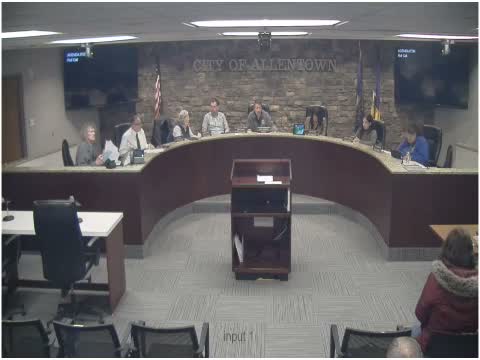
Allentown City council met in a special session to vote on Resolution R199, a motion to override Mayor DeVito's veto of budget bills 84–90; the motion failed on a 4–3 roll call, one vote short of the five votes required. The debate focused on whether to accept a compromise that would reinstate a roughly 3.9% tax increase while reducing a contracted solid-waste fee by $50 and funding the difference with an interfund loan.
The issue drew several public speakers who urged the council to override the veto. Joseph Maher, a former Lehigh County commissioner and attorney, warned of upward pressure on rents under the proposed budgets and said he had seen "gross amounts of increases like 10 to 20%" in proposed rent hikes. The solicitor told council members, "Under the current charter, there is no default budget," clarifying that the city could enter 2026 without an automatically enacted budget if council does not act.
Council discussion centered on the tradeoffs between a modest, citywide tax increase and a sharp, flat increase in the contracted trash fee. Supporters of the compromise said the approach would place money back in the pockets of many homeowners and spread costs more progressively; one council member said the compromise would leave 23,000 of about 26,000 homeowners paying less or nothing under the plan. Opponents and some residents said reducing the trash fee by $50 merely "kicks the can down the road," because the general fund would borrow from the solid-waste fund and reimburse it over several years, possibly with interest.
Several council members and residents discussed mechanics cited by staff and members: the proposed tax change was described at about 3.9% (figures cited in the record varied from 3.9% to 3.97%) and members referenced a contracted solid-waste increase described in the discussion as about $140 per property if applied incrementally. Council members said the interfund loan to smooth the $50 reduction would be repaid over multiple years; participants referenced five- and seven-year repayment frames and potential interest rates around 2.5–3% in different examples raised during the meeting.
During roll call, the record shows the following votes: Miss Apfa — "No"; Miss Gerlach — "Yes"; Miss Moda — "Yes"; (voice listed as) Annapolis — "No"; Miss Santos — "Yes"; Chizuko — "Yes"; Mister Hendricks — "No." That produced a tally of four yeas and three nays; five votes were needed for an override and the motion therefore failed. After the vote the presiding officer attempted to present an amended proposal but a point of order was raised that only a member of the prevailing side that initiated the original motion could properly make that motion; the point of order was sustained and the meeting was adjourned.
The meeting record includes claims and contested factual points that remained unresolved in the session: residents and members disagreed about which measure — the tax increase or the flat trash fee — would more directly drive rent increases; members debated whether borrowing from the solid-waste fund shifts costs to future years and whether the proposed repayment and interest terms sufficiently protected the fund. The solicitor's statement that the city has "no default budget" under the charter was the clearest procedural clarification about the consequences of a failed override.
No additional votes on the budget occurred at the meeting; the council adjourned after the override attempt failed and a procedural challenge blocked the introduced amendment.
The issue drew several public speakers who urged the council to override the veto. Joseph Maher, a former Lehigh County commissioner and attorney, warned of upward pressure on rents under the proposed budgets and said he had seen "gross amounts of increases like 10 to 20%" in proposed rent hikes. The solicitor told council members, "Under the current charter, there is no default budget," clarifying that the city could enter 2026 without an automatically enacted budget if council does not act.
Council discussion centered on the tradeoffs between a modest, citywide tax increase and a sharp, flat increase in the contracted trash fee. Supporters of the compromise said the approach would place money back in the pockets of many homeowners and spread costs more progressively; one council member said the compromise would leave 23,000 of about 26,000 homeowners paying less or nothing under the plan. Opponents and some residents said reducing the trash fee by $50 merely "kicks the can down the road," because the general fund would borrow from the solid-waste fund and reimburse it over several years, possibly with interest.
Several council members and residents discussed mechanics cited by staff and members: the proposed tax change was described at about 3.9% (figures cited in the record varied from 3.9% to 3.97%) and members referenced a contracted solid-waste increase described in the discussion as about $140 per property if applied incrementally. Council members said the interfund loan to smooth the $50 reduction would be repaid over multiple years; participants referenced five- and seven-year repayment frames and potential interest rates around 2.5–3% in different examples raised during the meeting.
During roll call, the record shows the following votes: Miss Apfa — "No"; Miss Gerlach — "Yes"; Miss Moda — "Yes"; (voice listed as) Annapolis — "No"; Miss Santos — "Yes"; Chizuko — "Yes"; Mister Hendricks — "No." That produced a tally of four yeas and three nays; five votes were needed for an override and the motion therefore failed. After the vote the presiding officer attempted to present an amended proposal but a point of order was raised that only a member of the prevailing side that initiated the original motion could properly make that motion; the point of order was sustained and the meeting was adjourned.
The meeting record includes claims and contested factual points that remained unresolved in the session: residents and members disagreed about which measure — the tax increase or the flat trash fee — would more directly drive rent increases; members debated whether borrowing from the solid-waste fund shifts costs to future years and whether the proposed repayment and interest terms sufficiently protected the fund. The solicitor's statement that the city has "no default budget" under the charter was the clearest procedural clarification about the consequences of a failed override.
No additional votes on the budget occurred at the meeting; the council adjourned after the override attempt failed and a procedural challenge blocked the introduced amendment.
Don't Miss a Word: See the Full Meeting!
Go beyond summaries. Unlock every video, transcript, and key insight with a Founder Membership.
✓
Get instant access to full meeting videos
✓
Search and clip any phrase from complete transcripts
✓
Receive AI-powered summaries & custom alerts
✓
Enjoy lifetime, unrestricted access to government data
30-day money-back guarantee
