Vermont agencies outline strategy to reduce wildlife–vehicle collisions by resizing culverts, building shelves
February 14, 2026 | Transportation, HOUSE OF REPRESENTATIVES, Committees, Legislative , Vermont
This article was created by AI summarizing key points discussed. AI makes mistakes, so for full details and context, please refer to the video of the full meeting. Please report any errors so we can fix them. Report an error »
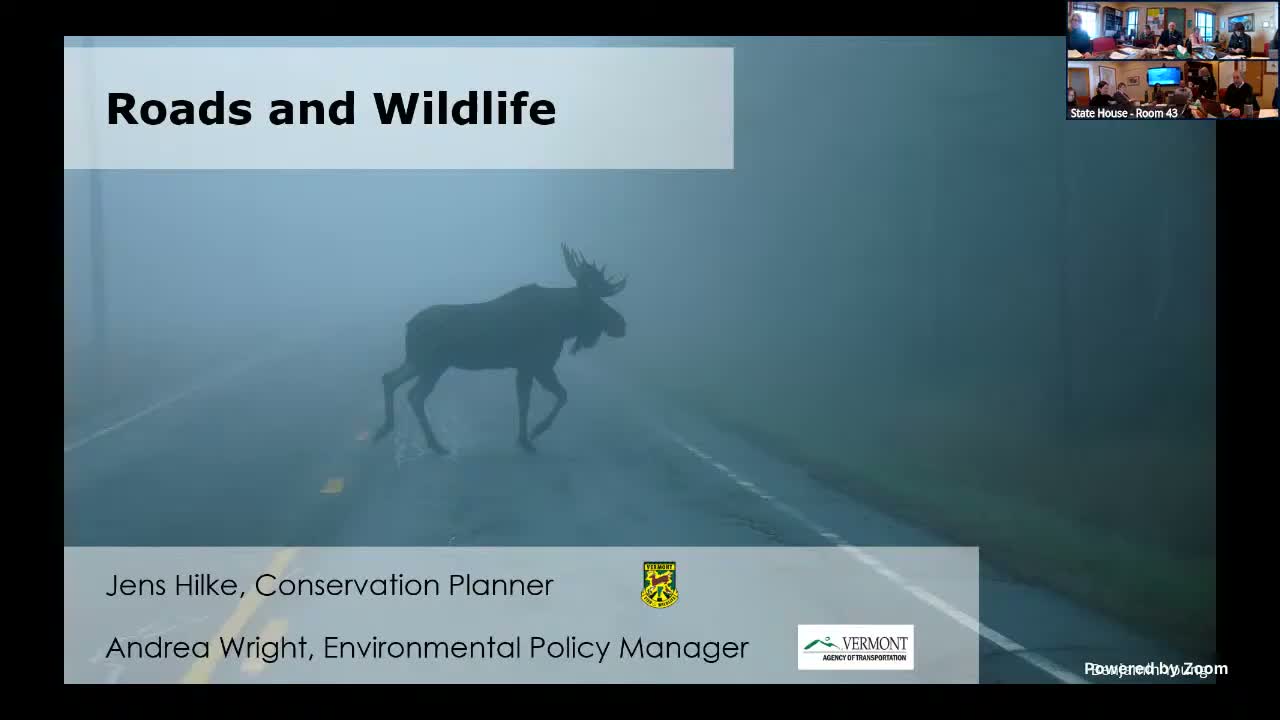
Jens Hilke, conservation planner with the Vermont Fish and Wildlife Department, and an environmental policy manager at the Agency of Transportation presented a joint plan to reduce wildlife–vehicle collisions and preserve habitat connectivity.
The agencies said collisions are costly and frequent: "vehicle collisions result in $8,000,000,000 in property damage every year," Hilke told the committee, citing national estimates, and offered per-collision cost figures of about $7,000 for a deer crash and about $30,000 for a moose crash. They argued that properly sized road structures can advance both safety and ecological goals.
The presentation framed the work at three scales: landscape, species and project. At the landscape scale the agencies are using the Vermont Conservation Design to identify core forest blocks, stepping-stone connectors and micro-connectors where transportation corridors pinch wildlife movement. At the species scale the agencies have mapped crossings where road and habitat overlap; at the project scale they said right-sizing culverts and replacing culverts with appropriately sized bridges can provide both flood resilience and animal passage.
Agency staff showed project examples including Route 12 and Route 9 retrofits where undersized culverts were replaced with larger structures that include "wildlife shelves"—narrow, vegetated paths inside bridge abutments. The AOT presenter said one shelf added roughly $20,000 to an $8 million resurfacing project, and that post-construction monitoring shows rapid use: "we found exactly nothing moving through those culverts before construction" but animals began using the passages soon after.
Committee members asked about design dimensions and species-specific needs. The environmental policy manager said a typical wildlife shelf is intended as a "goat path," not a roadway, and offered a width figure of about 23 feet in the example shown. Speakers noted species differences: some animals (mink) readily use culverts, while larger animals (bear, moose) may only use underpasses with sufficient headroom and light.
Presenters also described long-running collaboration and training—Highways and Habitats field training, ongoing since the early 2000s—and a crowdsourced roadkill reporting system that helps prioritize sites. Hilke said the agencies have identified 1,285 structures that overlap with high-priority conservation areas, of which 67 are in poor condition and represent near-term opportunities for appropriately sizing work.
The agencies emphasized that infrastructure alone is not enough: land protection and land-use planning around prioritized corridors are needed to secure the ecological benefits of any enhanced crossings. The presentation closed with outreach examples, including a school project that engaged students on roadkill and wildlife awareness. The committee thanked the presenters and moved to bill introductions.
The agencies did not ask the committee to vote on funding; presenters noted that construction funding remains constrained and that some design work has been funded while construction matches remain unresolved.
The agencies said collisions are costly and frequent: "vehicle collisions result in $8,000,000,000 in property damage every year," Hilke told the committee, citing national estimates, and offered per-collision cost figures of about $7,000 for a deer crash and about $30,000 for a moose crash. They argued that properly sized road structures can advance both safety and ecological goals.
The presentation framed the work at three scales: landscape, species and project. At the landscape scale the agencies are using the Vermont Conservation Design to identify core forest blocks, stepping-stone connectors and micro-connectors where transportation corridors pinch wildlife movement. At the species scale the agencies have mapped crossings where road and habitat overlap; at the project scale they said right-sizing culverts and replacing culverts with appropriately sized bridges can provide both flood resilience and animal passage.
Agency staff showed project examples including Route 12 and Route 9 retrofits where undersized culverts were replaced with larger structures that include "wildlife shelves"—narrow, vegetated paths inside bridge abutments. The AOT presenter said one shelf added roughly $20,000 to an $8 million resurfacing project, and that post-construction monitoring shows rapid use: "we found exactly nothing moving through those culverts before construction" but animals began using the passages soon after.
Committee members asked about design dimensions and species-specific needs. The environmental policy manager said a typical wildlife shelf is intended as a "goat path," not a roadway, and offered a width figure of about 23 feet in the example shown. Speakers noted species differences: some animals (mink) readily use culverts, while larger animals (bear, moose) may only use underpasses with sufficient headroom and light.
Presenters also described long-running collaboration and training—Highways and Habitats field training, ongoing since the early 2000s—and a crowdsourced roadkill reporting system that helps prioritize sites. Hilke said the agencies have identified 1,285 structures that overlap with high-priority conservation areas, of which 67 are in poor condition and represent near-term opportunities for appropriately sizing work.
The agencies emphasized that infrastructure alone is not enough: land protection and land-use planning around prioritized corridors are needed to secure the ecological benefits of any enhanced crossings. The presentation closed with outreach examples, including a school project that engaged students on roadkill and wildlife awareness. The committee thanked the presenters and moved to bill introductions.
The agencies did not ask the committee to vote on funding; presenters noted that construction funding remains constrained and that some design work has been funded while construction matches remain unresolved.
View the Full Meeting & All Its Details
This article offers just a summary. Unlock complete video, transcripts, and insights as a Founder Member.
✓
Watch full, unedited meeting videos
✓
Search every word spoken in unlimited transcripts
✓
AI summaries & real-time alerts (all government levels)
✓
Permanent access to expanding government content
30-day money-back guarantee
