Committee reviews draft to repeal and reshape dozens of legislative reporting requirements
February 14, 2026 | Government Operations & Military Affairs, HOUSE OF REPRESENTATIVES, Committees, Legislative , Vermont
This article was created by AI summarizing key points discussed. AI makes mistakes, so for full details and context, please refer to the video of the full meeting. Please report any errors so we can fix them. Report an error »
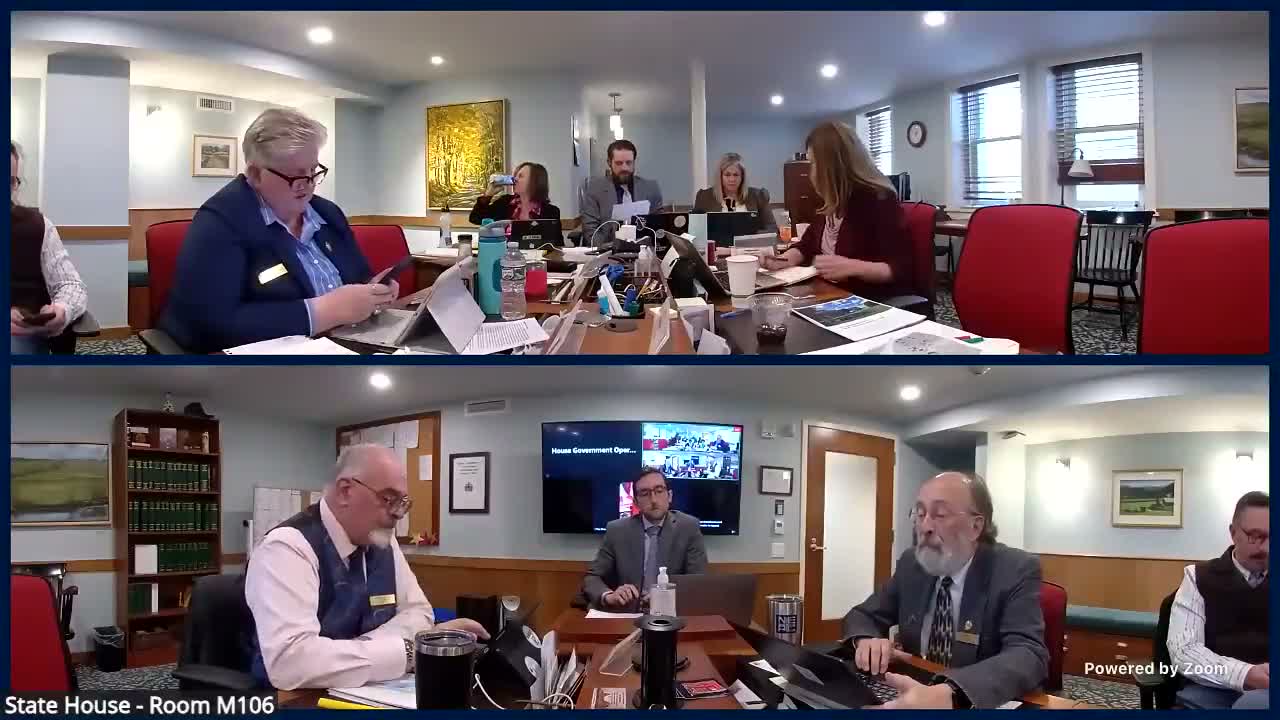
The Government Operations & Military Affairs committee on Feb. 14 reviewed draft request number 251019 (draft 1.1), a bill that would repeal a wide range of standing legislative reporting requirements, extend a subset of reports’ review timelines to 2030 and make several reports permanently required.
Tucker Anderson of the Legislative Council presented the draft and told members, “You should have in front of you draft request number 251019, draft 1.1, which is the draft of the committee's reports repeal bill.” Anderson laid out three sections in the draft: items proposed for repeal; items extended four years to a 2030 reviews cycle; and items deemed imperative that would be permanently required.
Why it matters: committee staff and members said the package is meant to reduce redundant or outdated reports and to focus legislative oversight on higher-priority reporting while preserving agencies’ continued collection of underlying data. Anderson emphasized that repealing a legislative reporting requirement does not stop agencies from collecting the information, and "it also does not restrain the general assembly or the committees from asking for this information in the future." That distinction figured in members’ questions about specific entries.
What’s in the draft: Anderson read examples across the draft, including proposals to repeal the genuine progress indicator report from the chief performance officer, a Department for Human Resources report on temporary employees, certain Clean Water Act performance reports, an annual technical-advisory committee report on potable water and wastewater permits (Title 10), the State Education Board annual report and a pre-K report from the Agency of Education, and offender reintegration/community placement reports from the Department of Corrections. Anderson also noted the draft would remove a legislative reporting requirement on prescription drug cost data that “will still be reported to the Green Mountain Care Board and posted on the websites of the Green Mountain Care Board and the attorney general,” but would no longer be a report to the legislature.
Extensions and permanent retentions: the draft moves other reports to a 2030 review date, including a report on racial disparities from the criminal and juvenile justice advisory panel, State Ethics Commission reports on complaints and guidance, broadband program reports, and several public-safety and EMS oversight reports. Separately, the committee identified a subset of reports to be permanently required in statute, including the Office of Economic Opportunity’s weatherization/data management budget testimony items, a court-administrator report on temporary employees, a judicial-retention committee recommendation report, the Vermont Farm and Forest Viability Program report, and reports tied to the treasurer’s Local Investment Advisory Committee and special funds created in prior years.
Points of contention and clarification: some members pressed for care before removing certain statutory reports. One committee member said of the judiciary temporary-employee report, “I don't think we should take it off the list before having it,” noting public reporting and statutory caps had been discussed in prior years. Anderson acknowledged uncertainty on some entries and said he would "go back and check" with staff (he referred to checking with a staff member named Sophie) and perform technical cleanups so the draft does not accidentally repeal items intended to be retained.
Process and next steps: Anderson said the bill "goes to the floor, traditionally," after the committee file is tightened, giving other committees an opportunity to review items that touch their jurisdictions. Members thanked Legislative Council staff for the work and asked for language cleanups; Anderson agreed to reconcile section cross-references and return with a revised version. No motion or vote was taken on the draft during the session.
The committee recessed to consider a separate agenda item (H.514) on procedures for a minor's legal name change and planned to return after a short break to continue consideration of housekeeping and technical edits to draft request 251019.
Tucker Anderson of the Legislative Council presented the draft and told members, “You should have in front of you draft request number 251019, draft 1.1, which is the draft of the committee's reports repeal bill.” Anderson laid out three sections in the draft: items proposed for repeal; items extended four years to a 2030 reviews cycle; and items deemed imperative that would be permanently required.
Why it matters: committee staff and members said the package is meant to reduce redundant or outdated reports and to focus legislative oversight on higher-priority reporting while preserving agencies’ continued collection of underlying data. Anderson emphasized that repealing a legislative reporting requirement does not stop agencies from collecting the information, and "it also does not restrain the general assembly or the committees from asking for this information in the future." That distinction figured in members’ questions about specific entries.
What’s in the draft: Anderson read examples across the draft, including proposals to repeal the genuine progress indicator report from the chief performance officer, a Department for Human Resources report on temporary employees, certain Clean Water Act performance reports, an annual technical-advisory committee report on potable water and wastewater permits (Title 10), the State Education Board annual report and a pre-K report from the Agency of Education, and offender reintegration/community placement reports from the Department of Corrections. Anderson also noted the draft would remove a legislative reporting requirement on prescription drug cost data that “will still be reported to the Green Mountain Care Board and posted on the websites of the Green Mountain Care Board and the attorney general,” but would no longer be a report to the legislature.
Extensions and permanent retentions: the draft moves other reports to a 2030 review date, including a report on racial disparities from the criminal and juvenile justice advisory panel, State Ethics Commission reports on complaints and guidance, broadband program reports, and several public-safety and EMS oversight reports. Separately, the committee identified a subset of reports to be permanently required in statute, including the Office of Economic Opportunity’s weatherization/data management budget testimony items, a court-administrator report on temporary employees, a judicial-retention committee recommendation report, the Vermont Farm and Forest Viability Program report, and reports tied to the treasurer’s Local Investment Advisory Committee and special funds created in prior years.
Points of contention and clarification: some members pressed for care before removing certain statutory reports. One committee member said of the judiciary temporary-employee report, “I don't think we should take it off the list before having it,” noting public reporting and statutory caps had been discussed in prior years. Anderson acknowledged uncertainty on some entries and said he would "go back and check" with staff (he referred to checking with a staff member named Sophie) and perform technical cleanups so the draft does not accidentally repeal items intended to be retained.
Process and next steps: Anderson said the bill "goes to the floor, traditionally," after the committee file is tightened, giving other committees an opportunity to review items that touch their jurisdictions. Members thanked Legislative Council staff for the work and asked for language cleanups; Anderson agreed to reconcile section cross-references and return with a revised version. No motion or vote was taken on the draft during the session.
The committee recessed to consider a separate agenda item (H.514) on procedures for a minor's legal name change and planned to return after a short break to continue consideration of housekeeping and technical edits to draft request 251019.
Don't Miss a Word: See the Full Meeting!
Go beyond summaries. Unlock every video, transcript, and key insight with a Founder Membership.
✓
Get instant access to full meeting videos
✓
Search and clip any phrase from complete transcripts
✓
Receive AI-powered summaries & custom alerts
✓
Enjoy lifetime, unrestricted access to government data
30-day money-back guarantee
