Sweetwater commission unanimously approves first reading of Flagler Center master development agreement
February 14, 2026 | City of Sweetwater, Miami-Dade County, Florida
This article was created by AI summarizing key points discussed. AI makes mistakes, so for full details and context, please refer to the video of the full meeting. Please report any errors so we can fix them. Report an error »
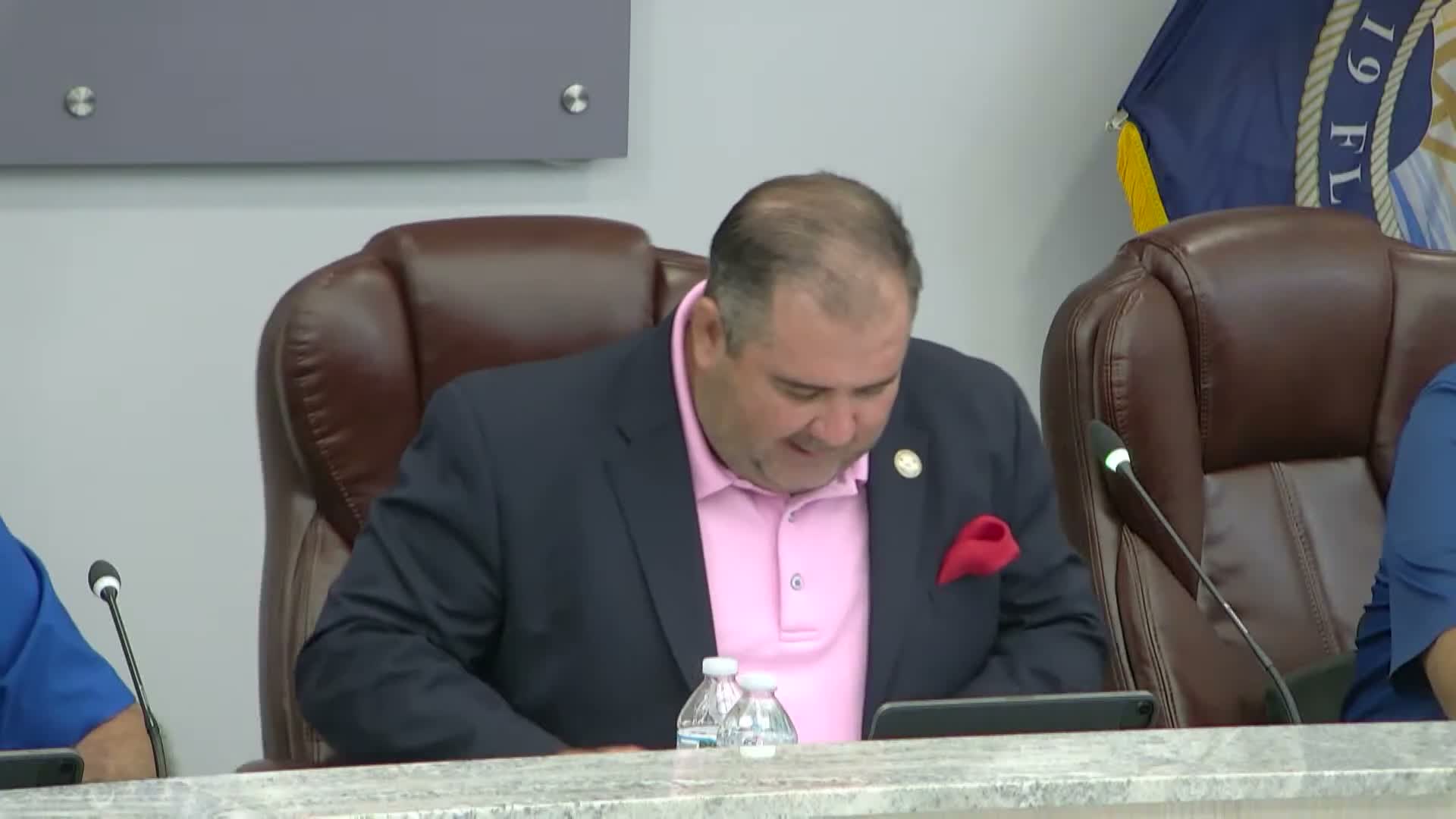
Mayor Diaz and the City of Sweetwater Commission voted unanimously on Feb. 13 to approve on first reading an ordinance authorizing a master development agreement (MDA) for the 104‑acre Flagler Center District, a mixed‑use redevelopment the applicant and mayor called transformational for the city.
The motion to adopt first reading, moved by Commissioner Saul Diaz and seconded by Commissioner Villasil, passed on a unanimous roll call. Commission President Villanueva closed debate by urging negotiators and staff to take time to resolve outstanding items before second reading.
Alejandro Arias, speaking for the applicant, described the MDA before the commission as a long‑term contract that will govern phased construction, infrastructure and impact fees. "The term of the agreement is 30 years and may be extended for 10 years," Arias said, and he told commissioners the agreement will cap density at "a 105 dwelling units per gross acre" and require "a minimum of 100,000 square feet of nonresidential uses." He said exhibits to the agreement will include the conceptual plan, a list of required permits and the impact‑fee and credit framework, but that many of those exhibits remain under negotiation between first and second reading.
Commissioners pressed the applicant on several practical matters. Members asked whether certain buildings would form homeowners or condominium associations and whether market‑rate units were planned; Arias said some buildings could have associations and that market‑rate apartments are a possibility. He said the applicant expects to carry out substantial on‑ and off‑site infrastructure work and that impact‑fee amounts and credits are "to be determined" depending on final program and what the developer performs in‑kind.
Traffic and access were also discussed. Commissioners asked whether roadway expansions were planned for NW 114 and how many entrances would serve the development. Arias said most roadways through the project will be improved and reviewed the conceptual counts presented in the packet: five entrances on West Flagler Street, three on NW 7th Street, three on NW 114 and five on NW 110 (as shown in the conceptual plan).
Public‑safety and quality‑of‑life issues drew repeated attention. A commissioner said the ability to host festivals worried neighbors and could raise noise complaints; Arias responded events would require city permits and proper police, restroom and permit conditions and said any noise‑ordinance adjustments would be intended only to reconcile a mixed residential‑commercial urban district—not to permit large nightclub‑style events. "This project is gonna be or is 1 of the largest projects this city has ever faced," Mayor Diaz said in opening remarks, urging full transparency as negotiators finalize details.
Arias and commissioners also discussed the proposed medical campus: if a hospital operator cannot be secured, the zoning and MDA allow alternative uses (medical office, additional residential or other office), but any major change would require a site plan and commission approval. The VESTA development program approved earlier by the commission anticipates about 6,000 residences across the district; Arias provided a rough population estimate of roughly 12,000 people (he said doubling one‑person assumptions) and noted numbers could vary with household size.
The applicant committed to provide about 4.5 acres of open space within the 104‑acre plan and said building heights vary by subdistrict (one subdistrict concept showed heights up to 31 stories). Questions were raised about existing grant‑funded trees near a trailer park and the need to coordinate tree removal or relocation with county or state agencies.
Commissioners repeatedly objected to receiving a large packet only a day before the meeting and requested more lead time to review complex documents; one commissioner asked the city to implement a rule for earlier distribution. Commissioners and the applicant agreed that many technical and financial specifics—impact‑fee amounts, credits, exhibit language and final infrastructure responsibility—will be resolved between first and second reading.
The ordinance passed its first reading by unanimous vote. The city will return the item for second reading after negotiations and staff review of exhibits and impact‑fee schedules.
The motion to adopt first reading, moved by Commissioner Saul Diaz and seconded by Commissioner Villasil, passed on a unanimous roll call. Commission President Villanueva closed debate by urging negotiators and staff to take time to resolve outstanding items before second reading.
Alejandro Arias, speaking for the applicant, described the MDA before the commission as a long‑term contract that will govern phased construction, infrastructure and impact fees. "The term of the agreement is 30 years and may be extended for 10 years," Arias said, and he told commissioners the agreement will cap density at "a 105 dwelling units per gross acre" and require "a minimum of 100,000 square feet of nonresidential uses." He said exhibits to the agreement will include the conceptual plan, a list of required permits and the impact‑fee and credit framework, but that many of those exhibits remain under negotiation between first and second reading.
Commissioners pressed the applicant on several practical matters. Members asked whether certain buildings would form homeowners or condominium associations and whether market‑rate units were planned; Arias said some buildings could have associations and that market‑rate apartments are a possibility. He said the applicant expects to carry out substantial on‑ and off‑site infrastructure work and that impact‑fee amounts and credits are "to be determined" depending on final program and what the developer performs in‑kind.
Traffic and access were also discussed. Commissioners asked whether roadway expansions were planned for NW 114 and how many entrances would serve the development. Arias said most roadways through the project will be improved and reviewed the conceptual counts presented in the packet: five entrances on West Flagler Street, three on NW 7th Street, three on NW 114 and five on NW 110 (as shown in the conceptual plan).
Public‑safety and quality‑of‑life issues drew repeated attention. A commissioner said the ability to host festivals worried neighbors and could raise noise complaints; Arias responded events would require city permits and proper police, restroom and permit conditions and said any noise‑ordinance adjustments would be intended only to reconcile a mixed residential‑commercial urban district—not to permit large nightclub‑style events. "This project is gonna be or is 1 of the largest projects this city has ever faced," Mayor Diaz said in opening remarks, urging full transparency as negotiators finalize details.
Arias and commissioners also discussed the proposed medical campus: if a hospital operator cannot be secured, the zoning and MDA allow alternative uses (medical office, additional residential or other office), but any major change would require a site plan and commission approval. The VESTA development program approved earlier by the commission anticipates about 6,000 residences across the district; Arias provided a rough population estimate of roughly 12,000 people (he said doubling one‑person assumptions) and noted numbers could vary with household size.
The applicant committed to provide about 4.5 acres of open space within the 104‑acre plan and said building heights vary by subdistrict (one subdistrict concept showed heights up to 31 stories). Questions were raised about existing grant‑funded trees near a trailer park and the need to coordinate tree removal or relocation with county or state agencies.
Commissioners repeatedly objected to receiving a large packet only a day before the meeting and requested more lead time to review complex documents; one commissioner asked the city to implement a rule for earlier distribution. Commissioners and the applicant agreed that many technical and financial specifics—impact‑fee amounts, credits, exhibit language and final infrastructure responsibility—will be resolved between first and second reading.
The ordinance passed its first reading by unanimous vote. The city will return the item for second reading after negotiations and staff review of exhibits and impact‑fee schedules.
Don't Miss a Word: See the Full Meeting!
Go beyond summaries. Unlock every video, transcript, and key insight with a Founder Membership.
✓
Get instant access to full meeting videos
✓
Search and clip any phrase from complete transcripts
✓
Receive AI-powered summaries & custom alerts
✓
Enjoy lifetime, unrestricted access to government data
30-day money-back guarantee
