Indian River Lagoon council approves RFP rankings, authorizes contracts and allocates $100,000 to local septic-to-sewer project
February 14, 2026 | Sebastian , Indian River County, Florida
This article was created by AI summarizing key points discussed. AI makes mistakes, so for full details and context, please refer to the video of the full meeting. Please report any errors so we can fix them. Report an error »
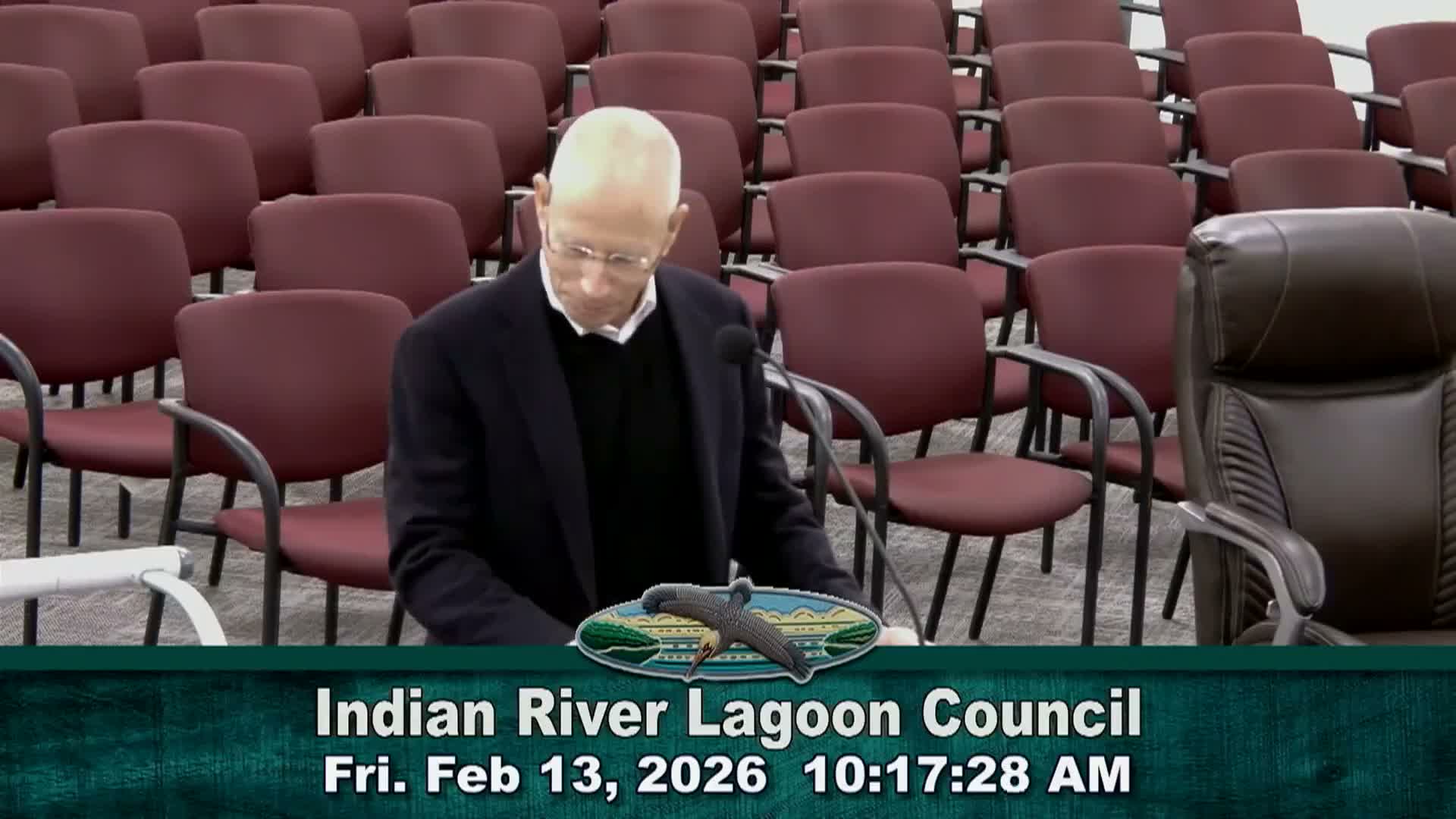
At its Feb. 13 quarterly meeting, the Indian River Lagoon Council accepted ranked recommendations from volunteer reviewers for three categories of requests for proposals and authorized staff to negotiate contracts with the top-ranked applicants, contingent on available funds and final budget authority.
Dr. Dwayne DeVries, the council's executive staff lead, described the RFP process and scoring method. "When we get that ranked order, we throw out the high scores and the low scores in order to, you know, normalize the data," he said, explaining conflict-of-interest rules for volunteer reviewers and the 75% eligibility threshold used to select projects.
In the water-quality category, top-ranked proposals included Fort Pierce Utilities Authority (requested $203,860; highly ranked) and an Indian River County North Sebastian Phase 2c septic-to-sewer project (requested $300,000; highly ranked). A Port St. Lucie septic project scored below the 75% threshold and was therefore deemed ineligible under the council's established rules.
The council voted to accept the rank lists and to authorize staff "to negotiate and enter into contracts with those applicants," with members noting that execution of any final contract will depend on confirmed funding. "We will not execute the full contract until we know that we've got funding to execute that contract with our partners," DeVries said.
Members also debated what to do with a separate $100,000 that had been earmarked for the habitat-restoration category but was unallocated after no proposals were received in that category. After discussion of alternatives — moving the funds to reserves versus immediately applying them to a borderline project — Commissioner Jeff Brower moved to allocate the $100,000 to the Indian River County North Sebastian Phase 2c septic-to-sewer project. The motion was seconded and passed unanimously.
"Let's put the money right at work, the closest to this lagoon, and work our way out of this," Brower said in support of reallocating the funds to septic-to-sewer conversion.
The council took similar actions in the community-based habitat-restoration and science & innovation categories, accepting the ranked lists (including a high-ranked pilot fish-habitat study from the East Coast Zoological Foundation/Brevard Zoo and multiple science projects led by the Florida Institute of Technology) and authorizing staff to negotiate contracts, subject to available funds.
All motions to accept ranked lists and authorize staff negotiation passed unanimously. The council asked staff to continue pursuing other grant or partner funding for projects that fell just below the funding line and to return with updates at the May meeting.
What happens next: staff will negotiate scopes and draft contracts for top-ranked projects and will hold contract execution until funding availability is confirmed. The council will review any recommended budget adjustments or supplemental funding opportunities at its May meeting.
Dr. Dwayne DeVries, the council's executive staff lead, described the RFP process and scoring method. "When we get that ranked order, we throw out the high scores and the low scores in order to, you know, normalize the data," he said, explaining conflict-of-interest rules for volunteer reviewers and the 75% eligibility threshold used to select projects.
In the water-quality category, top-ranked proposals included Fort Pierce Utilities Authority (requested $203,860; highly ranked) and an Indian River County North Sebastian Phase 2c septic-to-sewer project (requested $300,000; highly ranked). A Port St. Lucie septic project scored below the 75% threshold and was therefore deemed ineligible under the council's established rules.
The council voted to accept the rank lists and to authorize staff "to negotiate and enter into contracts with those applicants," with members noting that execution of any final contract will depend on confirmed funding. "We will not execute the full contract until we know that we've got funding to execute that contract with our partners," DeVries said.
Members also debated what to do with a separate $100,000 that had been earmarked for the habitat-restoration category but was unallocated after no proposals were received in that category. After discussion of alternatives — moving the funds to reserves versus immediately applying them to a borderline project — Commissioner Jeff Brower moved to allocate the $100,000 to the Indian River County North Sebastian Phase 2c septic-to-sewer project. The motion was seconded and passed unanimously.
"Let's put the money right at work, the closest to this lagoon, and work our way out of this," Brower said in support of reallocating the funds to septic-to-sewer conversion.
The council took similar actions in the community-based habitat-restoration and science & innovation categories, accepting the ranked lists (including a high-ranked pilot fish-habitat study from the East Coast Zoological Foundation/Brevard Zoo and multiple science projects led by the Florida Institute of Technology) and authorizing staff to negotiate contracts, subject to available funds.
All motions to accept ranked lists and authorize staff negotiation passed unanimously. The council asked staff to continue pursuing other grant or partner funding for projects that fell just below the funding line and to return with updates at the May meeting.
What happens next: staff will negotiate scopes and draft contracts for top-ranked projects and will hold contract execution until funding availability is confirmed. The council will review any recommended budget adjustments or supplemental funding opportunities at its May meeting.
View the Full Meeting & All Its Details
This article offers just a summary. Unlock complete video, transcripts, and insights as a Founder Member.
✓
Watch full, unedited meeting videos
✓
Search every word spoken in unlimited transcripts
✓
AI summaries & real-time alerts (all government levels)
✓
Permanent access to expanding government content
30-day money-back guarantee
