House Education and Labor hearing at Green Valley spotlights debate over Section 14(c) and employment choice for people with disabilities
February 14, 2026 | Education and Labor: House Committee, Standing Committees - House & Senate, Congressional Hearings Compilation, Legislative, Federal
This article was created by AI summarizing key points discussed. AI makes mistakes, so for full details and context, please refer to the video of the full meeting. Please report any errors so we can fix them. Report an error »
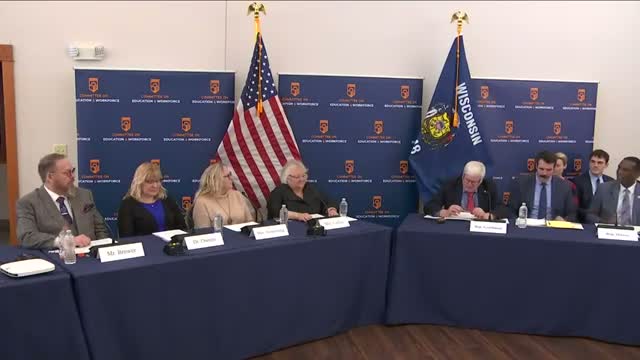
Members of the House Committee on Education and Labor held a field hearing at Green Valley Enterprises in Beaver Dam, Wisconsin, to examine Section 14(c) of the Fair Labor Standards Act and competing views about its role in employment for people with disabilities.
Representative Glenn opened the hearing by saying the purpose was to see “what’s going on in the real world” and hear whether removing 14(c) would close local facilities and displace workers. He introduced four witnesses and said each would have five minutes to give prepared remarks.
Barbara LeDuc, introduced in the transcript as the president and CEO of the facility operator, told the committee that community rehabilitation programs (CRPs) that operate under 14(c) both provide jobs and backstop attempts at competitive integrated employment (CIE). “Preserving choice is not a step backward,” LeDuc said, arguing that CRPs provide “rehabilitation services, training, skill development, social engagement” and that stripping 14(c) would “strip away opportunities to contribute, to grow, to stay healthy, and to belong.”
Kathy Anderson Armstrong, the mother of Clara (who works at Green Valley), described the personal impact of the facility on her daughter’s daily life and routine and said that short, token community placements do not replace the structure and social benefits of facility employment. Armstrong also noted that, under WIOA, some young people cannot participate in 14(c) work centers until age 26 and said states that eliminated 14(c) “cannot show where all the displaced workers ended up.”
By contrast, Dr. Laura Owens, a professor at the University of Wisconsin–Milwaukee and president of Transcend Inc., said Section 14(c) functions as a subminimum-wage exemption that produces “predictable outcomes: poverty, segregation, and lost economic potential.” Owens cited studies she said show many workers under 14(c) earn less than $3.50 an hour, noted that 15 states and the District of Columbia had eliminated subminimum wage practices by 2024, and referenced a December 2024 Department of Labor proposal to phase out 14(c). “When people with disabilities are paid competitive wages, the economic impact is immediate and local,” she said.
Kit Brewer, vice president of the Coalition for the Preservation of Employment Choice and operator of Project CU in St. Louis, urged a state-by-state, best-practices approach rather than a federal elimination. Brewer described higher-than-expected average wages at some providers, warned that available data are incomplete, and cited a 2025 GAO study the witnesses discussed as showing inconsistent follow-up and transition tracking across states. “We’ve got to mandate a nationwide collection of data,” he said.
Committee members pressed witnesses on transitions from facility work to community jobs, job hours, and whether some community placements are tokenized charity positions. The chair and other members repeatedly returned to data gaps about where displaced workers end up, how many hours they work in community placements, and whether reduced hours or loss of supports lead families to resume caregiving responsibilities.
Witnesses and members agreed on the need for better data and for phased, individualized approaches to transitions. Dr. Owens urged person-centered job matching and employer partnerships to make community work sustainable; Brewer and LeDuc said CRPs also play a role in supporting CIE and that some workers prefer or require facility-based supports.
The hearing closed without a vote. Members said they would submit written statements within 14 days and encouraged further federal–state cooperation on data, supports and transition planning.
Ending: The committee left the field hearing emphasizing next steps: improved data collection on transitions, continued engagement between providers and federal officials, and a focus on tailoring employment options to individual needs rather than an immediate federal shutdown of 14(c) operations.
Representative Glenn opened the hearing by saying the purpose was to see “what’s going on in the real world” and hear whether removing 14(c) would close local facilities and displace workers. He introduced four witnesses and said each would have five minutes to give prepared remarks.
Barbara LeDuc, introduced in the transcript as the president and CEO of the facility operator, told the committee that community rehabilitation programs (CRPs) that operate under 14(c) both provide jobs and backstop attempts at competitive integrated employment (CIE). “Preserving choice is not a step backward,” LeDuc said, arguing that CRPs provide “rehabilitation services, training, skill development, social engagement” and that stripping 14(c) would “strip away opportunities to contribute, to grow, to stay healthy, and to belong.”
Kathy Anderson Armstrong, the mother of Clara (who works at Green Valley), described the personal impact of the facility on her daughter’s daily life and routine and said that short, token community placements do not replace the structure and social benefits of facility employment. Armstrong also noted that, under WIOA, some young people cannot participate in 14(c) work centers until age 26 and said states that eliminated 14(c) “cannot show where all the displaced workers ended up.”
By contrast, Dr. Laura Owens, a professor at the University of Wisconsin–Milwaukee and president of Transcend Inc., said Section 14(c) functions as a subminimum-wage exemption that produces “predictable outcomes: poverty, segregation, and lost economic potential.” Owens cited studies she said show many workers under 14(c) earn less than $3.50 an hour, noted that 15 states and the District of Columbia had eliminated subminimum wage practices by 2024, and referenced a December 2024 Department of Labor proposal to phase out 14(c). “When people with disabilities are paid competitive wages, the economic impact is immediate and local,” she said.
Kit Brewer, vice president of the Coalition for the Preservation of Employment Choice and operator of Project CU in St. Louis, urged a state-by-state, best-practices approach rather than a federal elimination. Brewer described higher-than-expected average wages at some providers, warned that available data are incomplete, and cited a 2025 GAO study the witnesses discussed as showing inconsistent follow-up and transition tracking across states. “We’ve got to mandate a nationwide collection of data,” he said.
Committee members pressed witnesses on transitions from facility work to community jobs, job hours, and whether some community placements are tokenized charity positions. The chair and other members repeatedly returned to data gaps about where displaced workers end up, how many hours they work in community placements, and whether reduced hours or loss of supports lead families to resume caregiving responsibilities.
Witnesses and members agreed on the need for better data and for phased, individualized approaches to transitions. Dr. Owens urged person-centered job matching and employer partnerships to make community work sustainable; Brewer and LeDuc said CRPs also play a role in supporting CIE and that some workers prefer or require facility-based supports.
The hearing closed without a vote. Members said they would submit written statements within 14 days and encouraged further federal–state cooperation on data, supports and transition planning.
Ending: The committee left the field hearing emphasizing next steps: improved data collection on transitions, continued engagement between providers and federal officials, and a focus on tailoring employment options to individual needs rather than an immediate federal shutdown of 14(c) operations.
View the Full Meeting & All Its Details
This article offers just a summary. Unlock complete video, transcripts, and insights as a Founder Member.
✓
Watch full, unedited meeting videos
✓
Search every word spoken in unlimited transcripts
✓
AI summaries & real-time alerts (all government levels)
✓
Permanent access to expanding government content
30-day money-back guarantee
