Kentucky Senate approves SB72, a conscience-protections bill for health-care workers after heated debate
February 14, 2026 | 2026 Legislature KY, Kentucky
This article was created by AI summarizing key points discussed. AI makes mistakes, so for full details and context, please refer to the video of the full meeting. Please report any errors so we can fix them. Report an error »
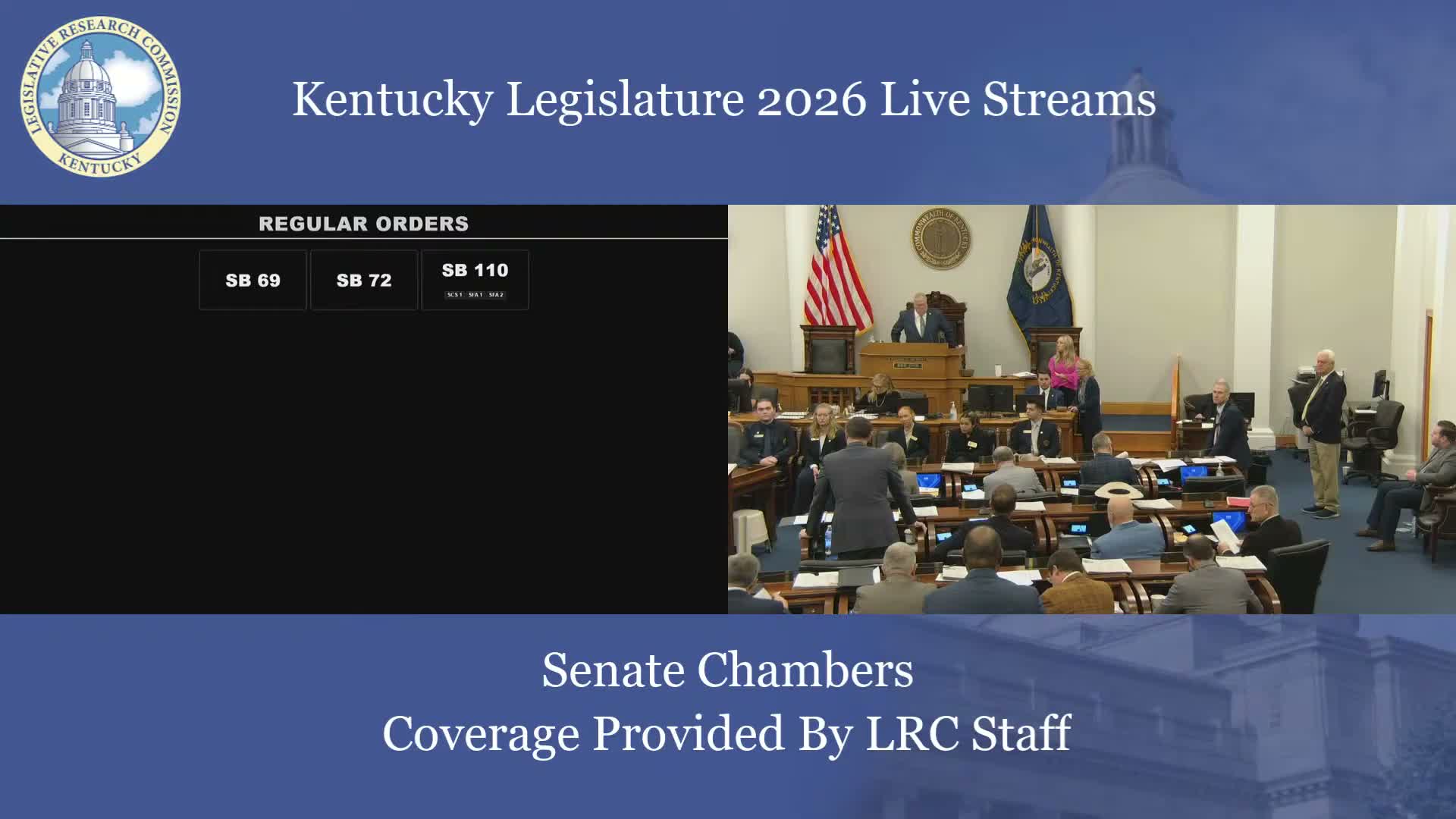
The Kentucky Senate on Feb. 13 passed Senate Bill 72, legislation the sponsor described as a recruitment and retention measure for health‑care professionals that would protect providers who refuse participation in particular health‑care services on grounds of conscience. The bill passed on a roll call of 28 yays to 5 nays.
Sponsor Senator from Jessamine opened floor debate by framing the bill as an economic development tool to address provider shortages, urging colleagues to treat it as a narrow protection for clinicians’ conscience rights and saying it ‘‘protects those with strongly held conscious beliefs as long as it does as long as their beliefs don't put others in danger or interfere with the rights of others.’’ Supporters repeatedly emphasized that they did not intend to deny emergency care, citing the federal Emergency Medical Treatment and Labor Act of 1986 as a backstop for emergency situations.
Opponents, including Senator from Jefferson 19, argued the bill’s definitions are vague and could allow refusals of nonemergency care ‘‘for any reason of conscience,’’ including moral or ethical beliefs unrelated to established medical standards. The senator said the bill ‘‘makes me really sad’’ because, in their view, it could allow a provider or a facility to refuse care to a patient for reasons tied to who the patient is or how they live. Senator from Fayette 13 pressed the sponsor with hypotheticals about whether a provider could refuse care to a racial group based on a ‘‘sincerely held’’ moral belief; the sponsor declined to answer hypotheticals, saying the chamber should avoid hypothetical framing and reiterating the bill’s intent.
Several supporters offered examples and personal anecdotes. Senator from McCracken said he had consulted physician colleagues and did not believe the bill sought to deny basic health services but acknowledged the language could be clearer. Senator from Boone cited EMTALA and argued that systems and policies typically allow another provider or the health system to ensure basic services are delivered when an individual clinician steps aside for conscience reasons.
Members used permitted time to explain their votes. Senators explaining no votes cited the bill’s vagueness and the risk of legally protected discrimination; those supporting the bill emphasized retention and recruitment of clinicians and protections for individual conscience when procedures or administrative directives conflict with a provider’s judgment. The presiding officer announced the final tally: 28 yeas and 5 nays, and declared Senate Bill 72 passed.
The bill was declared an emergency measure by the sponsor when taken up on the floor. The transcript does not list a complete, named roll‑call record for every senator; the published journal and committee files will contain the official roll‑call record and the bill text governing the scope of the protections. The Senate did not place further clarifying amendments on the floor during this session’s debate. The immediate next procedural steps (transmittal to the House or enrollment) were not specified in the floor recording.
Sponsor Senator from Jessamine opened floor debate by framing the bill as an economic development tool to address provider shortages, urging colleagues to treat it as a narrow protection for clinicians’ conscience rights and saying it ‘‘protects those with strongly held conscious beliefs as long as it does as long as their beliefs don't put others in danger or interfere with the rights of others.’’ Supporters repeatedly emphasized that they did not intend to deny emergency care, citing the federal Emergency Medical Treatment and Labor Act of 1986 as a backstop for emergency situations.
Opponents, including Senator from Jefferson 19, argued the bill’s definitions are vague and could allow refusals of nonemergency care ‘‘for any reason of conscience,’’ including moral or ethical beliefs unrelated to established medical standards. The senator said the bill ‘‘makes me really sad’’ because, in their view, it could allow a provider or a facility to refuse care to a patient for reasons tied to who the patient is or how they live. Senator from Fayette 13 pressed the sponsor with hypotheticals about whether a provider could refuse care to a racial group based on a ‘‘sincerely held’’ moral belief; the sponsor declined to answer hypotheticals, saying the chamber should avoid hypothetical framing and reiterating the bill’s intent.
Several supporters offered examples and personal anecdotes. Senator from McCracken said he had consulted physician colleagues and did not believe the bill sought to deny basic health services but acknowledged the language could be clearer. Senator from Boone cited EMTALA and argued that systems and policies typically allow another provider or the health system to ensure basic services are delivered when an individual clinician steps aside for conscience reasons.
Members used permitted time to explain their votes. Senators explaining no votes cited the bill’s vagueness and the risk of legally protected discrimination; those supporting the bill emphasized retention and recruitment of clinicians and protections for individual conscience when procedures or administrative directives conflict with a provider’s judgment. The presiding officer announced the final tally: 28 yeas and 5 nays, and declared Senate Bill 72 passed.
The bill was declared an emergency measure by the sponsor when taken up on the floor. The transcript does not list a complete, named roll‑call record for every senator; the published journal and committee files will contain the official roll‑call record and the bill text governing the scope of the protections. The Senate did not place further clarifying amendments on the floor during this session’s debate. The immediate next procedural steps (transmittal to the House or enrollment) were not specified in the floor recording.
Don't Miss a Word: See the Full Meeting!
Go beyond summaries. Unlock every video, transcript, and key insight with a Founder Membership.
✓
Get instant access to full meeting videos
✓
Search and clip any phrase from complete transcripts
✓
Receive AI-powered summaries & custom alerts
✓
Enjoy lifetime, unrestricted access to government data
30-day money-back guarantee
