Appropriations subcommittee reports multiple health, insurance and workers’ compensation bills; two carried to 2027
February 14, 2026 | 2026 Legislature VA, Virginia
This article was created by AI summarizing key points discussed. AI makes mistakes, so for full details and context, please refer to the video of the full meeting. Please report any errors so we can fix them. Report an error »
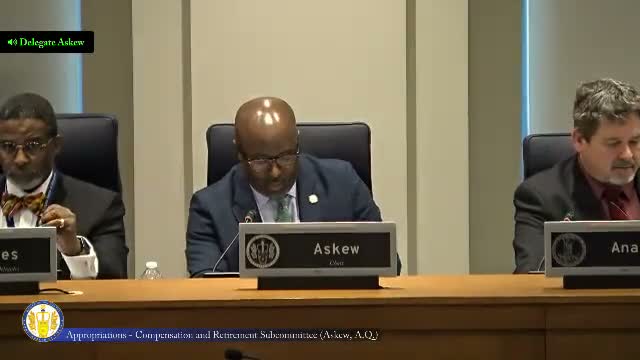
The appropriations, compensation and retirement subcommittee met and took action on a slate of mostly health- and insurance-related bills, reporting most to the next stage and carrying two large items to the 2027 session. The committee did not take public testimony and asked staff analyst Michael J. to read bill summaries.
Michael J., the committee analyst, described a substitute for House Bill 393 establishing a "First Responders Cancer Screening Fund" under the Department of Fire Programs to pay for firefighter cancer screening. "The fund would provide funding for localities to give their firefighters cancer screens," Michael J. said, noting the substitute caps the cost covered at $350 per firefighter and that localities would pay amounts above that cap. The substitute was reported as substituted by a roll call vote recorded as 6 to 0.
The subcommittee carried two bills to the 2027 session. House Bill 406 (by Delegate Reid) would allow a law-enforcement officer’s spouse who must provide care because the officer cannot perform two activities of daily living to receive workers’ compensation up to 66% of the spouse’s average wage over the last three years (or 80% of Virginia’s average salary, whichever is lower), capped at 12 weeks; analysts said the fiscal impact on state and local government is indeterminate. The motion to carry HB 406 to the 2027 session passed by voice vote.
House Bill 1390 (by Delegate Dalia Ward) would prohibit insurers that provide pharmacy benefits from limiting where those benefits may be received and expands the definition of "pharmacy" to include physician offices, outpatient hospitals, infusion centers and other clinical settings. Michael J. reported an estimated annual cost as introduced of $38,200,000 in general fund and $90,000,000 in total funds. The committee moved to carry HB 1390 to the 2027 session by voice vote.
Several other bills were reported out of the subcommittee with roll-call votes and without public testimony. House Bill 490 (by Delegate Hope) would require insurers covering eye-drop medications to allow a refill once 85% of the initial supply is used, when medically necessary; the committee reported HB 490 by a 6-0 roll-call vote. House Bill 736 (by Delegate Maldonado) would set minimum durations for initial and continued pharmacy prior authorizations (six months initial; 12 months continued); DHRM reported no fiscal impact and the bill was reported 7-0. House Bill 830 (substituted) imposes restrictions on pharmacy benefit managers — including routing savings to insurers and limiting retroactive claim reversals — and was reported as substituted 7-0; staff estimated first-year nongeneral-fund costs to the State Corporation Commission of about $50,000 and $63,000 in year two for one staff position. House Bill 1182 (by Delegate Douglas Thomas) would require coverage for contraceptive drugs and devices, including over-the-counter options, without copays; estimated costs were about $788,000 per year (total funds) with $330,000 general fund, and the bill was reported 6-1. House Bill 1313, a technical substitute clarifying workers' compensation provisions related to PTSD benefits for law enforcement and firefighters, was reported as substituted 7-0.
The subcommittee’s actions were procedural: most items were read and acted on with motions to report or carry over; the chair repeatedly noted no public testimony would be taken because many items had been vetted previously. The meeting closed after the final carryover motion and, without objection, the chair adjourned the committee.
Votes and outcomes at a glance: House Bill 393 (reported as substituted): reported, vote recorded 6-0. House Bill 406: carried to 2027 (voice vote). House Bill 490: reported, 6-0. House Bill 736: reported, 7-0. House Bill 830 (substituted): reported as substituted, 7-0. House Bill 1182: reported, 6-1. House Bill 1313 (substituted): reported as substituted, 7-0. House Bill 1390: carried to 2027 (voice vote).
Next steps: Reported bills proceed to the next legislative stage per the subcommittee’s rules; carried bills are scheduled for consideration in the 2027 session. The committee made no changes that would take immediate effect during the meeting and did not set dates for further consideration at this hearing.
Michael J., the committee analyst, described a substitute for House Bill 393 establishing a "First Responders Cancer Screening Fund" under the Department of Fire Programs to pay for firefighter cancer screening. "The fund would provide funding for localities to give their firefighters cancer screens," Michael J. said, noting the substitute caps the cost covered at $350 per firefighter and that localities would pay amounts above that cap. The substitute was reported as substituted by a roll call vote recorded as 6 to 0.
The subcommittee carried two bills to the 2027 session. House Bill 406 (by Delegate Reid) would allow a law-enforcement officer’s spouse who must provide care because the officer cannot perform two activities of daily living to receive workers’ compensation up to 66% of the spouse’s average wage over the last three years (or 80% of Virginia’s average salary, whichever is lower), capped at 12 weeks; analysts said the fiscal impact on state and local government is indeterminate. The motion to carry HB 406 to the 2027 session passed by voice vote.
House Bill 1390 (by Delegate Dalia Ward) would prohibit insurers that provide pharmacy benefits from limiting where those benefits may be received and expands the definition of "pharmacy" to include physician offices, outpatient hospitals, infusion centers and other clinical settings. Michael J. reported an estimated annual cost as introduced of $38,200,000 in general fund and $90,000,000 in total funds. The committee moved to carry HB 1390 to the 2027 session by voice vote.
Several other bills were reported out of the subcommittee with roll-call votes and without public testimony. House Bill 490 (by Delegate Hope) would require insurers covering eye-drop medications to allow a refill once 85% of the initial supply is used, when medically necessary; the committee reported HB 490 by a 6-0 roll-call vote. House Bill 736 (by Delegate Maldonado) would set minimum durations for initial and continued pharmacy prior authorizations (six months initial; 12 months continued); DHRM reported no fiscal impact and the bill was reported 7-0. House Bill 830 (substituted) imposes restrictions on pharmacy benefit managers — including routing savings to insurers and limiting retroactive claim reversals — and was reported as substituted 7-0; staff estimated first-year nongeneral-fund costs to the State Corporation Commission of about $50,000 and $63,000 in year two for one staff position. House Bill 1182 (by Delegate Douglas Thomas) would require coverage for contraceptive drugs and devices, including over-the-counter options, without copays; estimated costs were about $788,000 per year (total funds) with $330,000 general fund, and the bill was reported 6-1. House Bill 1313, a technical substitute clarifying workers' compensation provisions related to PTSD benefits for law enforcement and firefighters, was reported as substituted 7-0.
The subcommittee’s actions were procedural: most items were read and acted on with motions to report or carry over; the chair repeatedly noted no public testimony would be taken because many items had been vetted previously. The meeting closed after the final carryover motion and, without objection, the chair adjourned the committee.
Votes and outcomes at a glance: House Bill 393 (reported as substituted): reported, vote recorded 6-0. House Bill 406: carried to 2027 (voice vote). House Bill 490: reported, 6-0. House Bill 736: reported, 7-0. House Bill 830 (substituted): reported as substituted, 7-0. House Bill 1182: reported, 6-1. House Bill 1313 (substituted): reported as substituted, 7-0. House Bill 1390: carried to 2027 (voice vote).
Next steps: Reported bills proceed to the next legislative stage per the subcommittee’s rules; carried bills are scheduled for consideration in the 2027 session. The committee made no changes that would take immediate effect during the meeting and did not set dates for further consideration at this hearing.
View the Full Meeting & All Its Details
This article offers just a summary. Unlock complete video, transcripts, and insights as a Founder Member.
✓
Watch full, unedited meeting videos
✓
Search every word spoken in unlimited transcripts
✓
AI summaries & real-time alerts (all government levels)
✓
Permanent access to expanding government content
30-day money-back guarantee
