House committee advances bill to codify de novo review, limit agency deference
February 14, 2026 | Judiciary Committee, House of Representative, Committees, Legislative, Wyoming
This article was created by AI summarizing key points discussed. AI makes mistakes, so for full details and context, please refer to the video of the full meeting. Please report any errors so we can fix them. Report an error »
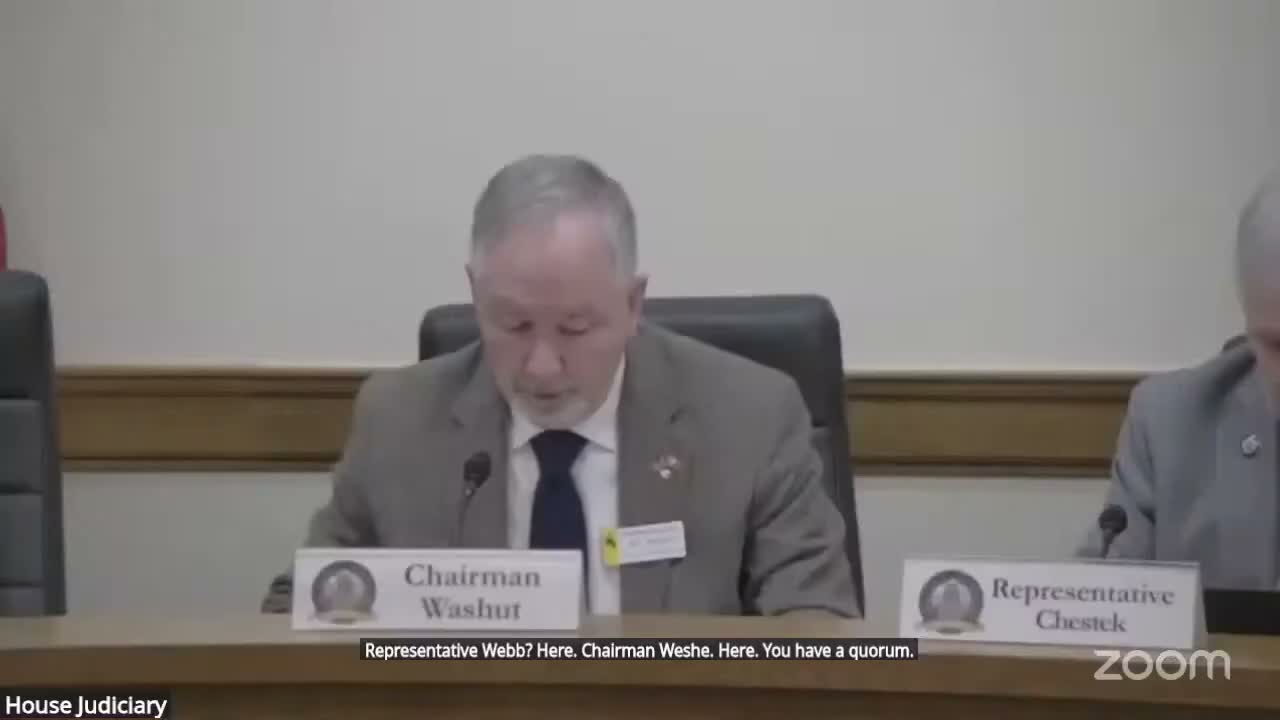
Vice Chair Representative Singh introduced House Bill 66 to clarify how courts should review agency decisions under the Administrative Procedures Act, saying the bill requires courts to "interpret the meaning of the statute, rule, regulation, or final decision, and effect de novo." He told the committee the measure is short, carries no fiscal note and would take effect July 1.
Singh said the bill is designed "to simultaneously reinforce judicial independence while also separating that branch of government from the executive branch," and that it aims to prevent executive agencies from having "a thumb on the scales." He described de novo review as giving the judiciary a "fresh set of eyes." Representative Chastick and others questioned whether the bill extends beyond typical APA appeals and whether removing statutory language about the Supreme Court's rules could raise separation‑of‑powers concerns.
Tyler Lindholm, state director of Americans for Prosperity, testified in favor. He said U.S. Supreme Court precedent removing Chevron deference motivated state action and cited Wyoming cases he said showed inconsistent agency deference, pointing to ExxonMobil v. Wyoming Department of Revenue (2009) as an instance where the court credited an agency interpretation.
Committee members debated multiple amendments that would have restored permissive language allowing Supreme Court rules to supersede statutes and language about prejudicial error; both amendment attempts failed. Representative Chester proposed simplifying the text to a single sentence requiring de novo review, but that motion died for lack of a second. Another amendment to replace the phrase "actions brought" with "reviews" was considered and failed.
The committee then held a roll call vote. The clerk recorded 7 ayes, 1 no and 1 excused; the bill was advanced to the House floor. Representative Singh said he will carry the bill and is open to amendments on the floor.
What happens next: House Bill 66 now heads to the full House for further consideration, where floor amendments are possible.
Singh said the bill is designed "to simultaneously reinforce judicial independence while also separating that branch of government from the executive branch," and that it aims to prevent executive agencies from having "a thumb on the scales." He described de novo review as giving the judiciary a "fresh set of eyes." Representative Chastick and others questioned whether the bill extends beyond typical APA appeals and whether removing statutory language about the Supreme Court's rules could raise separation‑of‑powers concerns.
Tyler Lindholm, state director of Americans for Prosperity, testified in favor. He said U.S. Supreme Court precedent removing Chevron deference motivated state action and cited Wyoming cases he said showed inconsistent agency deference, pointing to ExxonMobil v. Wyoming Department of Revenue (2009) as an instance where the court credited an agency interpretation.
Committee members debated multiple amendments that would have restored permissive language allowing Supreme Court rules to supersede statutes and language about prejudicial error; both amendment attempts failed. Representative Chester proposed simplifying the text to a single sentence requiring de novo review, but that motion died for lack of a second. Another amendment to replace the phrase "actions brought" with "reviews" was considered and failed.
The committee then held a roll call vote. The clerk recorded 7 ayes, 1 no and 1 excused; the bill was advanced to the House floor. Representative Singh said he will carry the bill and is open to amendments on the floor.
What happens next: House Bill 66 now heads to the full House for further consideration, where floor amendments are possible.
View the Full Meeting & All Its Details
This article offers just a summary. Unlock complete video, transcripts, and insights as a Founder Member.
✓
Watch full, unedited meeting videos
✓
Search every word spoken in unlimited transcripts
✓
AI summaries & real-time alerts (all government levels)
✓
Permanent access to expanding government content
30-day money-back guarantee
