Maryland Public Defender Calls Office 'in Survival Mode,' Seeks $2.2M for Evidence Tools and Staffing
This article was created by AI summarizing key points discussed. AI makes mistakes, so for full details and context, please refer to the video of the full meeting. Please report any errors so we can fix them. Report an error »
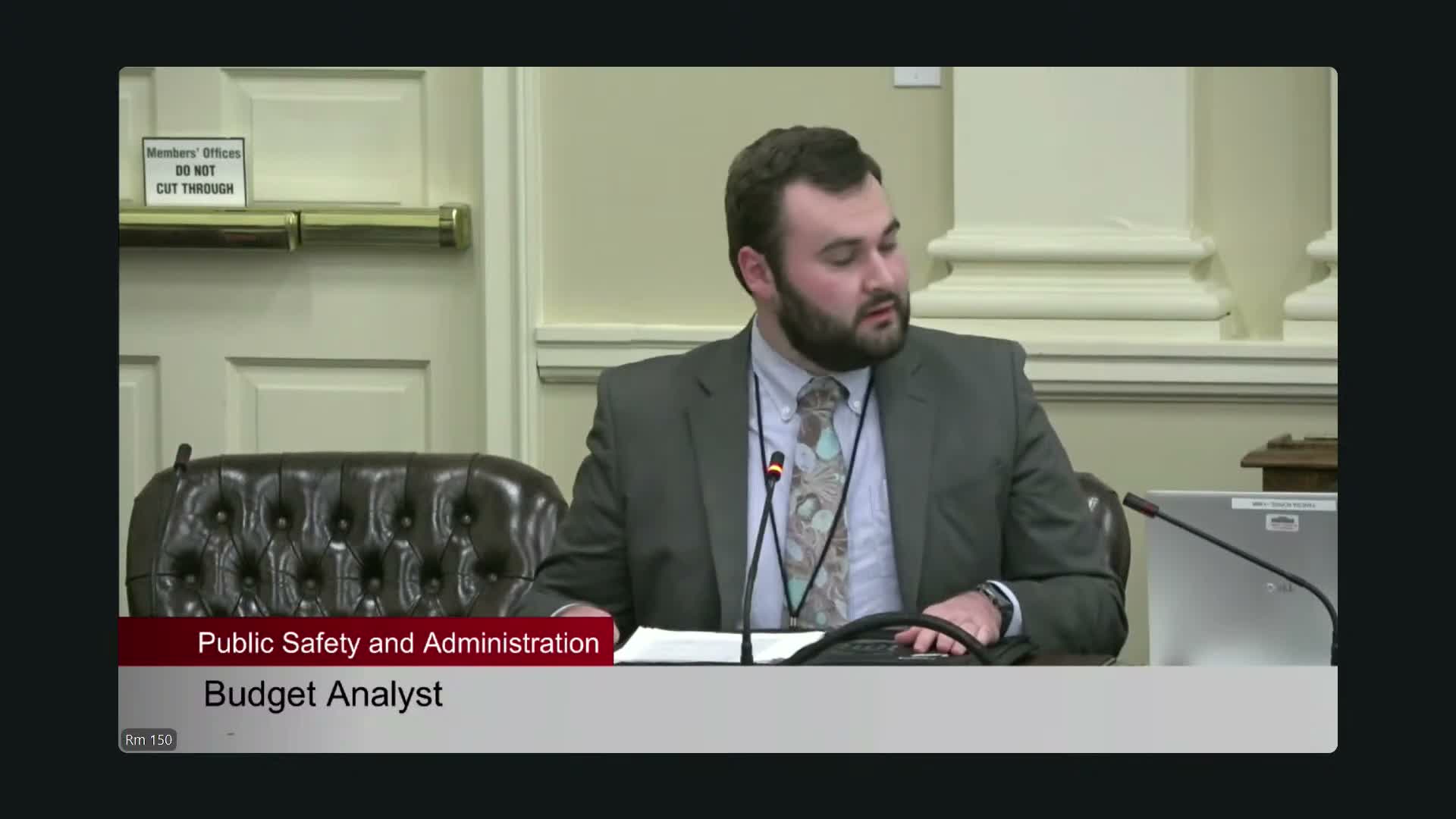
Natasha Dartigue, Maryland public defender, told the Appropriations Committee’s Public Safety Administration Subcommittee that her office is operating “in survival mode” and asked lawmakers to approve targeted funding to stabilize services. Dartigue said the office handled 116,330 new cases in FY25, represents about 80% of all criminal defendants in the state, and faces a 20% surge in juvenile cases. She requested five actions, including allowing competitive hiring to fill vacancies and $2.2 million annually to expand digital‑evidence tools so all 625 OPD attorneys have access.
The Department of Legislative Services analyst Scott Benson told the panel that the OPD FY27 allowance decreases by $3.3 million, to $174.3 million, but that the allowance includes deficiency appropriations totaling roughly $16.3 million to cover prior shortfalls. Benson’s analysis estimated OPD is understaffed by about 1,025 attorneys, with circuit‑court felonies the most acute gap, and noted panel‑attorney deficiencies have risen (an $8.5 million deficiency in FY25 after prior-year shortfalls). He recommended restricting the use of new deficiency funds so they can only be used for panel attorneys and requested reports on panel caseloads and spending.
Dartigue described how modern felony cases carry far more digital evidence than older case standards anticipated: “Today, a single felony case can include 50 or more hours of body cam, 10,000 text messages . . . the actual time needed to review this digital evidence is about 40 to 250 plus hours,” she said, and argued technology is a cost‑effective alternative to hiring large numbers of attorneys. OPD’s chief operating officer, Jennifer Curran, said pilots of transcription and evidence‑search platforms reduced review time dramatically and that statewide adoption could unlock an estimated $101 million–$118 million in labor value over 10 years.
Deputy Public Defender Keith Lottridge and OPD CFO Thaddeus Hubbard provided personnel and technical details in response to committee questions. Lottridge said the pay difference with the Attorney General’s Office for comparable attorney grades equates to roughly a one‑grade difference and about a 6% salary gap, and OPD committed to providing precise cost estimates in writing. OPD reported about 54 vacant attorney positions and 48 vacant core staff positions at the time of testimony and said panel attorneys are increasingly declining court appointments because hourly rates have not kept pace with inflation and case complexity.
Public defenders from several jurisdictions and a longtime board trustee reinforced Dartigue’s testimony. Jim Dils, Baltimore County district public defender, described extraordinary local caseloads that he said average roughly 425 cases per attorney. Steven Mussel, a felony defender and AFSCME member, called the staffing situation a “constitutional crisis.” T. Ray McCurdy, chair of the board of trustees for the public defender system, urged a much larger panel‑attorney rate to restore participation, suggesting a rate near $100 an hour rather than current levels.
The committee asked OPD for written follow‑ups with specific dollar estimates for filling vacancies and details on the pilot‑to‑full deployment path for the evidence software; OPD said procurement and vendor testing are complete and that funding approval would allow immediate scaling of an existing pilot.
The committee did not take a vote during the hearing. Lawmakers asked for the requested written cost estimates and for reports on panel caseloads and the proposed restrictions on deficiency appropriations.
The Department of Legislative Services analyst Scott Benson told the panel that the OPD FY27 allowance decreases by $3.3 million, to $174.3 million, but that the allowance includes deficiency appropriations totaling roughly $16.3 million to cover prior shortfalls. Benson’s analysis estimated OPD is understaffed by about 1,025 attorneys, with circuit‑court felonies the most acute gap, and noted panel‑attorney deficiencies have risen (an $8.5 million deficiency in FY25 after prior-year shortfalls). He recommended restricting the use of new deficiency funds so they can only be used for panel attorneys and requested reports on panel caseloads and spending.
Dartigue described how modern felony cases carry far more digital evidence than older case standards anticipated: “Today, a single felony case can include 50 or more hours of body cam, 10,000 text messages . . . the actual time needed to review this digital evidence is about 40 to 250 plus hours,” she said, and argued technology is a cost‑effective alternative to hiring large numbers of attorneys. OPD’s chief operating officer, Jennifer Curran, said pilots of transcription and evidence‑search platforms reduced review time dramatically and that statewide adoption could unlock an estimated $101 million–$118 million in labor value over 10 years.
Deputy Public Defender Keith Lottridge and OPD CFO Thaddeus Hubbard provided personnel and technical details in response to committee questions. Lottridge said the pay difference with the Attorney General’s Office for comparable attorney grades equates to roughly a one‑grade difference and about a 6% salary gap, and OPD committed to providing precise cost estimates in writing. OPD reported about 54 vacant attorney positions and 48 vacant core staff positions at the time of testimony and said panel attorneys are increasingly declining court appointments because hourly rates have not kept pace with inflation and case complexity.
Public defenders from several jurisdictions and a longtime board trustee reinforced Dartigue’s testimony. Jim Dils, Baltimore County district public defender, described extraordinary local caseloads that he said average roughly 425 cases per attorney. Steven Mussel, a felony defender and AFSCME member, called the staffing situation a “constitutional crisis.” T. Ray McCurdy, chair of the board of trustees for the public defender system, urged a much larger panel‑attorney rate to restore participation, suggesting a rate near $100 an hour rather than current levels.
The committee asked OPD for written follow‑ups with specific dollar estimates for filling vacancies and details on the pilot‑to‑full deployment path for the evidence software; OPD said procurement and vendor testing are complete and that funding approval would allow immediate scaling of an existing pilot.
The committee did not take a vote during the hearing. Lawmakers asked for the requested written cost estimates and for reports on panel caseloads and the proposed restrictions on deficiency appropriations.
View the Full Meeting & All Its Details
This article offers just a summary. Unlock complete video, transcripts, and insights as a Founder Member.
✓
Watch full, unedited meeting videos
✓
Search every word spoken in unlimited transcripts
✓
AI summaries & real-time alerts (all government levels)
✓
Permanent access to expanding government content
30-day money-back guarantee
