Palm Desert Council Upholds Planning Commission, Denies Appeal of 546‑Home Katavina Project
February 13, 2026 | Palm Desert, Riverside County, California
This article was created by AI summarizing key points discussed. AI makes mistakes, so for full details and context, please refer to the video of the full meeting. Please report any errors so we can fix them. Report an error »
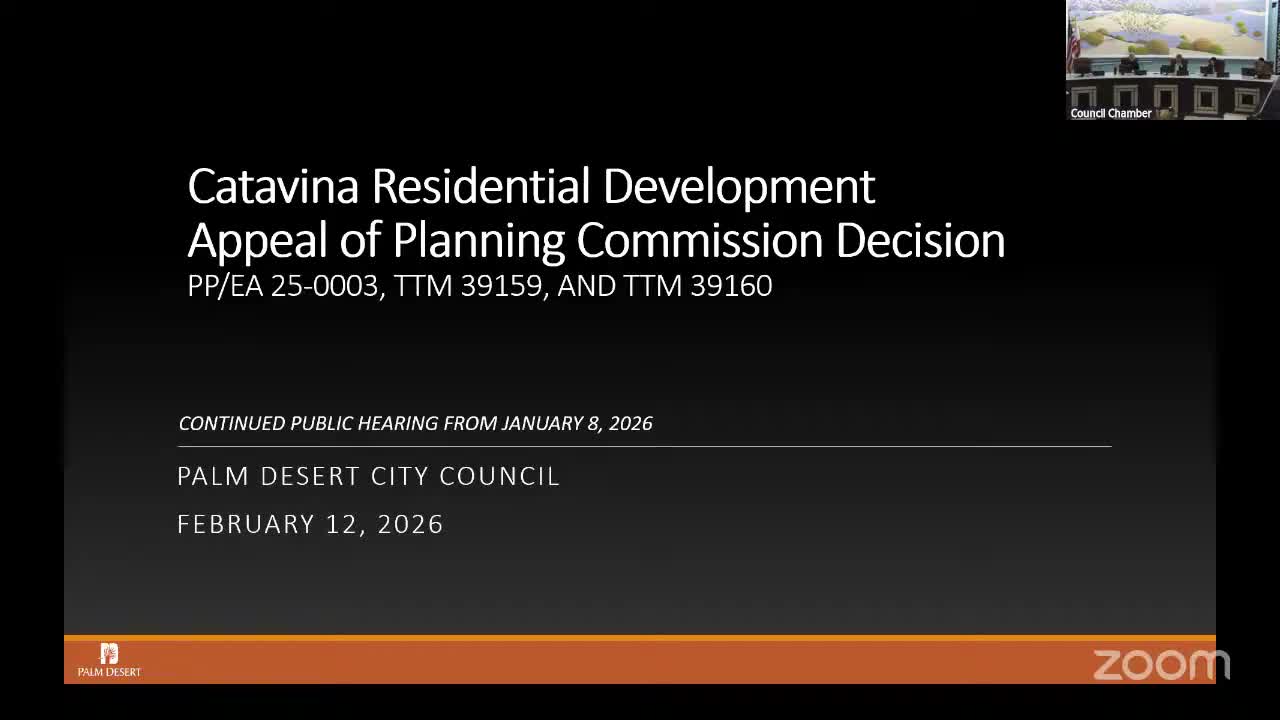
The Palm Desert City Council voted unanimously on Feb. 12 to deny an appeal filed by the Supporters Alliance for Environmental Responsibility (SAFER) and to confirm the planning commission’s approval of the Katavina residential project, a proposed 546‑lot single‑family development on the former Santa Rosa golf course.
City staff, represented by Rosie Lua, director of development services, recommended the council accept the administrative record, find the project consistent with the city’s 2016 General Plan and the certified EIR for that plan, and apply the CEQA Guidelines §15183 general‑plan consistency exemption and streamlining. Staff told the council that the project’s 7 dwelling units per acre fall at the low end of the town‑center neighborhood designation evaluated by the 2016 EIR and that technical studies and subsequent site testing addressed concerns raised during review.
CEQA counsel for the applicant, David Hubbard, told the council the project is “consistent on all fours” with the general plan and that §15183 provides a separate ground for denying the appeal because it limits the standard of review when a project is consistent with adopted planning documents. Hubbard said the project does not present a “significant and peculiar” impact not analyzed in the 2016 EIR.
SAFER’s attorney Brian Flynn countered that the administrative record supports fair‑argument concerns requiring a full Environmental Impact Report (EIR). Flynn highlighted technical comments alleging potential greenhouse‑gas (GHG) and air‑quality impacts, and a wildlife ecologist’s field observations suggesting more species and special‑status habitat than the project’s biological surveys documented. Flynn said the MND required eight mitigation measures and argued those measures are not uniformly applied development standards that would permit §15183 streamlining.
The council debated the legal standard, including subsection (h) of §15183 and whether any impacts were peculiar to the site. Several council members said they found no evidence of significant and peculiar impacts that would preclude the exemption; council members also noted the site’s history as a golf course and the lower density of the proposal relative to the ranges the general plan EIR evaluated.
Council member Perdeto moved to uphold staff’s recommendation; Mayor Truby seconded the motion. The council’s roll call vote was 5‑0 in favor of denying the appeal and confirming the planning commission’s approval.
What’s next: The council’s decision is final under local rules; the appellant may pursue litigation outside the city process. The project’s approvals include adoption of the MND, certification of required technical studies, and approval of the precise plan and subdivision maps as presented to the council.
City staff, represented by Rosie Lua, director of development services, recommended the council accept the administrative record, find the project consistent with the city’s 2016 General Plan and the certified EIR for that plan, and apply the CEQA Guidelines §15183 general‑plan consistency exemption and streamlining. Staff told the council that the project’s 7 dwelling units per acre fall at the low end of the town‑center neighborhood designation evaluated by the 2016 EIR and that technical studies and subsequent site testing addressed concerns raised during review.
CEQA counsel for the applicant, David Hubbard, told the council the project is “consistent on all fours” with the general plan and that §15183 provides a separate ground for denying the appeal because it limits the standard of review when a project is consistent with adopted planning documents. Hubbard said the project does not present a “significant and peculiar” impact not analyzed in the 2016 EIR.
SAFER’s attorney Brian Flynn countered that the administrative record supports fair‑argument concerns requiring a full Environmental Impact Report (EIR). Flynn highlighted technical comments alleging potential greenhouse‑gas (GHG) and air‑quality impacts, and a wildlife ecologist’s field observations suggesting more species and special‑status habitat than the project’s biological surveys documented. Flynn said the MND required eight mitigation measures and argued those measures are not uniformly applied development standards that would permit §15183 streamlining.
The council debated the legal standard, including subsection (h) of §15183 and whether any impacts were peculiar to the site. Several council members said they found no evidence of significant and peculiar impacts that would preclude the exemption; council members also noted the site’s history as a golf course and the lower density of the proposal relative to the ranges the general plan EIR evaluated.
Council member Perdeto moved to uphold staff’s recommendation; Mayor Truby seconded the motion. The council’s roll call vote was 5‑0 in favor of denying the appeal and confirming the planning commission’s approval.
What’s next: The council’s decision is final under local rules; the appellant may pursue litigation outside the city process. The project’s approvals include adoption of the MND, certification of required technical studies, and approval of the precise plan and subdivision maps as presented to the council.
View the Full Meeting & All Its Details
This article offers just a summary. Unlock complete video, transcripts, and insights as a Founder Member.
✓
Watch full, unedited meeting videos
✓
Search every word spoken in unlimited transcripts
✓
AI summaries & real-time alerts (all government levels)
✓
Permanent access to expanding government content
30-day money-back guarantee
