Bradley County EMS reports rising revenue, seeks vans and pay-plan as demand grows
February 13, 2026 | Bradley County, Tennessee
This article was created by AI summarizing key points discussed. AI makes mistakes, so for full details and context, please refer to the video of the full meeting. Please report any errors so we can fix them. Report an error »
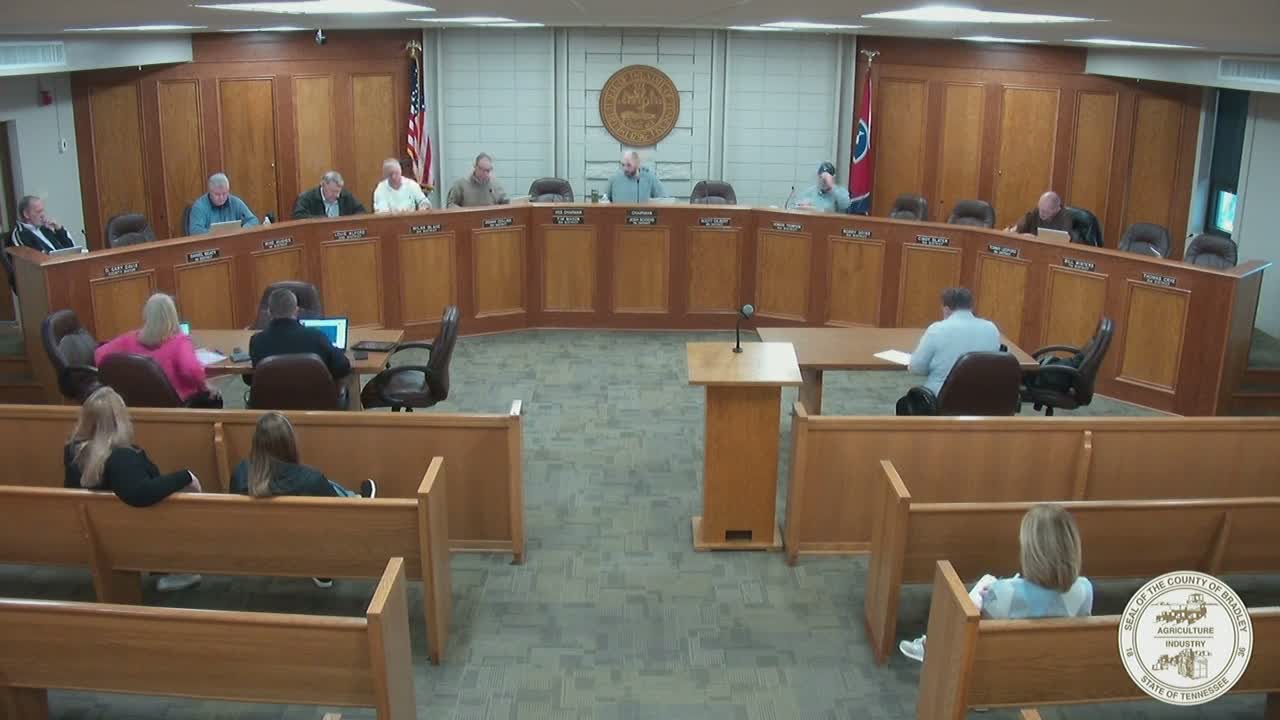
Bradley County Emergency Medical Services Director Adam Lewis told the county commission on Feb. 13 that the agency responded to 26,887 calls in calendar year 2025 and transported patients 13,858 times, with 3,128 of those transports originating from Bradley Medical Center.
Lewis said improvements in billing and modest rate increases have produced a five-year upward revenue trend. "Every dime we bring in is one less dime that the taxpayers need to fork over for us to operate," he said, adding that EMS is on track to exceed the budget projection of $5.2 million and could bring in roughly $6.2 million this year against a $7.5 million operating budget.
The revenue gains, Lewis told commissioners, create room to invest in both equipment and expanded service lines. He proposed adding more nonemergency "convalescent" vehicles — vans dedicated to discharges and routine transports — and estimated the first-year investment for one van, its equipment and two full-time hires at about $450,000. Lewis said the county could plausibly generate $800,000–$900,000 in annual revenue from an added van once operational. "We will absolutely transport wherever we need to go from one of these stand-alone ERs," Lewis said when asked about new emergency facilities opening locally.
Lewis described operational changes that underlie the revenue increases: the county improved internal claim-preparation turnaround (billing lag largely down into the 35–45 day range), now uses a billing company for claim submission, and raised transport rates for the first time in about 20 years to capture higher commercial-payer reimbursements. That combination, he said, reduced denials and improved collections.
Commissioners pressed Lewis on several details. Commissioner Blake asked whether raising rates would be neutralized by Medicare and Medicaid allowable rates; Lewis said federal and state payers still pay allowable amounts, but commercial payers often reimburse at higher rates, and capturing that revenue matters. Commissioner Thompson asked about prior-authorization denials; Lewis cited a recent two-month report showing about 60 such calls representing roughly $20,000 in missed payment, and said he will review denial rates for VA, Medicare and other payers.
The presentation included a fleet and equipment update: Bradley County runs 14 vehicles (12 ambulances and two vans) and recently added a new ambulance purchased with COVID relief funds. Lewis said the county is negotiating to receive an ambulance donated by Cleveland City Schools, which would be a net fleet gain; under a gentleman's agreement the county would in turn donate an older unit to Bradley County Fire.
Looking ahead, Lewis previewed budget requests the EMS office will send to the mayor, including an annual $123,500 lease payment to replace aging cardiac monitors (the devices were bought with COVID funds and are approaching end of service life) and funding for a new full ambulance (roughly $500,000 including required equipment). He said the county previously relied on COVID funding to update the fleet and will need alternative sources — including potential opioid-settlement funds or property-tax dollars — to sustain replacements going forward.
Lewis also described technology and workforce initiatives: mobile data terminals (MDTs) are being rolled out in trucks to provide call data and GPS positioning for dispatch, and an EMS pay-plan proposal is in development that would raise starting pay and introduce step increases to reward longevity. In comparing regional pay, he said Bradley County starting pay for EMTs and paramedics trails larger counties such as Hamilton County, and that improving pay is critical to retaining personnel.
Mayor Gary Davis told the commission that the county will follow state guidelines on transport destinations, warning against private providers promising transport options beyond what regulations allow. "The regulation says the closest appropriate facility," Davis said, and commissioners reiterated that rules are intended to protect patients and system resources.
The commission voted by voice to approve the June minutes before the presentation (motion by Commissioner Thompson; second by Commissioner Collins). The EMS committee chair asked for a follow-up EMS committee meeting to review denial-rate analysis, the pay-plan proposal and vehicle cost details before the committee issues budget recommendations to the finance committee and the mayor.
What’s next: Lewis said he will provide detailed denial-rate figures, firm pay-plan numbers and truck/van cost breakdowns at a subsequent EMS committee meeting so the commission can vet funding options for the coming budget cycle.
Lewis said improvements in billing and modest rate increases have produced a five-year upward revenue trend. "Every dime we bring in is one less dime that the taxpayers need to fork over for us to operate," he said, adding that EMS is on track to exceed the budget projection of $5.2 million and could bring in roughly $6.2 million this year against a $7.5 million operating budget.
The revenue gains, Lewis told commissioners, create room to invest in both equipment and expanded service lines. He proposed adding more nonemergency "convalescent" vehicles — vans dedicated to discharges and routine transports — and estimated the first-year investment for one van, its equipment and two full-time hires at about $450,000. Lewis said the county could plausibly generate $800,000–$900,000 in annual revenue from an added van once operational. "We will absolutely transport wherever we need to go from one of these stand-alone ERs," Lewis said when asked about new emergency facilities opening locally.
Lewis described operational changes that underlie the revenue increases: the county improved internal claim-preparation turnaround (billing lag largely down into the 35–45 day range), now uses a billing company for claim submission, and raised transport rates for the first time in about 20 years to capture higher commercial-payer reimbursements. That combination, he said, reduced denials and improved collections.
Commissioners pressed Lewis on several details. Commissioner Blake asked whether raising rates would be neutralized by Medicare and Medicaid allowable rates; Lewis said federal and state payers still pay allowable amounts, but commercial payers often reimburse at higher rates, and capturing that revenue matters. Commissioner Thompson asked about prior-authorization denials; Lewis cited a recent two-month report showing about 60 such calls representing roughly $20,000 in missed payment, and said he will review denial rates for VA, Medicare and other payers.
The presentation included a fleet and equipment update: Bradley County runs 14 vehicles (12 ambulances and two vans) and recently added a new ambulance purchased with COVID relief funds. Lewis said the county is negotiating to receive an ambulance donated by Cleveland City Schools, which would be a net fleet gain; under a gentleman's agreement the county would in turn donate an older unit to Bradley County Fire.
Looking ahead, Lewis previewed budget requests the EMS office will send to the mayor, including an annual $123,500 lease payment to replace aging cardiac monitors (the devices were bought with COVID funds and are approaching end of service life) and funding for a new full ambulance (roughly $500,000 including required equipment). He said the county previously relied on COVID funding to update the fleet and will need alternative sources — including potential opioid-settlement funds or property-tax dollars — to sustain replacements going forward.
Lewis also described technology and workforce initiatives: mobile data terminals (MDTs) are being rolled out in trucks to provide call data and GPS positioning for dispatch, and an EMS pay-plan proposal is in development that would raise starting pay and introduce step increases to reward longevity. In comparing regional pay, he said Bradley County starting pay for EMTs and paramedics trails larger counties such as Hamilton County, and that improving pay is critical to retaining personnel.
Mayor Gary Davis told the commission that the county will follow state guidelines on transport destinations, warning against private providers promising transport options beyond what regulations allow. "The regulation says the closest appropriate facility," Davis said, and commissioners reiterated that rules are intended to protect patients and system resources.
The commission voted by voice to approve the June minutes before the presentation (motion by Commissioner Thompson; second by Commissioner Collins). The EMS committee chair asked for a follow-up EMS committee meeting to review denial-rate analysis, the pay-plan proposal and vehicle cost details before the committee issues budget recommendations to the finance committee and the mayor.
What’s next: Lewis said he will provide detailed denial-rate figures, firm pay-plan numbers and truck/van cost breakdowns at a subsequent EMS committee meeting so the commission can vet funding options for the coming budget cycle.
Don't Miss a Word: See the Full Meeting!
Go beyond summaries. Unlock every video, transcript, and key insight with a Founder Membership.
✓
Get instant access to full meeting videos
✓
Search and clip any phrase from complete transcripts
✓
Receive AI-powered summaries & custom alerts
✓
Enjoy lifetime, unrestricted access to government data
30-day money-back guarantee
