Ways & Means reviews 50‑section miscellaneous tax bill, flags S‑corp credit repeal, transfer‑tax compliance and Fish & Wildlife fee change
February 13, 2026 | Ways & Means, HOUSE OF REPRESENTATIVES, Committees, Legislative , Vermont
This article was created by AI summarizing key points discussed. AI makes mistakes, so for full details and context, please refer to the video of the full meeting. Please report any errors so we can fix them. Report an error »
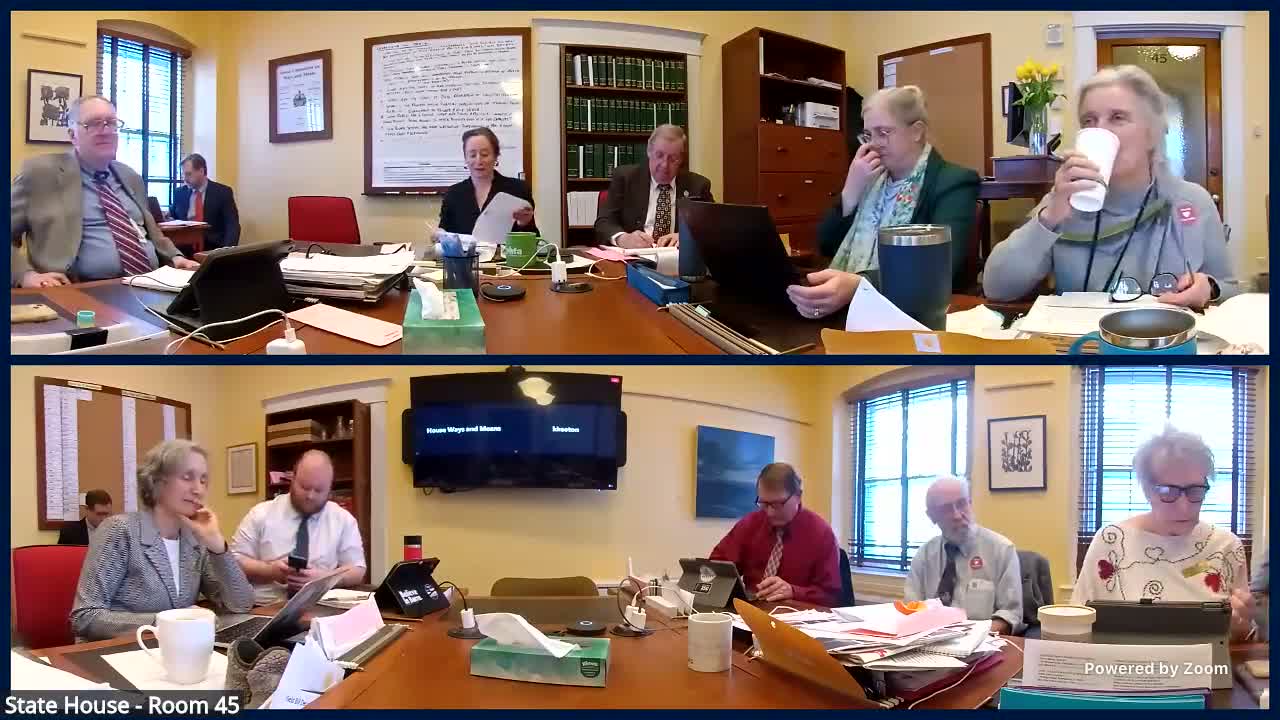
The Vermont House Ways & Means Committee met Feb. 13 in the Ways & Means room for a section‑by‑section review of a 50‑section miscellaneous tax bill, staff said. Kirby Keating of the Legislative Council walked members through each change and staff will invite witnesses next week on several items the committee flagged for further detail.
The bill covers a broad set of technical and substantive changes. "Section 1 on page 1 line 12 is a repeal of the denial of tax credits for s corporations," Keating said, noting staff historical briefing that the provision traces to litigation in the 1990s. Keating also described Section 2 as granting the Department of Taxes authority to investigate whether a bona fide landlord‑tenant relationship exists for transfer‑tax purposes to limit avoidance of higher rates for second homes and short‑term rentals.
Members spent notable time on proposals affecting property valuation and municipal finance. Sections 3 and 4 would let PVR perform valuations for portions of parcels that are unenrolled or developed when municipalities cannot complete the appraisal work in a timely way, applying land‑use change tax to the developed portion. Section 5 would add grazing income or grazing rights as a qualifying path for enrolling small agricultural parcels in current‑use programs; committee members said the Natural Resources committee and agricultural stakeholders should review potential loopholes.
On municipal flood reimbursement, staff described a technical change (Section 6) aligning the tax rate used to calculate payments with the year immediately preceding the payment, consistent with pilot practice; a Representative summarized the buyout reimbursement structure as 10 years of support (first five years at 100% of value, next five at 50%).
Section 7 would add enforcement tools for communications providers that fail to submit inventories to PVR, including a civil penalty "not more than a $100 for each violation" and authority for PVR to estimate value and foreclose appeal when false inventories or sworn false answers occur. Members questioned how "each violation" would be interpreted (per day, per property, or per missing line item) and whether a $100 cap would deter noncompliance for large providers.
Keating said a new equalization‑study clarification would treat CHIP house sites like a TIF district for equalization purposes, and Section 9 would allow PVR to use a 100 common level of appraisal (CLA) where a municipality has completed a master appraisal for education tax calculations; staff confirmed the effective date is on passage and would apply to the 2026–27 property tax year unless changed.
Other items: Sections 10–11 extend the Health IT Fund sunset to 2031; a new subsection would permit a special rollover from a 529 plan to a Roth IRA if the account is maintained for at least 20 years (vs. the federal 15‑year rule), with VSAC invited to testify; sections 13–16 update inflation indexing references to NIPA; Section 17 modifies property‑tax‑credit calculation for separated or divorced taxpayers living in the homestead; estate‑tax filing thresholds would be raised to $5,000,000 to reduce zero‑liability filings; Section 19 extends the down payment assistance program to 2031 and increases the first‑year credit allocation to $350,000; Sections 20–21 address whether Vermont will participate in a federal scholarship‑granting organization credit and assigns the decision explicitly to the General Assembly.
Sections 22 and 26–49 address grand‑list and mapping issues: Section 22 narrows the parcel definition for mapping and per‑parcel payments, and Sections 26–49 move the grand‑list assessment date from April 1 to January 1 (intended to create time for appeals), with the latter change written to take effect 07/01/2031 per the RAD report. Sections 23–25 repeal the Department of Fish & Wildlife commissioner’s fee‑setting authority effective 07/01/2027 and require Fish & Wildlife to report recommended statutory fees to the General Assembly before repeal. Members discussed recent local rulemaking (an Elkhart/LCAR example) and asked staff to follow up with Michael O'Grady and LCAR counsel about the practical reach of the change and which agencies hold comparable authority.
Keating outlined effective dates: many technical clarifications are drafted to take effect on passage; the S‑corporation credit change would be retroactive to 2025; some current‑use changes are set for 10/01/2026; the grand‑list parcel definition change is set for 04/01/2027; and the grand‑list assessment‑date change is set for 07/01/2031. The Chair and staff compiled a list of stakeholders to invite for next‑week testimony (VLCT, Vermont Housing Finance Agency, Sierra Club, VSAC, Fish & Wildlife, LCAR counsel, Michael O'Grady). The committee recessed until 1:00 p.m. to pick up other agenda items.
Quotes in context: Kirby Keating said, "We have 50 sections now," and described Section 1 as "a repeal of the denial of tax credits for s corporations." On transfer‑tax enforcement he summarized the intent: the department would "look into those transfers to determine if there's an actual landlord tenant relationship or if this is just a landlord certificates ... set up to avoid the tax." On penalties for communications providers Keating read the draft: the commissioner "may find the provider not more than a $100 for each violation unless the provider's failure is due to factors beyond the provider's control."
What’s next: staff will invite identified witnesses to testify next week on specific sections; committee members asked staff to clarify penalty definitions (e.g., what counts as "each violation") and to check administrative practice around fee‑setting authority before the committee takes further action.
The bill covers a broad set of technical and substantive changes. "Section 1 on page 1 line 12 is a repeal of the denial of tax credits for s corporations," Keating said, noting staff historical briefing that the provision traces to litigation in the 1990s. Keating also described Section 2 as granting the Department of Taxes authority to investigate whether a bona fide landlord‑tenant relationship exists for transfer‑tax purposes to limit avoidance of higher rates for second homes and short‑term rentals.
Members spent notable time on proposals affecting property valuation and municipal finance. Sections 3 and 4 would let PVR perform valuations for portions of parcels that are unenrolled or developed when municipalities cannot complete the appraisal work in a timely way, applying land‑use change tax to the developed portion. Section 5 would add grazing income or grazing rights as a qualifying path for enrolling small agricultural parcels in current‑use programs; committee members said the Natural Resources committee and agricultural stakeholders should review potential loopholes.
On municipal flood reimbursement, staff described a technical change (Section 6) aligning the tax rate used to calculate payments with the year immediately preceding the payment, consistent with pilot practice; a Representative summarized the buyout reimbursement structure as 10 years of support (first five years at 100% of value, next five at 50%).
Section 7 would add enforcement tools for communications providers that fail to submit inventories to PVR, including a civil penalty "not more than a $100 for each violation" and authority for PVR to estimate value and foreclose appeal when false inventories or sworn false answers occur. Members questioned how "each violation" would be interpreted (per day, per property, or per missing line item) and whether a $100 cap would deter noncompliance for large providers.
Keating said a new equalization‑study clarification would treat CHIP house sites like a TIF district for equalization purposes, and Section 9 would allow PVR to use a 100 common level of appraisal (CLA) where a municipality has completed a master appraisal for education tax calculations; staff confirmed the effective date is on passage and would apply to the 2026–27 property tax year unless changed.
Other items: Sections 10–11 extend the Health IT Fund sunset to 2031; a new subsection would permit a special rollover from a 529 plan to a Roth IRA if the account is maintained for at least 20 years (vs. the federal 15‑year rule), with VSAC invited to testify; sections 13–16 update inflation indexing references to NIPA; Section 17 modifies property‑tax‑credit calculation for separated or divorced taxpayers living in the homestead; estate‑tax filing thresholds would be raised to $5,000,000 to reduce zero‑liability filings; Section 19 extends the down payment assistance program to 2031 and increases the first‑year credit allocation to $350,000; Sections 20–21 address whether Vermont will participate in a federal scholarship‑granting organization credit and assigns the decision explicitly to the General Assembly.
Sections 22 and 26–49 address grand‑list and mapping issues: Section 22 narrows the parcel definition for mapping and per‑parcel payments, and Sections 26–49 move the grand‑list assessment date from April 1 to January 1 (intended to create time for appeals), with the latter change written to take effect 07/01/2031 per the RAD report. Sections 23–25 repeal the Department of Fish & Wildlife commissioner’s fee‑setting authority effective 07/01/2027 and require Fish & Wildlife to report recommended statutory fees to the General Assembly before repeal. Members discussed recent local rulemaking (an Elkhart/LCAR example) and asked staff to follow up with Michael O'Grady and LCAR counsel about the practical reach of the change and which agencies hold comparable authority.
Keating outlined effective dates: many technical clarifications are drafted to take effect on passage; the S‑corporation credit change would be retroactive to 2025; some current‑use changes are set for 10/01/2026; the grand‑list parcel definition change is set for 04/01/2027; and the grand‑list assessment‑date change is set for 07/01/2031. The Chair and staff compiled a list of stakeholders to invite for next‑week testimony (VLCT, Vermont Housing Finance Agency, Sierra Club, VSAC, Fish & Wildlife, LCAR counsel, Michael O'Grady). The committee recessed until 1:00 p.m. to pick up other agenda items.
Quotes in context: Kirby Keating said, "We have 50 sections now," and described Section 1 as "a repeal of the denial of tax credits for s corporations." On transfer‑tax enforcement he summarized the intent: the department would "look into those transfers to determine if there's an actual landlord tenant relationship or if this is just a landlord certificates ... set up to avoid the tax." On penalties for communications providers Keating read the draft: the commissioner "may find the provider not more than a $100 for each violation unless the provider's failure is due to factors beyond the provider's control."
What’s next: staff will invite identified witnesses to testify next week on specific sections; committee members asked staff to clarify penalty definitions (e.g., what counts as "each violation") and to check administrative practice around fee‑setting authority before the committee takes further action.
Don't Miss a Word: See the Full Meeting!
Go beyond summaries. Unlock every video, transcript, and key insight with a Founder Membership.
✓
Get instant access to full meeting videos
✓
Search and clip any phrase from complete transcripts
✓
Receive AI-powered summaries & custom alerts
✓
Enjoy lifetime, unrestricted access to government data
30-day money-back guarantee
