Virginia Senate advances broad package on energy, courts, housing and authorizes Fairfax casino referendum
February 13, 2026 | 2026 Legislature VA, Virginia
This article was created by AI summarizing key points discussed. AI makes mistakes, so for full details and context, please refer to the video of the full meeting. Please report any errors so we can fix them. Report an error »
RICHMOND, Va. — The Virginia Senate met in Richmond on Feb. 13 and moved a wide-ranging slate of legislation, approving measures on renewable energy, utility regulation, court debt collection, child welfare and more, and voting to permit a casino referendum in Fairfax County.
The day began with routine business — roll call and introductions — and quickly moved into a packed calendar. Senators placed a large group of uncontested third‑reading bills in a final-passage block and passed them by voice and recorded vote. Floor debate then focused on a mix of energy and consumer bills, criminal-justice reforms and a prolonged controversy over SB 756, the measure authorizing a casino referendum in Fairfax County.
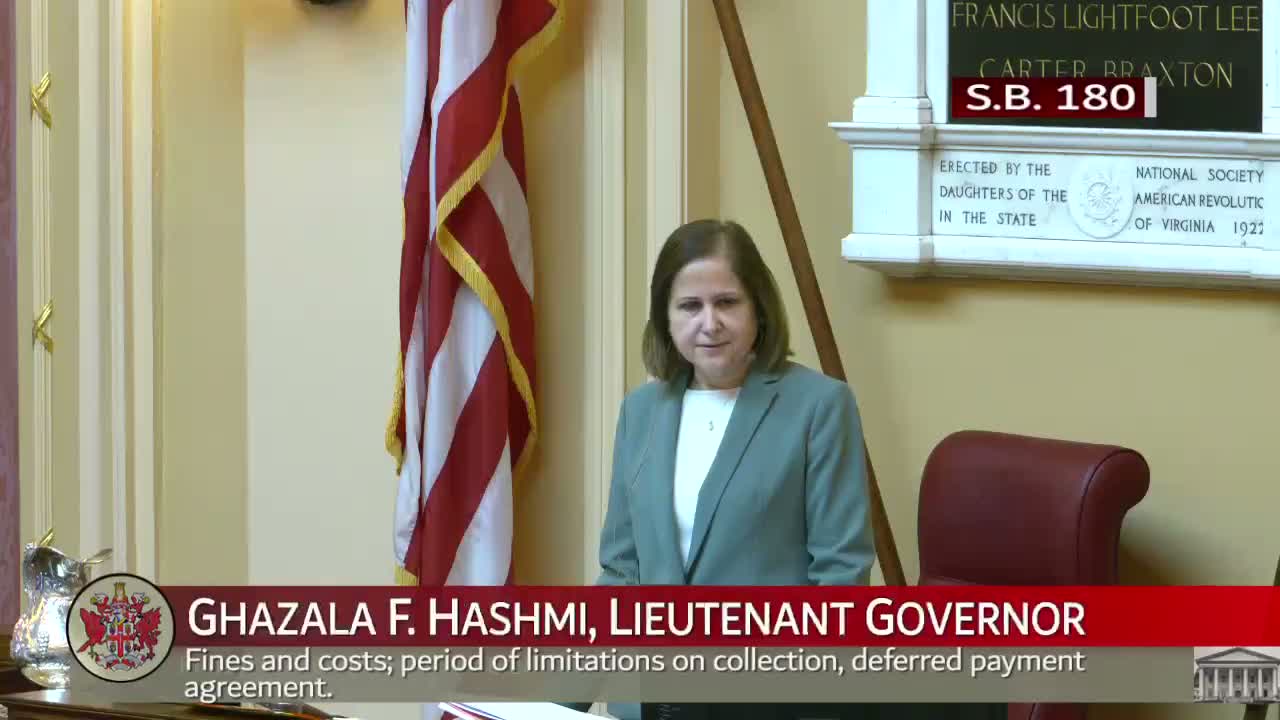
Senate Democrats and Republicans split on several high-profile bills. The Senate passed SB 180, a substitute aimed at court-debt collection reform that establishes a 10-year statute of limitations on collection of many court‑imposed fines and fees, extends the referral period to 180 days and bars collection activity while an individual is incarcerated and subject to a deferred payment agreement. "This bill provides certainty," the sponsor said while arguing the changes are designed to aid reentry without erasing obligations; the measure passed on a recorded vote.
On energy and utility policy, senators approved a package of bills sponsors described as affordability and grid‑modernization measures. That package included SB 175, which expands carve-outs for distributed solar and increases set-asides for previously developed sites; SB 250, which authorizes small “balcony” plug-in solar devices for consumers; and several bills directing the State Corporation Commission to review integrated resource planning, shared/ community solar programs and surplus interconnection options. Proponents framed these measures as steps to get more renewable generation online and reduce bills for consumers; opponents on occasion raised reliability and technical questions about device safety and interconnection planning.
Child-welfare and housing-related bills also advanced. Senate Bill 305 creates a two-step waiver process so certain relatives or "fictive kin" with past nonviolent convictions may be considered as foster parents under a new Department of Social Services process, with reporting and safeguard requirements added on the floor. Senators passed SB 628 to codify and expand DHCD’s eviction reduction pilot into a permanent program intended to prevent and divert eviction filings.
The most protracted floor exchange centered on SB 756, which would allow Fairfax County to place a casino referendum before voters and requires projects meeting specified size criteria. The senator who carried the bill emphasized potential statewide and local revenue, saying one revenue scenario could generate roughly $232 million a year for the Commonwealth and produce thousands of construction and permanent jobs. "If it does 1,200,000,000 in gaming revenue a year, that would generate about $232,000,000 per year to the Commonwealth," the sponsor said.
Opponents — particularly senators representing Fairfax County and Northern Virginia — disputed both the process and the underlying figures. Several speakers noted Fairfax County officials had not requested the authority and cited polls and a formal board position opposing the proposal. "The host locality, Fairfax County, is not asking for this authority," one Northern Virginia senator said, urging the body to respect the locality's position. Supporters countered that the ultimate decision would be placed before voters in a local referendum. The Senate approved SB 756 on a recorded vote.
Votes at a glance (selected bills and recorded tallies reported on the floor): SB 83 (courthouse access/security) — passed; SB 129 (fantasy contests study) — passed 29–10; SB 162 (restoration of rights enabling bill) — passed 21–18; SB 175 (renewable/distributed solar expansion) — passed 23–16; SB 180 (court debt reform) — passed 22–17; SB 250 (balcony solar) — passed under Rule 36, Ayes 30 Noes 7; SB 305 (kinship foster-care waiver, after floor amendments) — passed 37–0; SB 491 (school nondiscrimination on immigration status and related protections) — passed 21–18; SB 508 (surplus interconnection pilot/reporting) — passed 23–15; SB 756 (Fairfax casino referendum authorization) — passed 23–14.
What happens next: Several bills will move to the House or to additional steps depending on their origin and subject; SB 756, if enacted, would let Fairfax County place a referendum before local voters under the bill's statutory terms and the state's existing gaming structure. The Senate adjourned and is scheduled to reconvene at 10 a.m. Monday for further business.
Reporting note: Quotes and vote tallies in this account are taken from the Senate floor record for Feb. 13, 2026. The transcript uses role-based attributions (for example, "the senator from Eastern Fairfax"); where full names were not stated on the record those role attributions are used in reporting.
The day began with routine business — roll call and introductions — and quickly moved into a packed calendar. Senators placed a large group of uncontested third‑reading bills in a final-passage block and passed them by voice and recorded vote. Floor debate then focused on a mix of energy and consumer bills, criminal-justice reforms and a prolonged controversy over SB 756, the measure authorizing a casino referendum in Fairfax County.
Senate Democrats and Republicans split on several high-profile bills. The Senate passed SB 180, a substitute aimed at court-debt collection reform that establishes a 10-year statute of limitations on collection of many court‑imposed fines and fees, extends the referral period to 180 days and bars collection activity while an individual is incarcerated and subject to a deferred payment agreement. "This bill provides certainty," the sponsor said while arguing the changes are designed to aid reentry without erasing obligations; the measure passed on a recorded vote.
On energy and utility policy, senators approved a package of bills sponsors described as affordability and grid‑modernization measures. That package included SB 175, which expands carve-outs for distributed solar and increases set-asides for previously developed sites; SB 250, which authorizes small “balcony” plug-in solar devices for consumers; and several bills directing the State Corporation Commission to review integrated resource planning, shared/ community solar programs and surplus interconnection options. Proponents framed these measures as steps to get more renewable generation online and reduce bills for consumers; opponents on occasion raised reliability and technical questions about device safety and interconnection planning.
Child-welfare and housing-related bills also advanced. Senate Bill 305 creates a two-step waiver process so certain relatives or "fictive kin" with past nonviolent convictions may be considered as foster parents under a new Department of Social Services process, with reporting and safeguard requirements added on the floor. Senators passed SB 628 to codify and expand DHCD’s eviction reduction pilot into a permanent program intended to prevent and divert eviction filings.
The most protracted floor exchange centered on SB 756, which would allow Fairfax County to place a casino referendum before voters and requires projects meeting specified size criteria. The senator who carried the bill emphasized potential statewide and local revenue, saying one revenue scenario could generate roughly $232 million a year for the Commonwealth and produce thousands of construction and permanent jobs. "If it does 1,200,000,000 in gaming revenue a year, that would generate about $232,000,000 per year to the Commonwealth," the sponsor said.
Opponents — particularly senators representing Fairfax County and Northern Virginia — disputed both the process and the underlying figures. Several speakers noted Fairfax County officials had not requested the authority and cited polls and a formal board position opposing the proposal. "The host locality, Fairfax County, is not asking for this authority," one Northern Virginia senator said, urging the body to respect the locality's position. Supporters countered that the ultimate decision would be placed before voters in a local referendum. The Senate approved SB 756 on a recorded vote.
Votes at a glance (selected bills and recorded tallies reported on the floor): SB 83 (courthouse access/security) — passed; SB 129 (fantasy contests study) — passed 29–10; SB 162 (restoration of rights enabling bill) — passed 21–18; SB 175 (renewable/distributed solar expansion) — passed 23–16; SB 180 (court debt reform) — passed 22–17; SB 250 (balcony solar) — passed under Rule 36, Ayes 30 Noes 7; SB 305 (kinship foster-care waiver, after floor amendments) — passed 37–0; SB 491 (school nondiscrimination on immigration status and related protections) — passed 21–18; SB 508 (surplus interconnection pilot/reporting) — passed 23–15; SB 756 (Fairfax casino referendum authorization) — passed 23–14.
What happens next: Several bills will move to the House or to additional steps depending on their origin and subject; SB 756, if enacted, would let Fairfax County place a referendum before local voters under the bill's statutory terms and the state's existing gaming structure. The Senate adjourned and is scheduled to reconvene at 10 a.m. Monday for further business.
Reporting note: Quotes and vote tallies in this account are taken from the Senate floor record for Feb. 13, 2026. The transcript uses role-based attributions (for example, "the senator from Eastern Fairfax"); where full names were not stated on the record those role attributions are used in reporting.
Don't Miss a Word: See the Full Meeting!
Go beyond summaries. Unlock every video, transcript, and key insight with a Founder Membership.
✓
Get instant access to full meeting videos
✓
Search and clip any phrase from complete transcripts
✓
Receive AI-powered summaries & custom alerts
✓
Enjoy lifetime, unrestricted access to government data
30-day money-back guarantee
