Committee votes to report 'Lexi's Law' to bar geriatric parole for the most violent offenders
February 13, 2026 | 2026 Legislature VA, Virginia
This article was created by AI summarizing key points discussed. AI makes mistakes, so for full details and context, please refer to the video of the full meeting. Please report any errors so we can fix them. Report an error »
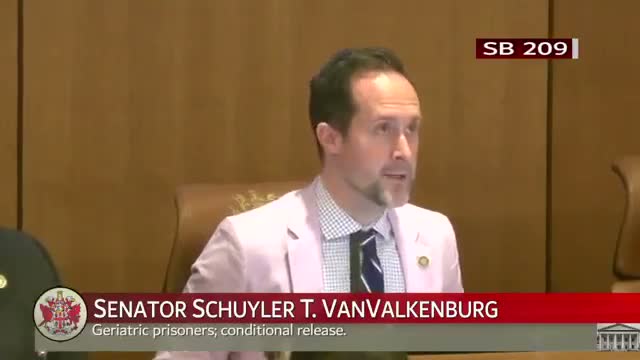
Senate Bill 209, described by its sponsor as "Lexi's Law," would limit eligibility for geriatric parole for people convicted of the most violent offenses, including murder, kidnapping and certain sexual and violent offenses. Senator Steph, the bill sponsor, told the committee the measure would close loopholes that have allowed some violent offenders to be considered for geriatric release (SEG 076-083).
Multiple survivors testified in person and online. Marie Jones said her sister Lexi Walters, 53, was murdered and urged passage: "Please vote yes to Lexi's Law, senate bill 209" (Marie Jones, SEG 161-163). Georgeann Allen described her brother's 1994 killing and subsequent repeated parole proceedings and said violent offenders "do not deserve to walk outside the walls" of prison (Georgeann Allen, SEG 233-239). An online survivor (unnamed on the record) described an attempted abduction and assault and asked the committee to consider serial violent offenders in the bill (Unidentified Online Witness, SEG 262-291).
Senators debated both the policy goal and statistical impacts. Senator Servo noted that geriatric conditional release has a statutory floor (including an at-least-10-year-served threshold and age-based eligibility) and questioned whether limiting release would move the needle statistically, recommending carrying the bill to 2027 for further study (SEG 318-366). Other members argued victims' suffering warrants reporting the bill now and working with the sponsor to tighten language where needed (SEG 381-392, SEG 480-484).
The committee ultimately voted to report the bill to the floor, recorded as "Eyes 12, No 1." Senator Steph said he would work with colleagues to narrow the bill's language to focus on the most heinous offenses before floor consideration (SEG 480-484).
The committee's action advances the bill to the next stage; sponsors and critics signaled plans to refine statutory language and definitions before the floor debate.
Multiple survivors testified in person and online. Marie Jones said her sister Lexi Walters, 53, was murdered and urged passage: "Please vote yes to Lexi's Law, senate bill 209" (Marie Jones, SEG 161-163). Georgeann Allen described her brother's 1994 killing and subsequent repeated parole proceedings and said violent offenders "do not deserve to walk outside the walls" of prison (Georgeann Allen, SEG 233-239). An online survivor (unnamed on the record) described an attempted abduction and assault and asked the committee to consider serial violent offenders in the bill (Unidentified Online Witness, SEG 262-291).
Senators debated both the policy goal and statistical impacts. Senator Servo noted that geriatric conditional release has a statutory floor (including an at-least-10-year-served threshold and age-based eligibility) and questioned whether limiting release would move the needle statistically, recommending carrying the bill to 2027 for further study (SEG 318-366). Other members argued victims' suffering warrants reporting the bill now and working with the sponsor to tighten language where needed (SEG 381-392, SEG 480-484).
The committee ultimately voted to report the bill to the floor, recorded as "Eyes 12, No 1." Senator Steph said he would work with colleagues to narrow the bill's language to focus on the most heinous offenses before floor consideration (SEG 480-484).
The committee's action advances the bill to the next stage; sponsors and critics signaled plans to refine statutory language and definitions before the floor debate.
Don't Miss a Word: See the Full Meeting!
Go beyond summaries. Unlock every video, transcript, and key insight with a Founder Membership.
✓
Get instant access to full meeting videos
✓
Search and clip any phrase from complete transcripts
✓
Receive AI-powered summaries & custom alerts
✓
Enjoy lifetime, unrestricted access to government data
30-day money-back guarantee
