Senate committee advances rail crew‑size bill after dueling safety and preemption arguments
February 13, 2026 | 2026 Legislature VA, Virginia
This article was created by AI summarizing key points discussed. AI makes mistakes, so for full details and context, please refer to the video of the full meeting. Please report any errors so we can fix them. Report an error »
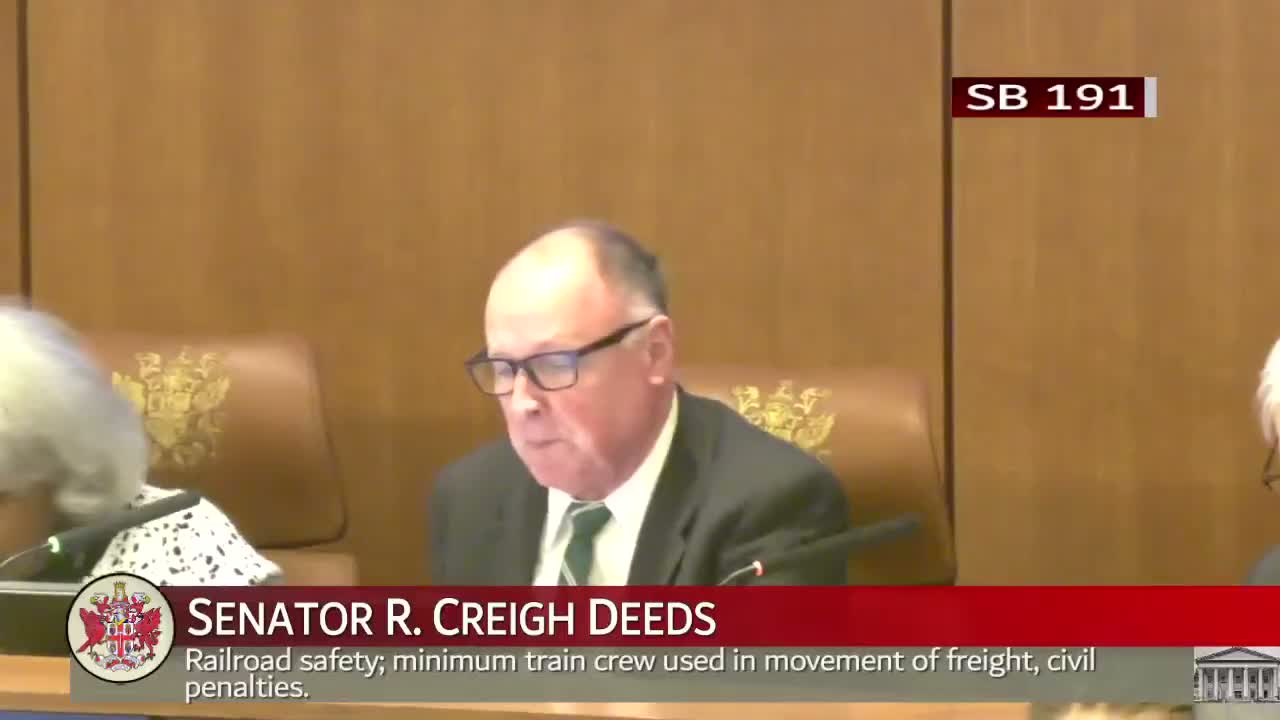
The Senate committee on (committee name) took up Senate Bill 191 on a substitute that would require any train, locomotive or light engine used to move freight in Virginia to operate with a crew of at least two qualified individuals, typically an engineer and a conductor, while explicitly excluding hostler and utility‑service operations. The sponsor described the bill as a public‑safety measure that would preserve a long‑standing industry practice and serve as a state‑level backstop if federal protections were weakened.
Supporters included union representatives and long‑service railroad workers. Ronnie Haas of SMART‑TD said the proposal simply codifies an existing operational standard used in many states and would ensure communities along rail corridors have protections if federal regulation changes. Tim Craver of the Brotherhood of Locomotive Engineers and Trainmen and other workers described real‑world scenarios — derailments and blocked crossings — where two trained crew members can coordinate immediate response and protect first responders and neighboring communities.
Railroad industry witnesses said federal law and current Federal Railroad Administration (FRA) regulations govern crew‑size issues and that state action risks conflict with federal preemption. Rob Bohannon of the Virginia Railroad Association told the committee he had seen no evidence of wide noncompliance with the federal rule and cited the Interstate Commerce Commission Termination Act and FRA directives as preemptive legal bases. Attorneys for Norfolk Southern and CSX reiterated that statutes and federal rules occupy the field for interstate rail operations and warned the bill could have downstream effects on shippers and supply‑chain costs.
Sponsor testimony acknowledged federal regulations (for example, 49 CFR 218.123) and said the bill was intended as a fallback if Congress or federal regulators reversed current protections. The substitute also removes the prior civil‑penalty framework and asks the State Corporation Commission to include in its annual report the number of probable violations of federal crew‑related safety standards investigated and referred to the FRA, a transparency provision the sponsor said preserves accountability without duplicative enforcement.
Committee action was procedural and divided. The committee adopted the substitute and later handled a motion to report and a motion to reconsider; the chair returned the measure to the docket for further consideration after procedural votes. The transcript records testimony from both workers and multiple railroad carriers and counsel; the committee did not adopt final enactment language that would become law during the session.
What happens next: The bill was reported subject to further procedural steps and returned to the committee’s docket for follow‑up motions and potential referral. The committee asked parties about federal preemption and requested technical clarifications on regulatory interplay.
Sources: Committee hearing testimony and sponsor presentation.
Supporters included union representatives and long‑service railroad workers. Ronnie Haas of SMART‑TD said the proposal simply codifies an existing operational standard used in many states and would ensure communities along rail corridors have protections if federal regulation changes. Tim Craver of the Brotherhood of Locomotive Engineers and Trainmen and other workers described real‑world scenarios — derailments and blocked crossings — where two trained crew members can coordinate immediate response and protect first responders and neighboring communities.
Railroad industry witnesses said federal law and current Federal Railroad Administration (FRA) regulations govern crew‑size issues and that state action risks conflict with federal preemption. Rob Bohannon of the Virginia Railroad Association told the committee he had seen no evidence of wide noncompliance with the federal rule and cited the Interstate Commerce Commission Termination Act and FRA directives as preemptive legal bases. Attorneys for Norfolk Southern and CSX reiterated that statutes and federal rules occupy the field for interstate rail operations and warned the bill could have downstream effects on shippers and supply‑chain costs.
Sponsor testimony acknowledged federal regulations (for example, 49 CFR 218.123) and said the bill was intended as a fallback if Congress or federal regulators reversed current protections. The substitute also removes the prior civil‑penalty framework and asks the State Corporation Commission to include in its annual report the number of probable violations of federal crew‑related safety standards investigated and referred to the FRA, a transparency provision the sponsor said preserves accountability without duplicative enforcement.
Committee action was procedural and divided. The committee adopted the substitute and later handled a motion to report and a motion to reconsider; the chair returned the measure to the docket for further consideration after procedural votes. The transcript records testimony from both workers and multiple railroad carriers and counsel; the committee did not adopt final enactment language that would become law during the session.
What happens next: The bill was reported subject to further procedural steps and returned to the committee’s docket for follow‑up motions and potential referral. The committee asked parties about federal preemption and requested technical clarifications on regulatory interplay.
Sources: Committee hearing testimony and sponsor presentation.
View the Full Meeting & All Its Details
This article offers just a summary. Unlock complete video, transcripts, and insights as a Founder Member.
✓
Watch full, unedited meeting videos
✓
Search every word spoken in unlimited transcripts
✓
AI summaries & real-time alerts (all government levels)
✓
Permanent access to expanding government content
30-day money-back guarantee
