Security Council signatories urge full inclusion of Syrian women in political transition, call to revoke discriminatory laws
February 13, 2026 | United Nations, International
This article was created by AI summarizing key points discussed. AI makes mistakes, so for full details and context, please refer to the video of the full meeting. Please report any errors so we can fix them. Report an error »
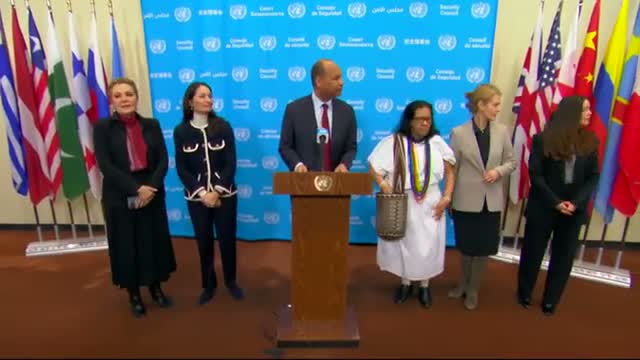
Unidentified Speaker, a representative of Security Council signatories including Colombia, Denmark, France, Greece, Latvia, Liberia, Panama and the United Kingdom, issued a statement at the United Nations calling for greater protections and political inclusion for Syrian women.
"We call for the full, equal, meaningful, and safe participation of women in all political and decision making processes in Syria," the speaker said, urging demonstrable progress toward an inclusive transition following years of conflict.
The statement noted 14 years of conflict and catalogued harms to women’s political and civil rights, saying women have in some cases lost property, inheritance and custody of children when male relatives were killed or missing. It welcomed provisions in the constitutional declaration of March 2025 intended to guarantee women’s rights and said signatories expect discriminatory laws enacted under the Assad era that deny women their rights to be revoked. The speaker urged development of a national action plan "in line with Security Council Resolution 1325."
The statement expressed deep concern about reports that women and girls "have faced ****** and gender based violence" (the transcript includes a redaction at this point) and said signatories are monitoring the impact of recent events in northeast Syria on displacements and access to services. It reaffirmed Syrian women’s role in peacebuilding, intercommunal dialogue and transitional justice and encouraged the Syrian government and other transition actors to listen to women’s testimonies and take steps to realize their ideas.
The signatories also voiced support for institutions addressing disappearances, including the National Commission for Missing Persons, a national inquiry and an independent institution on missing persons. "We stand ready to work with the Syrian government and all relevant partners to help realize a Syria in which women and girls play an integral role in building a peaceful, prosperous, and stable future," the statement concluded.
The delivery was a formal, non-decisional statement by signatory delegations; the transcript contains no motion or vote and does not record any immediate follow-up actions with timelines.
"We call for the full, equal, meaningful, and safe participation of women in all political and decision making processes in Syria," the speaker said, urging demonstrable progress toward an inclusive transition following years of conflict.
The statement noted 14 years of conflict and catalogued harms to women’s political and civil rights, saying women have in some cases lost property, inheritance and custody of children when male relatives were killed or missing. It welcomed provisions in the constitutional declaration of March 2025 intended to guarantee women’s rights and said signatories expect discriminatory laws enacted under the Assad era that deny women their rights to be revoked. The speaker urged development of a national action plan "in line with Security Council Resolution 1325."
The statement expressed deep concern about reports that women and girls "have faced ****** and gender based violence" (the transcript includes a redaction at this point) and said signatories are monitoring the impact of recent events in northeast Syria on displacements and access to services. It reaffirmed Syrian women’s role in peacebuilding, intercommunal dialogue and transitional justice and encouraged the Syrian government and other transition actors to listen to women’s testimonies and take steps to realize their ideas.
The signatories also voiced support for institutions addressing disappearances, including the National Commission for Missing Persons, a national inquiry and an independent institution on missing persons. "We stand ready to work with the Syrian government and all relevant partners to help realize a Syria in which women and girls play an integral role in building a peaceful, prosperous, and stable future," the statement concluded.
The delivery was a formal, non-decisional statement by signatory delegations; the transcript contains no motion or vote and does not record any immediate follow-up actions with timelines.
Don't Miss a Word: See the Full Meeting!
Go beyond summaries. Unlock every video, transcript, and key insight with a Founder Membership.
✓
Get instant access to full meeting videos
✓
Search and clip any phrase from complete transcripts
✓
Receive AI-powered summaries & custom alerts
✓
Enjoy lifetime, unrestricted access to government data
30-day money-back guarantee
