Committee advances bill for NG9‑1‑1 study and $3M PSAP grant to cover deficits
February 13, 2026 | Appropriations Committee, Senate, Committees, Legislative, Wyoming
This article was created by AI summarizing key points discussed. AI makes mistakes, so for full details and context, please refer to the video of the full meeting. Please report any errors so we can fix them. Report an error »
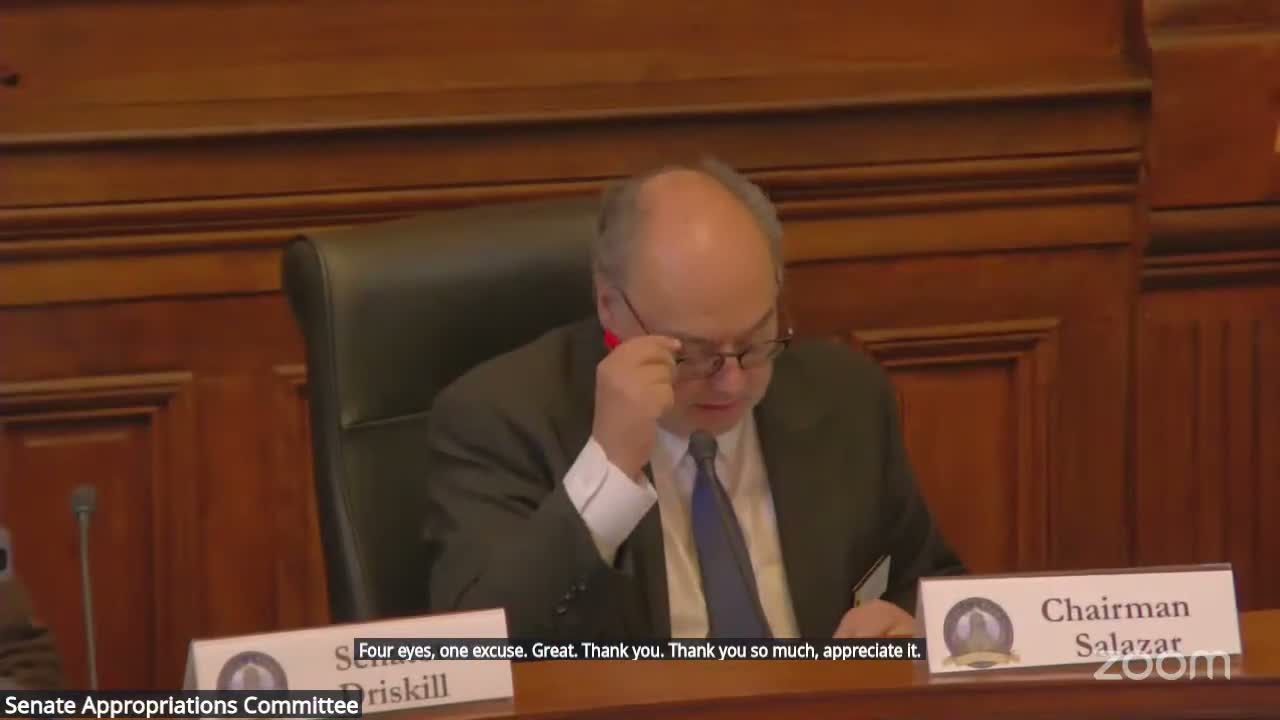
The Senate Appropriations Committee on Feb. 14 recommended passage of Senate File 32, a proposal to study Wyoming’s 9‑1‑1 system and provide $3,000,000 in grant funding to backfill deficits for local public safety answering points (PSAPs).
Nate Smolinski, YDOT chief technology officer and the statewide 9‑1‑1 coordinator, told the committee the measure would fund a $750,000 study and a separate $3,000,000 grant pool aimed only at deficit backfill. Smolinski said Wyoming currently has 33 PSAPs and that the revenue ceiling (75¢ per line) has not kept pace with rising technology and operating costs.
The study will examine funding models, expense drivers, governance, the appropriate number of PSAPs, and options for migrating to Next Generation 9‑1‑1. Smolinski emphasized that the $3,000,000 is not intended as a subsidy for migration to NG9‑1‑1, but rather to stabilize local operations while the state collects data needed to plan a transition.
Representatives from law enforcement and fire services including Alan Thompson (WASCOP) and Shad Cooper (Wyoming Fire Advisory Board) urged support, saying better data and transitional funding are needed to maintain service in low‑population areas. County and local officials—represented by Nick Agopian (Wyoming County Commissioners Association), Albany County Commissioner 'Fat Hoff' and Mayor Schrader of Buffalo—raised concerns about local capacity, tourism spikes that increase demand, and the infrastructure costs of moving from copper to data streams.
Committee members asked whether raising the fee ceiling or returning rate decisions to county commissioners would address shortfalls; Smolinski said the study will evaluate multiple funding options and neighboring states’ models but cautioned there is no single solution.
The clerk recorded a roll‑call vote: Senators Driscoll, French, Larson and Chairman Salazar voted Aye; one member was excused. The clerk announced the bill passed committee 4–0 with 1 excused.
If enacted, the bill would allow the state to better understand PSAP deficits and present policy options to lawmakers for both one‑time migration costs and ongoing funding models.
Nate Smolinski, YDOT chief technology officer and the statewide 9‑1‑1 coordinator, told the committee the measure would fund a $750,000 study and a separate $3,000,000 grant pool aimed only at deficit backfill. Smolinski said Wyoming currently has 33 PSAPs and that the revenue ceiling (75¢ per line) has not kept pace with rising technology and operating costs.
The study will examine funding models, expense drivers, governance, the appropriate number of PSAPs, and options for migrating to Next Generation 9‑1‑1. Smolinski emphasized that the $3,000,000 is not intended as a subsidy for migration to NG9‑1‑1, but rather to stabilize local operations while the state collects data needed to plan a transition.
Representatives from law enforcement and fire services including Alan Thompson (WASCOP) and Shad Cooper (Wyoming Fire Advisory Board) urged support, saying better data and transitional funding are needed to maintain service in low‑population areas. County and local officials—represented by Nick Agopian (Wyoming County Commissioners Association), Albany County Commissioner 'Fat Hoff' and Mayor Schrader of Buffalo—raised concerns about local capacity, tourism spikes that increase demand, and the infrastructure costs of moving from copper to data streams.
Committee members asked whether raising the fee ceiling or returning rate decisions to county commissioners would address shortfalls; Smolinski said the study will evaluate multiple funding options and neighboring states’ models but cautioned there is no single solution.
The clerk recorded a roll‑call vote: Senators Driscoll, French, Larson and Chairman Salazar voted Aye; one member was excused. The clerk announced the bill passed committee 4–0 with 1 excused.
If enacted, the bill would allow the state to better understand PSAP deficits and present policy options to lawmakers for both one‑time migration costs and ongoing funding models.
View the Full Meeting & All Its Details
This article offers just a summary. Unlock complete video, transcripts, and insights as a Founder Member.
✓
Watch full, unedited meeting videos
✓
Search every word spoken in unlimited transcripts
✓
AI summaries & real-time alerts (all government levels)
✓
Permanent access to expanding government content
30-day money-back guarantee
