Balcones Heights outlines phased plan for Wonderland of the Americas, eyes Opportunity Zone and infrastructure financing
February 13, 2026 | Balcones Heights, Bexar County, Texas
This article was created by AI summarizing key points discussed. AI makes mistakes, so for full details and context, please refer to the video of the full meeting. Please report any errors so we can fix them. Report an error »
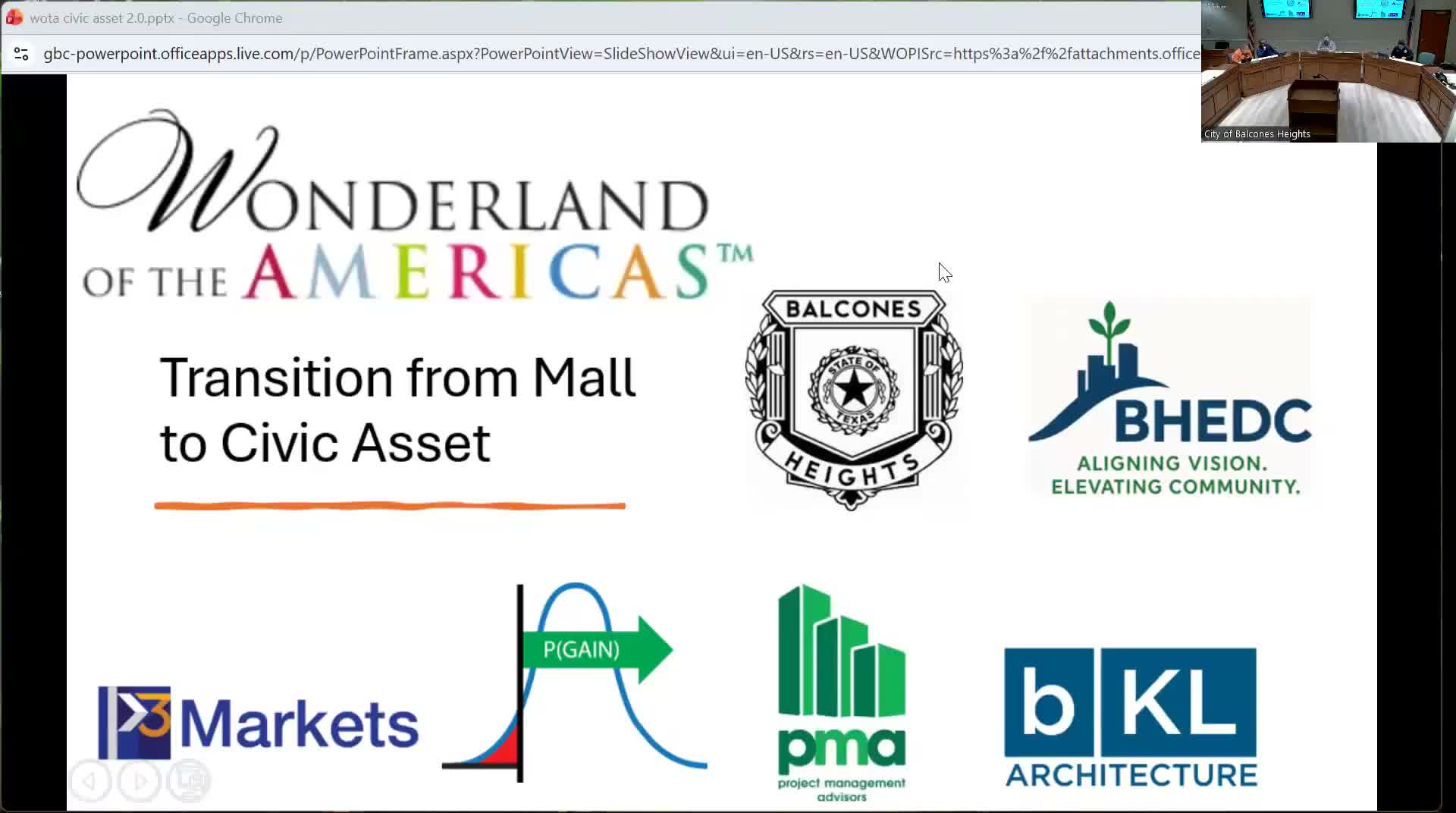
Balcones Heights Economic Development Corporation members on Feb. 13 heard a broad redevelopment proposal for Wonderland of the Americas that calls for a phased, publicly anchored mixed-use strategy aimed at stabilizing tenants, boosting sales and property tax revenue, and attracting private capital.
In a presentation summarized for the board, the chairman and staff said the conventional single-use mall model is no longer reliable and recommended converting parts of Wonderland into a mix of retail, medical, multifamily, civic uses and potentially higher education or transportation facilities. "Retail alone cannot carry the asset," the chairman said, urging a multi-party plan that "right size[s] all aspects of it" while seeking to avoid displacing long-standing tenants.
Why it matters: the city owns a 45.7% stake in the mall partnership, and officials framed redevelopment as a way to protect and grow a key source of sales and ad valorem tax revenue for the community. Presenters named potential partners and consultants (P3 Markets, PGANG, PMA, BKL) and said a longer, 30-minute presentation will be posted online for public review.
Officials also outlined two financing tools they intend to pursue. First, staff said Balcones Heights' census tract appears likely eligible for the federal Opportunity Zone program. The chairman described Opportunity Zone benefits: temporary deferral of capital gains tax, a step-down in taxable basis after five years, and potential tax-free gains on new appreciation after a 10-year holding period. "We intend to apply," the chairman said, noting governors nominate tracts and internal deadlines may require an earlier submission than the July 1 federal cutoff.
Second, the city has engaged Municap Public Finance to study an increment-financing district (referred to in the meeting as TERS/TIRS) around Wonderland to capture incremental tax revenue from the mall and immediate surrounding parcels for infrastructure: road work, sewer and internal circulation, sidewalks and signage. The chairman described the increment as a means to fund site stabilization and public improvements that would support phased redevelopment.
Staff emphasized priorities for any redevelopment: protect current tenants when possible, use predictable governance, align verified funding sources with vetted uses, and attract "partnerships, not predators." The presentation cited Highland Mall in Austin as an example of mixed-use reuse that accommodated institutional partners and catalyzed activity.
Next steps: staff and consultants will finalize studies and an expanded presentation for the public and governing bodies. Officials said they will pursue Opportunity Zone designation and continue work on the increment-financing analysis; specific financing details and timelines were not finalized during the meeting.
In a presentation summarized for the board, the chairman and staff said the conventional single-use mall model is no longer reliable and recommended converting parts of Wonderland into a mix of retail, medical, multifamily, civic uses and potentially higher education or transportation facilities. "Retail alone cannot carry the asset," the chairman said, urging a multi-party plan that "right size[s] all aspects of it" while seeking to avoid displacing long-standing tenants.
Why it matters: the city owns a 45.7% stake in the mall partnership, and officials framed redevelopment as a way to protect and grow a key source of sales and ad valorem tax revenue for the community. Presenters named potential partners and consultants (P3 Markets, PGANG, PMA, BKL) and said a longer, 30-minute presentation will be posted online for public review.
Officials also outlined two financing tools they intend to pursue. First, staff said Balcones Heights' census tract appears likely eligible for the federal Opportunity Zone program. The chairman described Opportunity Zone benefits: temporary deferral of capital gains tax, a step-down in taxable basis after five years, and potential tax-free gains on new appreciation after a 10-year holding period. "We intend to apply," the chairman said, noting governors nominate tracts and internal deadlines may require an earlier submission than the July 1 federal cutoff.
Second, the city has engaged Municap Public Finance to study an increment-financing district (referred to in the meeting as TERS/TIRS) around Wonderland to capture incremental tax revenue from the mall and immediate surrounding parcels for infrastructure: road work, sewer and internal circulation, sidewalks and signage. The chairman described the increment as a means to fund site stabilization and public improvements that would support phased redevelopment.
Staff emphasized priorities for any redevelopment: protect current tenants when possible, use predictable governance, align verified funding sources with vetted uses, and attract "partnerships, not predators." The presentation cited Highland Mall in Austin as an example of mixed-use reuse that accommodated institutional partners and catalyzed activity.
Next steps: staff and consultants will finalize studies and an expanded presentation for the public and governing bodies. Officials said they will pursue Opportunity Zone designation and continue work on the increment-financing analysis; specific financing details and timelines were not finalized during the meeting.
Don't Miss a Word: See the Full Meeting!
Go beyond summaries. Unlock every video, transcript, and key insight with a Founder Membership.
✓
Get instant access to full meeting videos
✓
Search and clip any phrase from complete transcripts
✓
Receive AI-powered summaries & custom alerts
✓
Enjoy lifetime, unrestricted access to government data
30-day money-back guarantee
