Senators hear that LERB review and layered process have narrowed Tier 1b eligible areas under Act 181
February 13, 2026 | Natural Resources & Energy, SENATE, Committees, Legislative , Vermont
This article was created by AI summarizing key points discussed. AI makes mistakes, so for full details and context, please refer to the video of the full meeting. Please report any errors so we can fix them. Report an error »
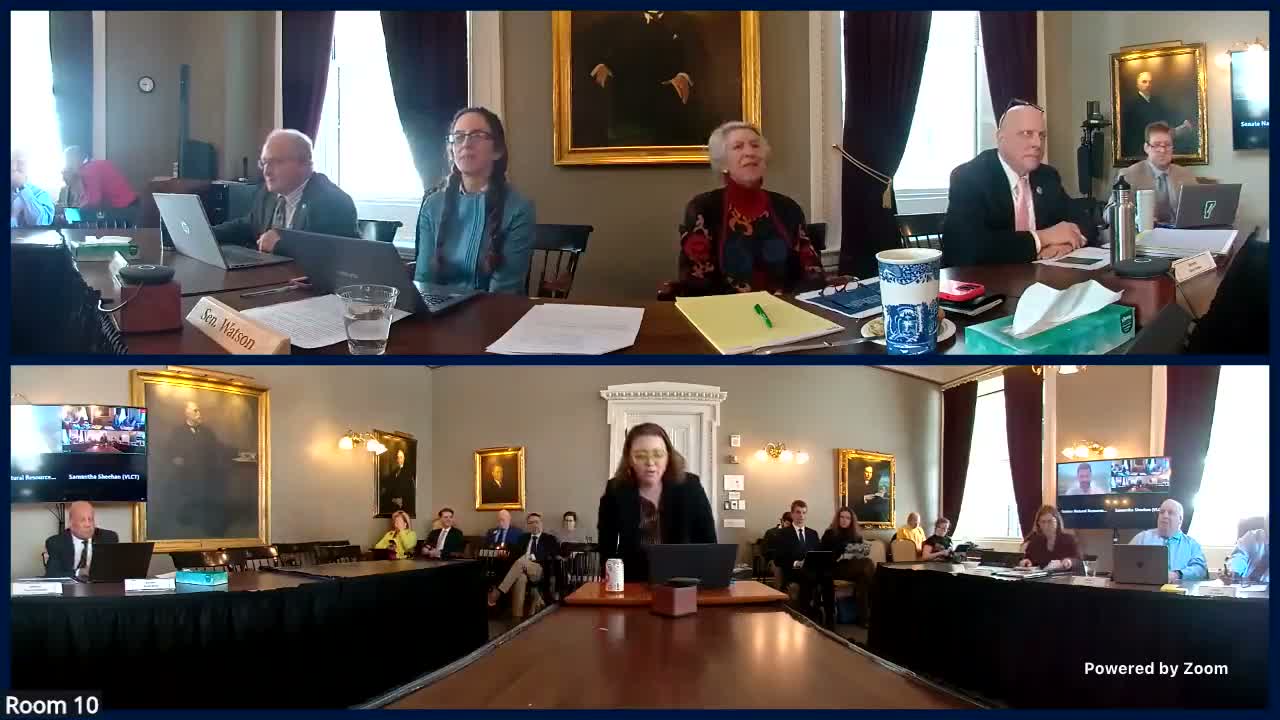
Samantha Sheehan, municipal policy and advocacy specialist for the Vermont League of Cities and Towns, told members of the Senate Committees on Natural Resources & Energy and on Economic Development, Housing and General Affairs that the multi-step process to create Tier 1b areas has, in practice, narrowed which places will qualify.
“For the record, I'm Samantha Sheehan, the municipal policy and advocacy specialist for the Vermont League of Cities and Towns,” Sheehan said. She outlined a sequence in which regional planning commissions map future land‑use areas, those maps go to LERB for a 60‑day review with public hearings and objections, and then maps return to RPCs and municipalities for adoption. “It's a lot of steps. Each step has public hearing, public comment,” she said.
The testimony described several sources of constriction. LERB reviewers, applying statutory tests and definitions drawn from Title 24, have interpreted ‘village area’ and related terms conservatively in some regions, Sheehan said, trimming areas that RPCs initially proposed. That conservatism has, in some cases, left municipalities with smaller Tier 1b‑eligible footprints than they expected in the pre‑application drafts.
Sheehan and committee members raised a second concern: the process is slow and administratively intensive. Witnesses urged an efficient mechanism to make minor map revisions without repeating the full, multistage process, arguing that small, local changes—property acquisitions, sewer projects, or conservation easements—should be reflected more nimbly.
The witnesses recommended two remedies: clearer statutory definitions so planners and LERB share a common understanding of terms like “traditional settlement area,” and an administrative amendment pathway to allow limited, noncontroversial map updates without restarting the entire approval sequence.
Committee members pressed for clarity about whether the layered review was intended to produce this level of contraction; one senator said the process was more bureaucratic than legislators expected when the law was drafted. Sheehan emphasized the public‑facing aspects of the process and the workload on RPCs and local planning commissions.
The committees did not take votes at the hearing. Witnesses were asked to provide further examples and to work with legislative staff on possible statutory clarifications.
“For the record, I'm Samantha Sheehan, the municipal policy and advocacy specialist for the Vermont League of Cities and Towns,” Sheehan said. She outlined a sequence in which regional planning commissions map future land‑use areas, those maps go to LERB for a 60‑day review with public hearings and objections, and then maps return to RPCs and municipalities for adoption. “It's a lot of steps. Each step has public hearing, public comment,” she said.
The testimony described several sources of constriction. LERB reviewers, applying statutory tests and definitions drawn from Title 24, have interpreted ‘village area’ and related terms conservatively in some regions, Sheehan said, trimming areas that RPCs initially proposed. That conservatism has, in some cases, left municipalities with smaller Tier 1b‑eligible footprints than they expected in the pre‑application drafts.
Sheehan and committee members raised a second concern: the process is slow and administratively intensive. Witnesses urged an efficient mechanism to make minor map revisions without repeating the full, multistage process, arguing that small, local changes—property acquisitions, sewer projects, or conservation easements—should be reflected more nimbly.
The witnesses recommended two remedies: clearer statutory definitions so planners and LERB share a common understanding of terms like “traditional settlement area,” and an administrative amendment pathway to allow limited, noncontroversial map updates without restarting the entire approval sequence.
Committee members pressed for clarity about whether the layered review was intended to produce this level of contraction; one senator said the process was more bureaucratic than legislators expected when the law was drafted. Sheehan emphasized the public‑facing aspects of the process and the workload on RPCs and local planning commissions.
The committees did not take votes at the hearing. Witnesses were asked to provide further examples and to work with legislative staff on possible statutory clarifications.
Don't Miss a Word: See the Full Meeting!
Go beyond summaries. Unlock every video, transcript, and key insight with a Founder Membership.
✓
Get instant access to full meeting videos
✓
Search and clip any phrase from complete transcripts
✓
Receive AI-powered summaries & custom alerts
✓
Enjoy lifetime, unrestricted access to government data
30-day money-back guarantee
