Conservation districts ask Vermont committee to build modest base funding to leverage federal grants
February 13, 2026 | Natural Resources & Energy, SENATE, Committees, Legislative , Vermont
This article was created by AI summarizing key points discussed. AI makes mistakes, so for full details and context, please refer to the video of the full meeting. Please report any errors so we can fix them. Report an error »
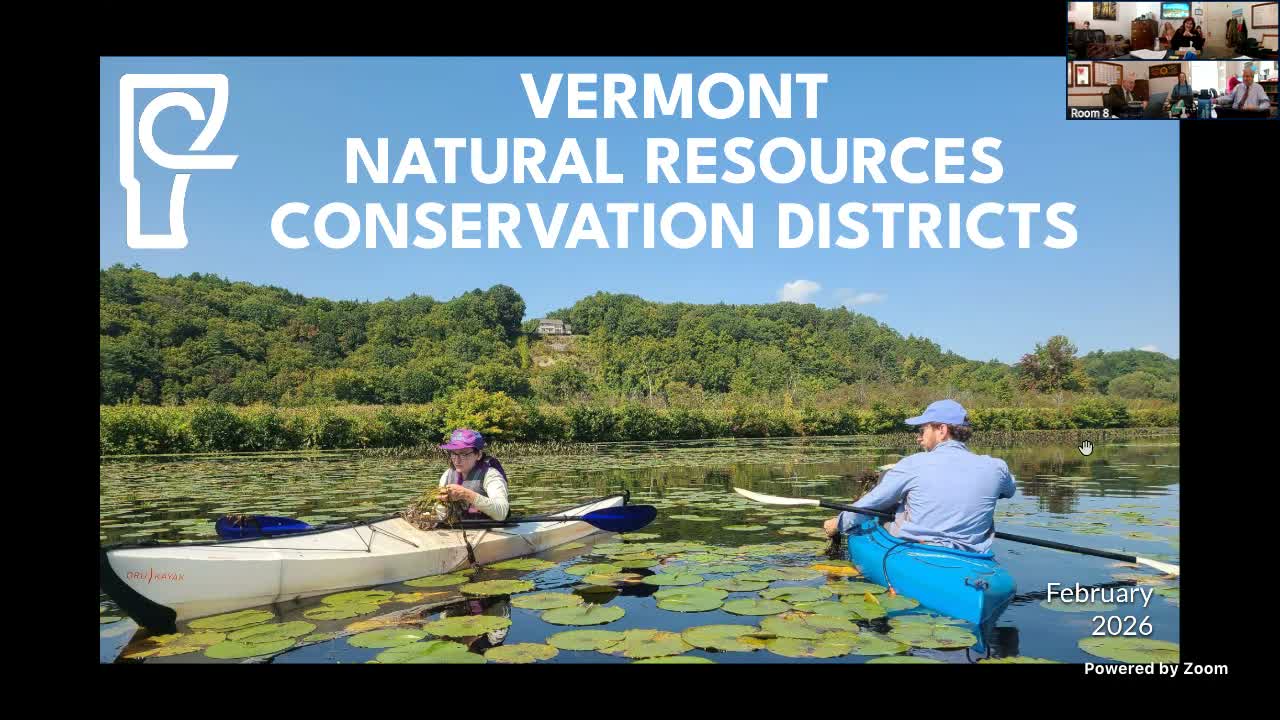
Michelle Munro, executive director of the Vermont Association of Conservation Districts, told the Natural Resources & Energy committee on Feb. 13 that the state’s 14 locally led conservation districts need a modest increase in flexible state funding to sustain staff and keep leveraging federal grants.
Munro said the districts are asking for $948,200 in total state support for the coming year; she described that figure as the overall funding request that includes the $612,000 the districts have received as base funding through the Agency of Agriculture plus a $250,000 one‑time appropriation they received this year and would like folded into an ongoing allocation. "This money that we receive from the state is the most flexible funding that we receive," Munro said, explaining that state dollars allow districts to cover staff time and to write grant applications that draw down federal dollars.
The testimony outlined how small state grants multiply into larger projects. Munro said conservation districts use base funding to match and administer federal and private grants and to support a range of projects: dam removals, wetland restoration, stormwater management, floodplain restoration and mechanical assistance to farms to comply with required agricultural practices. She said, for example, districts planted 29,422 stems statewide, restored 170 acres of wetland and treated invasive species on over five‑ten acres in the most recent fiscal year.
Laura (district manager for St. Albans) described a dam removal in Berkshire that the district funded largely with state dollars and supported with U.S. Fish and Wildlife Service monitoring; she also described a flood‑resilience study in Montgomery that used state and FEMA resources to model 50‑year flood inundation and identify priority mitigation projects. Munro said this year roughly $25,000,000 in NRCS funding is expected to flow into Vermont for locally identified conservation projects.
Committee members asked clarifying questions about whether the $948,200 is in addition to the $612,000 base; Munro answered that the request is to set the total at that level (i.e., incorporate the one‑time funding into the base and provide a modest increase to cover rising costs such as benefits). Members also pressed on how state dollars are distributed and emphasized that the districts’ ability to help small towns—many with limited staff—apply for FEMA and other federal funds is an important part of the districts’ role.
The testimony closed with Munro and other speakers urging the committee to support the request; witnesses stressed that reduced base funding would limit districts’ ability to support smaller but high‑impact projects and to act as local conveners that translate community priorities into funded conservation work.
The committee did not take a formal vote during the session; staff and committee members said they would follow up as budget deliberations continue.
Munro said the districts are asking for $948,200 in total state support for the coming year; she described that figure as the overall funding request that includes the $612,000 the districts have received as base funding through the Agency of Agriculture plus a $250,000 one‑time appropriation they received this year and would like folded into an ongoing allocation. "This money that we receive from the state is the most flexible funding that we receive," Munro said, explaining that state dollars allow districts to cover staff time and to write grant applications that draw down federal dollars.
The testimony outlined how small state grants multiply into larger projects. Munro said conservation districts use base funding to match and administer federal and private grants and to support a range of projects: dam removals, wetland restoration, stormwater management, floodplain restoration and mechanical assistance to farms to comply with required agricultural practices. She said, for example, districts planted 29,422 stems statewide, restored 170 acres of wetland and treated invasive species on over five‑ten acres in the most recent fiscal year.
Laura (district manager for St. Albans) described a dam removal in Berkshire that the district funded largely with state dollars and supported with U.S. Fish and Wildlife Service monitoring; she also described a flood‑resilience study in Montgomery that used state and FEMA resources to model 50‑year flood inundation and identify priority mitigation projects. Munro said this year roughly $25,000,000 in NRCS funding is expected to flow into Vermont for locally identified conservation projects.
Committee members asked clarifying questions about whether the $948,200 is in addition to the $612,000 base; Munro answered that the request is to set the total at that level (i.e., incorporate the one‑time funding into the base and provide a modest increase to cover rising costs such as benefits). Members also pressed on how state dollars are distributed and emphasized that the districts’ ability to help small towns—many with limited staff—apply for FEMA and other federal funds is an important part of the districts’ role.
The testimony closed with Munro and other speakers urging the committee to support the request; witnesses stressed that reduced base funding would limit districts’ ability to support smaller but high‑impact projects and to act as local conveners that translate community priorities into funded conservation work.
The committee did not take a formal vote during the session; staff and committee members said they would follow up as budget deliberations continue.
Don't Miss a Word: See the Full Meeting!
Go beyond summaries. Unlock every video, transcript, and key insight with a Founder Membership.
✓
Get instant access to full meeting videos
✓
Search and clip any phrase from complete transcripts
✓
Receive AI-powered summaries & custom alerts
✓
Enjoy lifetime, unrestricted access to government data
30-day money-back guarantee
