Committee backs bill to clarify impact-fee spending and service areas
February 13, 2026 | 2026 Utah Legislature, Utah Legislature, Utah Legislative Branch, Utah
This article was created by AI summarizing key points discussed. AI makes mistakes, so for full details and context, please refer to the video of the full meeting. Please report any errors so we can fix them. Report an error »
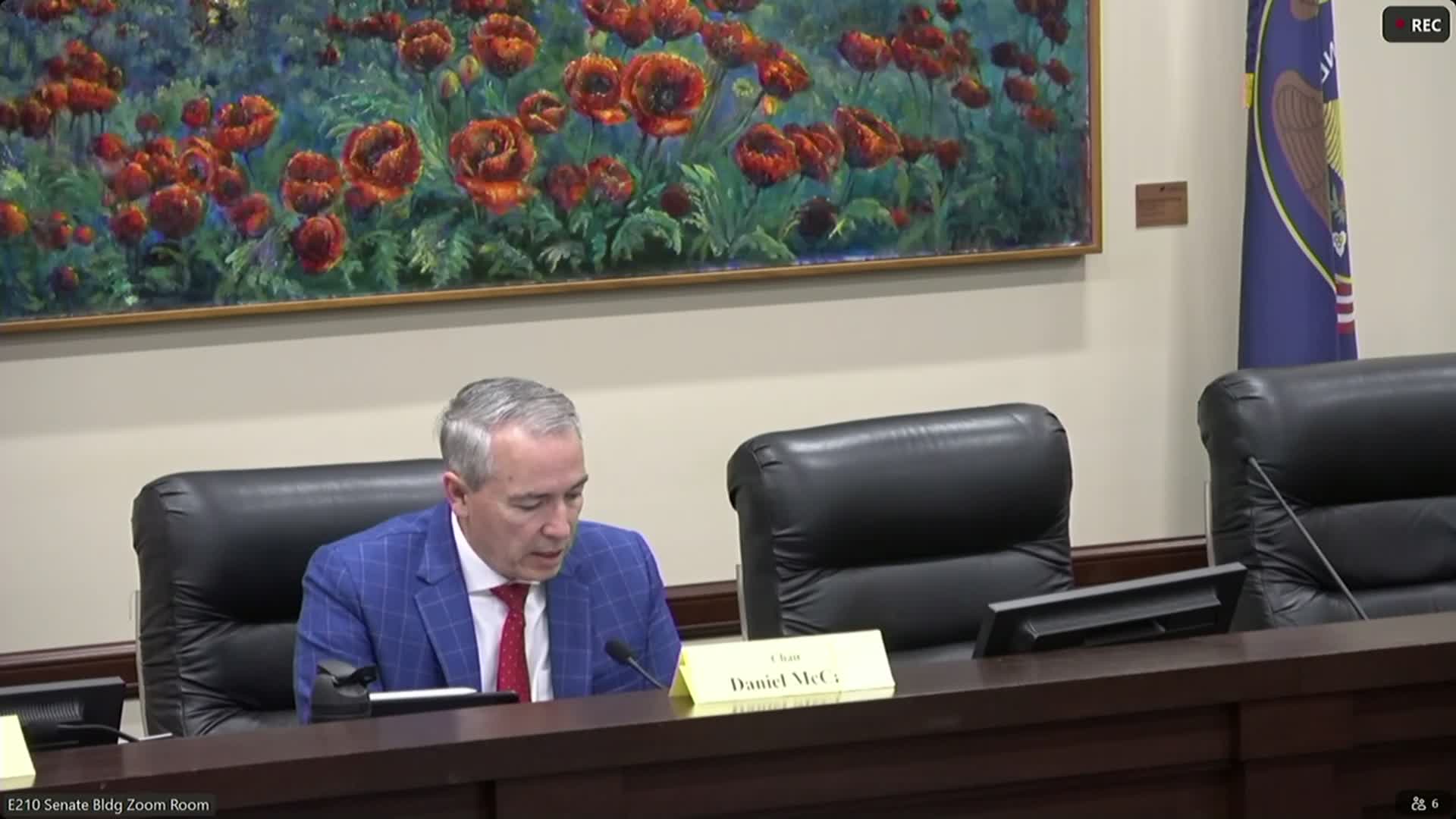
Senate Bill 245, which clarifies how municipalities may spend impact fees and tightens service-area definitions, won a unanimous committee recommendation Feb. 13.
Senator Musselman, sponsor of the bill, told the committee a recent district court ruling found ambiguity in state law about whether impact fee expenditures must be tied to the facilities plan in effect when fees were collected. "The court essentially said the legislature did not clearly limit expenditures to the plan in effect at the time of collection," he said, and the bill "aligns our statute with what the court already require[s]" by ensuring a clear geographic and proportional nexus between development and infrastructure funded by fees.
The bill also requires service areas be defined using planning and engineering principles rather than defaulting to an entire city. Musselman said the measure is not retroactive: "This does not change that framework at all... it simply clarifies that a recent district court ruling found ambiguity in our state regarding whether impact fees must be spent under the impact fee facilities plan that was in place when the fees was collected."
Committee members asked about a fiscal note that listed a $20,000 one-time 2026 cost for municipal impact-fee study revisions. The chair recommended the sponsor work with research staff to determine whether statutory update schedules for municipal studies might address that workload. Musselman said the amendment adopted at the committee's request likely mitigates retroactivity concerns and added he would follow up on timing questions.
Public commenters included Steven Price of Salt Lake City, who said experience in a local case showed fees collected on one side of the city were spent on improvements on another side, and Justin Lee of the Utah League of Cities and Towns, who said the sponsor's changes "alleviate our concerns" but urged flexibility in cases where an entire city could reasonably be a service area. Taz B. Singer of the Utah Home Builders Association said builders support the bill.
After adopting Amendment 1 clarifying nonretroactivity, the committee voted to recommend the bill favorably. The bill now moves to the next step in the legislative process.
Senator Musselman, sponsor of the bill, told the committee a recent district court ruling found ambiguity in state law about whether impact fee expenditures must be tied to the facilities plan in effect when fees were collected. "The court essentially said the legislature did not clearly limit expenditures to the plan in effect at the time of collection," he said, and the bill "aligns our statute with what the court already require[s]" by ensuring a clear geographic and proportional nexus between development and infrastructure funded by fees.
The bill also requires service areas be defined using planning and engineering principles rather than defaulting to an entire city. Musselman said the measure is not retroactive: "This does not change that framework at all... it simply clarifies that a recent district court ruling found ambiguity in our state regarding whether impact fees must be spent under the impact fee facilities plan that was in place when the fees was collected."
Committee members asked about a fiscal note that listed a $20,000 one-time 2026 cost for municipal impact-fee study revisions. The chair recommended the sponsor work with research staff to determine whether statutory update schedules for municipal studies might address that workload. Musselman said the amendment adopted at the committee's request likely mitigates retroactivity concerns and added he would follow up on timing questions.
Public commenters included Steven Price of Salt Lake City, who said experience in a local case showed fees collected on one side of the city were spent on improvements on another side, and Justin Lee of the Utah League of Cities and Towns, who said the sponsor's changes "alleviate our concerns" but urged flexibility in cases where an entire city could reasonably be a service area. Taz B. Singer of the Utah Home Builders Association said builders support the bill.
After adopting Amendment 1 clarifying nonretroactivity, the committee voted to recommend the bill favorably. The bill now moves to the next step in the legislative process.
Don't Miss a Word: See the Full Meeting!
Go beyond summaries. Unlock every video, transcript, and key insight with a Founder Membership.
✓
Get instant access to full meeting videos
✓
Search and clip any phrase from complete transcripts
✓
Receive AI-powered summaries & custom alerts
✓
Enjoy lifetime, unrestricted access to government data
30-day money-back guarantee
