House committee advances bill to curb feral swine, allow aerial predator control and shift fee authority
February 13, 2026 | 2026 Utah Legislature, Utah Legislature, Utah Legislative Branch, Utah
This article was created by AI summarizing key points discussed. AI makes mistakes, so for full details and context, please refer to the video of the full meeting. Please report any errors so we can fix them. Report an error »
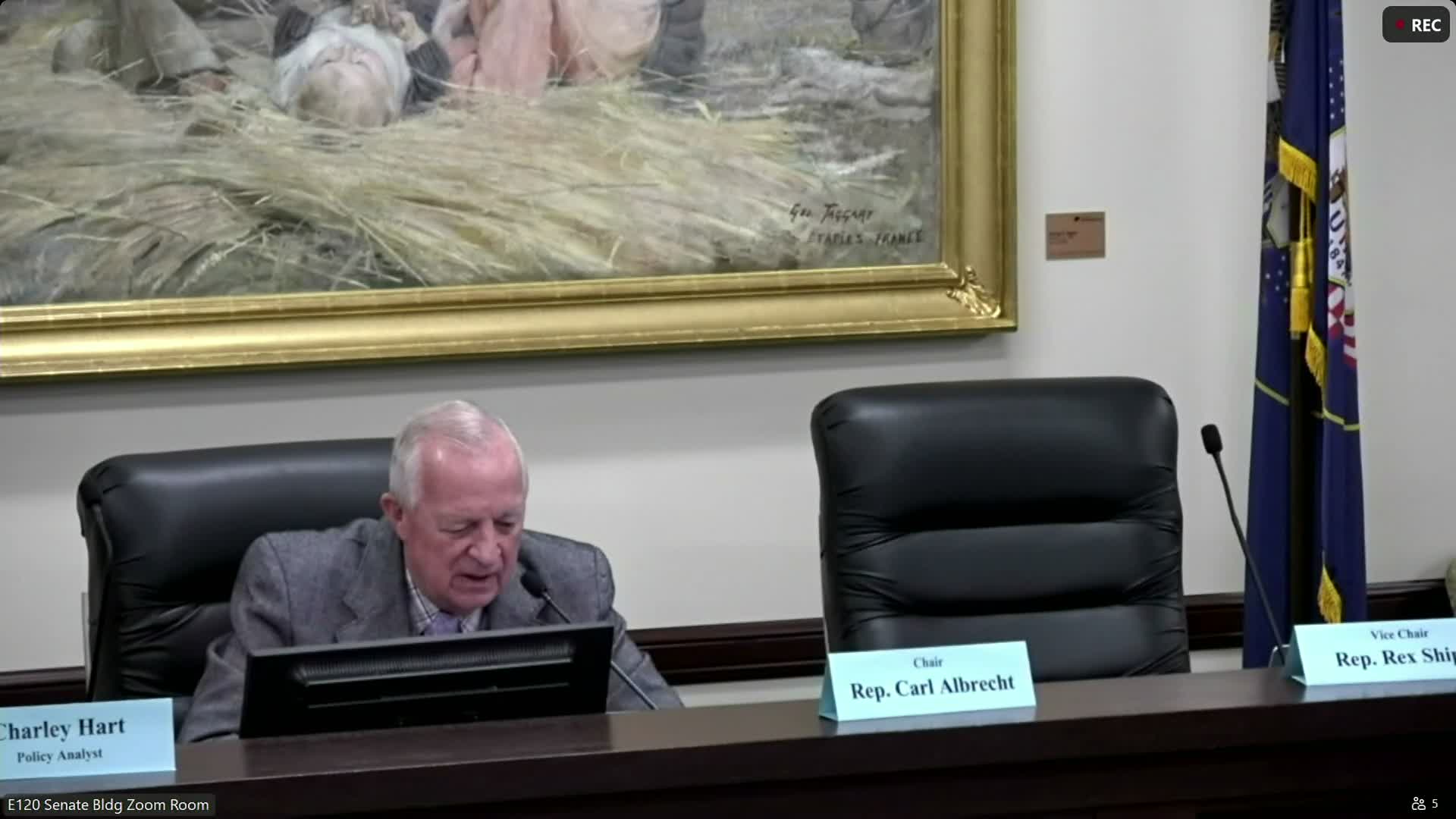
Representative Thomas Shipp introduced House Bill 326 (first substitute) on Friday, saying the measure responds to recent feral-swine introductions and would strengthen enforcement and penalties to halt agricultural and wildlife damage. "We need to eradicate these feral swine because they can cause significant damage to crops and and folks," Shipp said, explaining the bill would bar hunting of feral swine to avoid creating an incentive to import animals for sport.
The bill includes several central provisions: it escalates enforcement and penalties tied to feral-swine possession and transport (including probable-cause seizure and impound of vehicles, trailers and other items used to move animals), authorizes aerial permits for taking coyotes from aircraft on private lands or on state and federal grazing allotments with active grazing rights, and transfers predator-control fee-setting authority to the agricultural and wildlife damage prevention board. Under the bill, proceeds from public sale of impounded vehicles would be directed to depredation-control efforts, and permittees and pilots would assume liability for injuries or damages arising from aerial hunting.
Troy Forrest, deputy commissioner at the Utah Department of Agriculture and Food, told the committee that UDAF has "removed about 30" feral pigs this year and that genetic testing conducted by wildlife services indicated the animals in southern Utah came from the Panhandle of Texas and the Panhandle of Oklahoma. "We found bait stations; they were intentionally transported," Forrest said, arguing the enhanced penalties are intended as a deterrent to transporting animals into Utah.
Justin Shannon of the Division of Wildlife Resources echoed that prohibition on hunting can be an effective early strategy. "When we've asked other states that have feral pigs what they would have done different, they all said we wish we would have banned hunting of feral pigs from the get go," Shannon said, noting that allowing hunting can create a monetary incentive to bring pigs into a state.
Several agriculture and producer groups voiced support during public comment. Wade Garrett of the Utah Farm Bureau, Brett Selman of the Utah Wool Growers, Michael Larson of the Utah Association of Conservation Districts, Sierra Nelson (Utah Wool Growers Association) and Matt Anderson (Utah Sportsman's Caucus) each urged the committee to advance the bill, citing potential environmental and economic damage from feral pigs and the need for consistent fee authority and coordination among agencies.
Representative Arthur moved to adopt Amendment 1 to the first substitute to clarify wording in the bill; the committee adopted the amendment by voice vote. The committee then voted to pass HB 326 out favorably as amended; the chair announced the motion passed unanimously. The transcript does not record a roll-call tally.
The bill now advances from committee; the next procedural steps are placement on the calendar and consideration by the full House. The committee did not take additional votes (such as amendments that changed substantive policy) beyond the clarifying amendment that was adopted.
The bill includes several central provisions: it escalates enforcement and penalties tied to feral-swine possession and transport (including probable-cause seizure and impound of vehicles, trailers and other items used to move animals), authorizes aerial permits for taking coyotes from aircraft on private lands or on state and federal grazing allotments with active grazing rights, and transfers predator-control fee-setting authority to the agricultural and wildlife damage prevention board. Under the bill, proceeds from public sale of impounded vehicles would be directed to depredation-control efforts, and permittees and pilots would assume liability for injuries or damages arising from aerial hunting.
Troy Forrest, deputy commissioner at the Utah Department of Agriculture and Food, told the committee that UDAF has "removed about 30" feral pigs this year and that genetic testing conducted by wildlife services indicated the animals in southern Utah came from the Panhandle of Texas and the Panhandle of Oklahoma. "We found bait stations; they were intentionally transported," Forrest said, arguing the enhanced penalties are intended as a deterrent to transporting animals into Utah.
Justin Shannon of the Division of Wildlife Resources echoed that prohibition on hunting can be an effective early strategy. "When we've asked other states that have feral pigs what they would have done different, they all said we wish we would have banned hunting of feral pigs from the get go," Shannon said, noting that allowing hunting can create a monetary incentive to bring pigs into a state.
Several agriculture and producer groups voiced support during public comment. Wade Garrett of the Utah Farm Bureau, Brett Selman of the Utah Wool Growers, Michael Larson of the Utah Association of Conservation Districts, Sierra Nelson (Utah Wool Growers Association) and Matt Anderson (Utah Sportsman's Caucus) each urged the committee to advance the bill, citing potential environmental and economic damage from feral pigs and the need for consistent fee authority and coordination among agencies.
Representative Arthur moved to adopt Amendment 1 to the first substitute to clarify wording in the bill; the committee adopted the amendment by voice vote. The committee then voted to pass HB 326 out favorably as amended; the chair announced the motion passed unanimously. The transcript does not record a roll-call tally.
The bill now advances from committee; the next procedural steps are placement on the calendar and consideration by the full House. The committee did not take additional votes (such as amendments that changed substantive policy) beyond the clarifying amendment that was adopted.
Don't Miss a Word: See the Full Meeting!
Go beyond summaries. Unlock every video, transcript, and key insight with a Founder Membership.
✓
Get instant access to full meeting videos
✓
Search and clip any phrase from complete transcripts
✓
Receive AI-powered summaries & custom alerts
✓
Enjoy lifetime, unrestricted access to government data
30-day money-back guarantee
