Committee advances bill to raise cigarette tax and retax nicotine pouches after long debate
February 13, 2026 | 2026 Utah Legislature, Utah Legislature, Utah Legislative Branch, Utah
This article was created by AI summarizing key points discussed. AI makes mistakes, so for full details and context, please refer to the video of the full meeting. Please report any errors so we can fix them. Report an error »
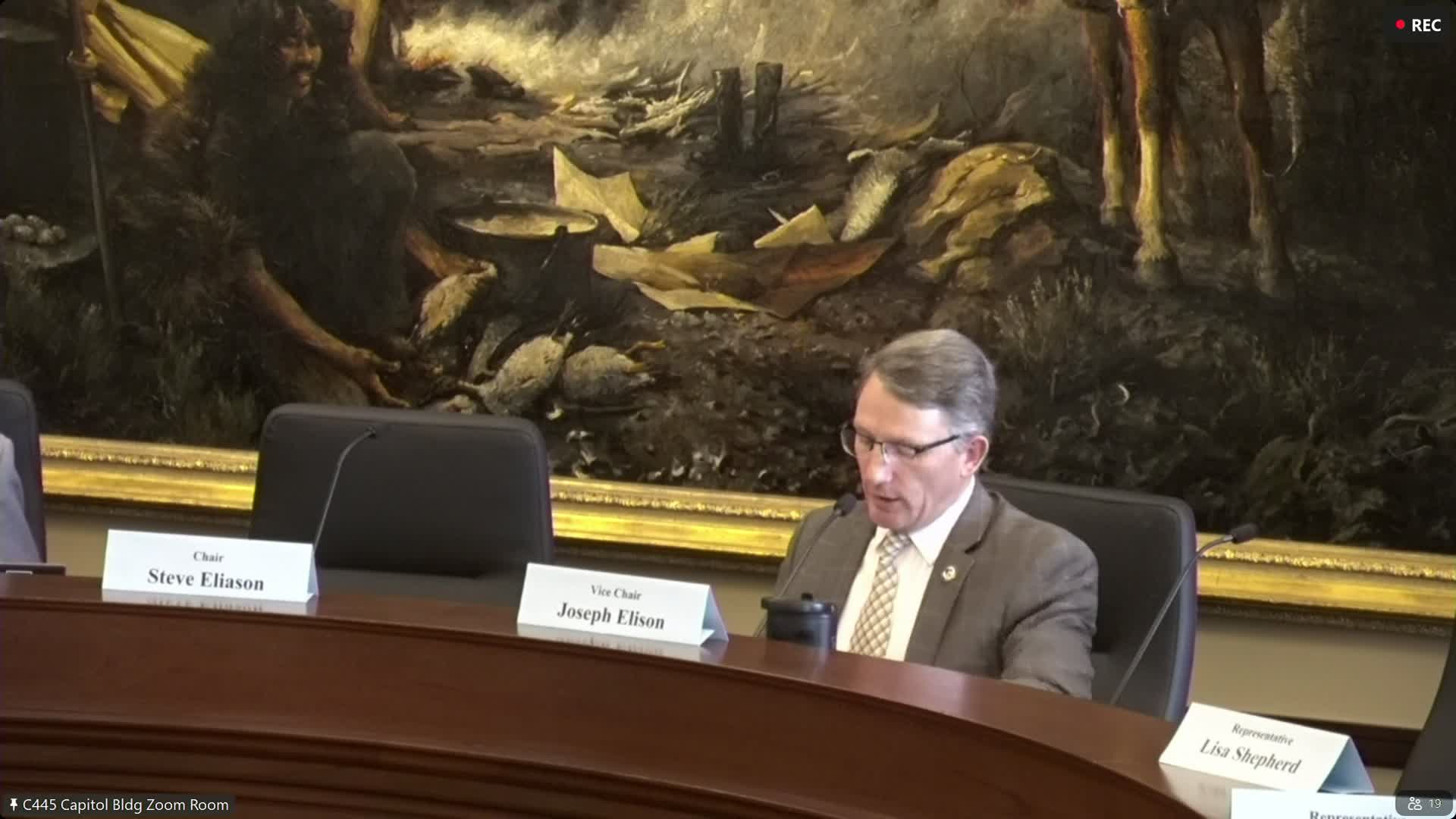
Representative Clancy asked the House Revenue and Taxation Committee to update Utah's tobacco tax structure, arguing the state has not adjusted the cigarette tax in 16 years and nicotine pouches are currently taxed in a way that creates a loophole for inexpensive youth-targeted products.
Clancy told the committee the bill ''does two things'': raise the cigarette tax (expressed in public discussion as a $2-per-pack equivalent in statute by cents-per-stick) and reclassify nicotine pouches so they are taxed as price-based alternative nicotine products instead of by weight.
The sponsor framed the measure as a public-health and revenue-action package aimed at reducing youth use and funding prevention.
Public-health advocates and former lawmakers urged the committee to act. Art Brown, who testified on behalf of youth-prevention efforts, emphasized reductions in youth vaping since earlier legislation and said funding must be preserved: ''We need those accounts to go back up'' so prevention and enforcement can continue. Former Representative Paul Ray cited federal data and state estimates, saying ''about 1,300 Utahns die each year from smoking'' and arguing taxation has historically reduced use.
Retailers and taxpayer groups urged caution on the proposed rates. Dave Davis, president of the Utah Retail Merchants Association, said the committee should avoid becoming an outlier regionally and warned of cross-border and online sales that could harm Utah businesses. The Utah Taxpayers Association estimated an offsetting fiscal-note increase of roughly $45 million to the general fund and urged lawmakers to be clear about how new revenue would be used.
Industry representatives, including PMI US, warned the bill would significantly raise the price of smoke-free alternatives and could discourage smokers from switching to lower-risk products. James Curry of PMI told the panel that ''tax rates should reflect relative risk'' and cautioned against raising prices on modified-risk products that have FDA review and monitoring requirements.
Committee members pressed the sponsor for data and math. Clancy and other presenters cited the SHARP survey for state youth-use estimates (e.g., nicotine-pouch use among twelfth graders reported at about 4.8% and an aggregate 3.1% across grades 6/8/10/12 in the survey as presented). The sponsor also showed an example calculation that an 86%-of-manufacturer-price tax on a $5.75 pack would add roughly $1.30 per can under the proposed structure.
After extended debate about negotiating a politically acceptable rate versus signaling strong action by advancing the bill, Representative Provo moved to adopt the first substitute and later moved that the committee pass HB337 (first substitute) out favorably. The committee adopted the substitute in committee and then voted to pass the substitute out favorably 9-2 (Representatives Strong and Coeffort were recorded opposed).
Next steps: HB337 advances with a committee recommendation for further consideration on the House floor; the sponsor said she will continue discussions with industry, retailers and public-health advocates to narrow rates and earmark language as the bill moves forward.
Clancy told the committee the bill ''does two things'': raise the cigarette tax (expressed in public discussion as a $2-per-pack equivalent in statute by cents-per-stick) and reclassify nicotine pouches so they are taxed as price-based alternative nicotine products instead of by weight.
The sponsor framed the measure as a public-health and revenue-action package aimed at reducing youth use and funding prevention.
Public-health advocates and former lawmakers urged the committee to act. Art Brown, who testified on behalf of youth-prevention efforts, emphasized reductions in youth vaping since earlier legislation and said funding must be preserved: ''We need those accounts to go back up'' so prevention and enforcement can continue. Former Representative Paul Ray cited federal data and state estimates, saying ''about 1,300 Utahns die each year from smoking'' and arguing taxation has historically reduced use.
Retailers and taxpayer groups urged caution on the proposed rates. Dave Davis, president of the Utah Retail Merchants Association, said the committee should avoid becoming an outlier regionally and warned of cross-border and online sales that could harm Utah businesses. The Utah Taxpayers Association estimated an offsetting fiscal-note increase of roughly $45 million to the general fund and urged lawmakers to be clear about how new revenue would be used.
Industry representatives, including PMI US, warned the bill would significantly raise the price of smoke-free alternatives and could discourage smokers from switching to lower-risk products. James Curry of PMI told the panel that ''tax rates should reflect relative risk'' and cautioned against raising prices on modified-risk products that have FDA review and monitoring requirements.
Committee members pressed the sponsor for data and math. Clancy and other presenters cited the SHARP survey for state youth-use estimates (e.g., nicotine-pouch use among twelfth graders reported at about 4.8% and an aggregate 3.1% across grades 6/8/10/12 in the survey as presented). The sponsor also showed an example calculation that an 86%-of-manufacturer-price tax on a $5.75 pack would add roughly $1.30 per can under the proposed structure.
After extended debate about negotiating a politically acceptable rate versus signaling strong action by advancing the bill, Representative Provo moved to adopt the first substitute and later moved that the committee pass HB337 (first substitute) out favorably. The committee adopted the substitute in committee and then voted to pass the substitute out favorably 9-2 (Representatives Strong and Coeffort were recorded opposed).
Next steps: HB337 advances with a committee recommendation for further consideration on the House floor; the sponsor said she will continue discussions with industry, retailers and public-health advocates to narrow rates and earmark language as the bill moves forward.
Don't Miss a Word: See the Full Meeting!
Go beyond summaries. Unlock every video, transcript, and key insight with a Founder Membership.
✓
Get instant access to full meeting videos
✓
Search and clip any phrase from complete transcripts
✓
Receive AI-powered summaries & custom alerts
✓
Enjoy lifetime, unrestricted access to government data
30-day money-back guarantee
