Fairport administrators outline budget revenues, tax‑cap mechanics and May 19 vote
February 13, 2026 | FAIRPORT CENTRAL SCHOOL DISTRICT, School Districts, New York
This article was created by AI summarizing key points discussed. AI makes mistakes, so for full details and context, please refer to the video of the full meeting. Please report any errors so we can fix them. Report an error »
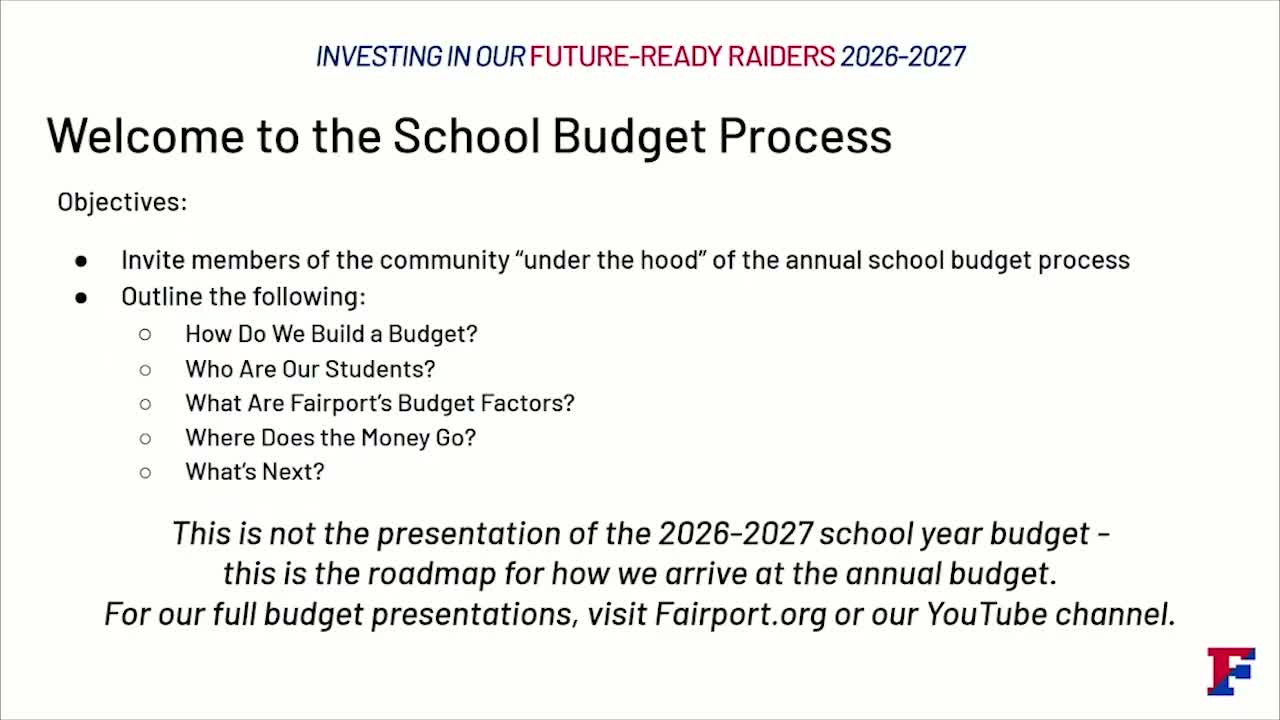
Brett Formanzano, superintendent of the Fairport Central School District, opened the district’s "Under the Hood" budget briefing, saying the session was intended to explain how the district builds its annual budget rather than present the final 2627 budget.
Jeremy Nardone, assistant superintendent for business and operations, summarized the district’s revenue mix: property taxes and payments in lieu of taxes (PILOTs) account for roughly 55 percent of the budget, state aid about 33 percent, Monroe County sales tax distributions about 4 percent and the remainder comes from federal grants, tuition, rentals, admissions, interest earnings and interfund transfers. Nardone said the district also uses fund balance and reserves (about 6 percent) to balance yearly budgets.
Nardone spent the bulk of the presentation explaining the tax‑cap formula that guides allowable levy growth. He said the commonly quoted “2 percent tax cap” is only one input (a measure tied to inflation/CPI); the formula also accounts for PILOTs, tax base growth, capital and court order exclusions and specific debt or pension exclusions when applicable. Using a recent example, he showed the district’s prior levy of $87,700,000, applied Perinton’s tax base growth factor and other adjustments to reach a new levy; Fairport went out last year at a 2.98 percent levy increase, Nardone said, noting that a levy above the formula requires a 60 percent supermajority while staying at or below it requires a simple majority (50% + 1).
Nardone also described how the district projects state aid: foundation aid is the largest unrestricted state aid category and other expense‑driven aids (transportation, BOCES, building aid and instructional materials) change with eligible expenditures and enrollment. He noted the governor’s budget proposal then under discussion would include a 1 percent minimum increase in foundation aid (about $326,000 for Fairport) and a proposed raise in UPK aid to $10,000 per pupil (Fairport currently receives about $5,233 per UPK pupil); both items remain proposals until the governor’s final budget in April/May.
On one‑time federal funding, Nardone said emergency ARP/CRRSA dollars significantly increased federal revenues for several years after COVID but those funds are phasing out and federal aid is expected to return toward pre‑pandemic levels, with the possible exception of increased state support for school lunch.
The presentation emphasized public engagement and schedule: the non‑instructional budget review continues in February, instructional budget work is scheduled for March, a board recommendation is expected in April and the district’s budget vote is set for May 19 at Joanna Perrin Middle School. Formanzano directed viewers to fairport.org and the district YouTube channel for full slide decks and invited feedback via a posted link or email.
Jeremy Nardone, assistant superintendent for business and operations, summarized the district’s revenue mix: property taxes and payments in lieu of taxes (PILOTs) account for roughly 55 percent of the budget, state aid about 33 percent, Monroe County sales tax distributions about 4 percent and the remainder comes from federal grants, tuition, rentals, admissions, interest earnings and interfund transfers. Nardone said the district also uses fund balance and reserves (about 6 percent) to balance yearly budgets.
Nardone spent the bulk of the presentation explaining the tax‑cap formula that guides allowable levy growth. He said the commonly quoted “2 percent tax cap” is only one input (a measure tied to inflation/CPI); the formula also accounts for PILOTs, tax base growth, capital and court order exclusions and specific debt or pension exclusions when applicable. Using a recent example, he showed the district’s prior levy of $87,700,000, applied Perinton’s tax base growth factor and other adjustments to reach a new levy; Fairport went out last year at a 2.98 percent levy increase, Nardone said, noting that a levy above the formula requires a 60 percent supermajority while staying at or below it requires a simple majority (50% + 1).
Nardone also described how the district projects state aid: foundation aid is the largest unrestricted state aid category and other expense‑driven aids (transportation, BOCES, building aid and instructional materials) change with eligible expenditures and enrollment. He noted the governor’s budget proposal then under discussion would include a 1 percent minimum increase in foundation aid (about $326,000 for Fairport) and a proposed raise in UPK aid to $10,000 per pupil (Fairport currently receives about $5,233 per UPK pupil); both items remain proposals until the governor’s final budget in April/May.
On one‑time federal funding, Nardone said emergency ARP/CRRSA dollars significantly increased federal revenues for several years after COVID but those funds are phasing out and federal aid is expected to return toward pre‑pandemic levels, with the possible exception of increased state support for school lunch.
The presentation emphasized public engagement and schedule: the non‑instructional budget review continues in February, instructional budget work is scheduled for March, a board recommendation is expected in April and the district’s budget vote is set for May 19 at Joanna Perrin Middle School. Formanzano directed viewers to fairport.org and the district YouTube channel for full slide decks and invited feedback via a posted link or email.
View the Full Meeting & All Its Details
This article offers just a summary. Unlock complete video, transcripts, and insights as a Founder Member.
✓
Watch full, unedited meeting videos
✓
Search every word spoken in unlimited transcripts
✓
AI summaries & real-time alerts (all government levels)
✓
Permanent access to expanding government content
30-day money-back guarantee
