Advisory committee wrestles with scope and enforcement of state-mandated cell-phone policy
February 13, 2026 | North Kingstown, School Districts, Rhode Island
This article was created by AI summarizing key points discussed. AI makes mistakes, so for full details and context, please refer to the video of the full meeting. Please report any errors so we can fix them. Report an error »
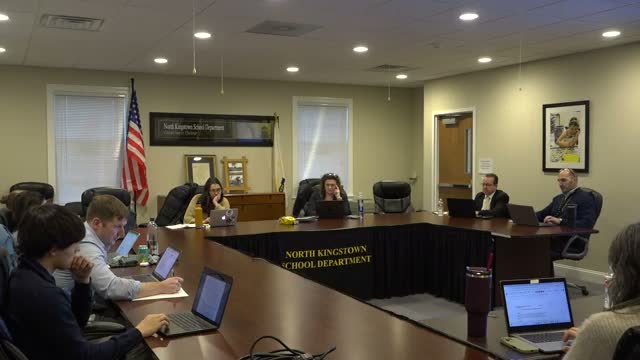
The North Kingstown Policy Advisory Committee spent the bulk of its Feb. 12 meeting drafting a district policy to comply with a state law that requires public-school systems to adopt rules limiting student access to personal electronic devices by Sept. 2026. Assistant Superintendent Rob Esenadi told the committee the drafting group included administrators, teachers, students and parents, and that the group favored a policy setting core expectations while leaving enforcement details to building handbooks.
Committee members debated several core issues: whether the prohibition should apply only during "instructional minutes" (the Department of Education definition discussed by counsel) or "bell-to-bell" for the full school day; whether buses and off-site school-sponsored activities (field trips, pep rallies) should be included; and how to treat medical, IEP and multilingual-learner (MLL) exceptions. Attorney Andrew Ennias read statute language about penalties and emphasized the need to reference statutory text in the draft.
Members discussed practical enforcement tools (lockers, Yonder charging pouches and pilot locking devices), the distinction between school-managed devices such as Chromebooks (which are covered by the district's responsible-use policies) and students' personal devices, and potential consequences. The committee agreed not to include out-of-school suspensions for PED violations in district policy and to add explicit references to IEP/medical/MLL exceptions as required by law. Rob Esenadi was asked to prepare a cleaned-up draft that includes statutory citations, clear definitions of "school day" and "school-sponsored activities," and recommended handbook-level progressive consequences for administrators to apply.
The committee will reconvene to continue edits; no final district-level prohibition was adopted at the meeting.
Committee members debated several core issues: whether the prohibition should apply only during "instructional minutes" (the Department of Education definition discussed by counsel) or "bell-to-bell" for the full school day; whether buses and off-site school-sponsored activities (field trips, pep rallies) should be included; and how to treat medical, IEP and multilingual-learner (MLL) exceptions. Attorney Andrew Ennias read statute language about penalties and emphasized the need to reference statutory text in the draft.
Members discussed practical enforcement tools (lockers, Yonder charging pouches and pilot locking devices), the distinction between school-managed devices such as Chromebooks (which are covered by the district's responsible-use policies) and students' personal devices, and potential consequences. The committee agreed not to include out-of-school suspensions for PED violations in district policy and to add explicit references to IEP/medical/MLL exceptions as required by law. Rob Esenadi was asked to prepare a cleaned-up draft that includes statutory citations, clear definitions of "school day" and "school-sponsored activities," and recommended handbook-level progressive consequences for administrators to apply.
The committee will reconvene to continue edits; no final district-level prohibition was adopted at the meeting.
Don't Miss a Word: See the Full Meeting!
Go beyond summaries. Unlock every video, transcript, and key insight with a Founder Membership.
✓
Get instant access to full meeting videos
✓
Search and clip any phrase from complete transcripts
✓
Receive AI-powered summaries & custom alerts
✓
Enjoy lifetime, unrestricted access to government data
30-day money-back guarantee
