Senate advances H.790 budget-adjustment bill with targeted funding and negotiated DA payment reform
February 13, 2026 | SENATE, Committees, Legislative , Vermont
This article was created by AI summarizing key points discussed. AI makes mistakes, so for full details and context, please refer to the video of the full meeting. Please report any errors so we can fix them. Report an error »
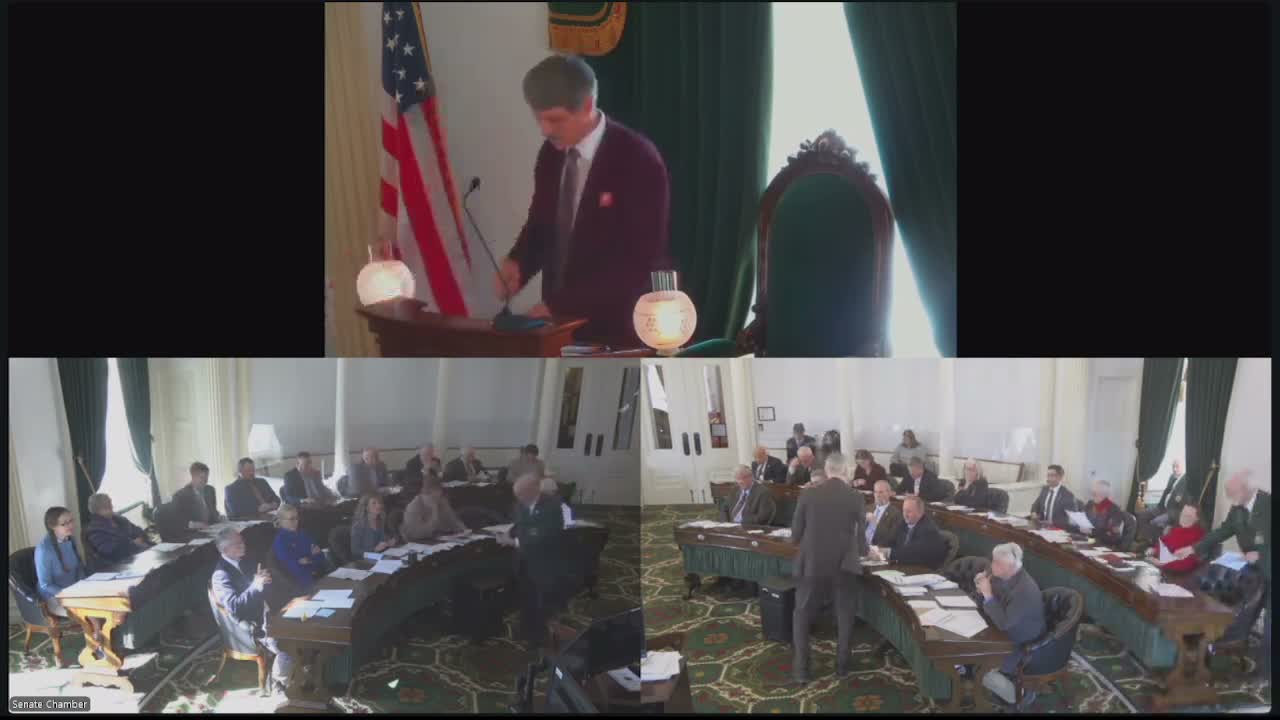
The Vermont Senate on Feb. 14 approved committee amendments to H.790, the Fiscal Year 2026 Budget Adjustment Act, moving the measure closer to final action while leaving several technical and policy questions for a conference committee.
Senator Perchlick, the committee reporter, told the chamber the bill adjusts previously enacted spending based on new facts and revenue changes. "So the whole budget is that $9,100,000,000," she said, and the committee is proposing roughly $2,850,000,000 in general-fund adjustments embedded in that total. The proposal includes a mix of operational and one-time appropriations, technical transfers and policy-directed language.
Why it matters: the bill moves money for pressing needs—public safety overtime, nursing-home relief and mental-health payments—while preserving emergency reserves and leaving some contested issues for further negotiation. Perchlick said examples include $870,000 to cover state police overtime, $14,000,000 in global-commitment aid to support nursing homes and a $3,400,000 reallocation from the general fund into a pilot special fund (B139/section 51) to support grand-list reappraisals.
Key policy and technical items
- Designated-agency payment reform (section 83): The bill changes how certain mental-health and community providers are paid for one year, increasing upfront payments to 65% (up from an administration proposal of 40%) with later reconciliation. Perchlick said the language was negotiated with designated agencies and committee stakeholders.
- Reporting deadline for designated agencies: During questioning, the senator from Addison highlighted a provision that requires designated agencies to deliver "comprehensive, financial, data" by 03/15/2026. The senator called the 30-day turnaround "concerning." Perchlick responded that recipients "won't be a surprise" to receive the request and that the date can be revisited in conference committee if necessary.
- Housing assistance and section 8 vouchers (sections 78–79): The bill preserves a $50,000,000 contingency reserve set last year; roughly $6.6 million was used for a SNAP payment during a federal lapse, leaving about $43.2 million for extraordinary needs. The House had earmarked $5,000,000 for additional Section 8 vouchers; the Senate left that language in but signaled it may seek additional information from the Vermont Housing Authority and legal counsel about the timing and federal implications before committing the funds.
- Other appropriations and technical corrections: The bill includes a range of smaller changes described by Perchlick — $390,000 for traveling nurses at the state hospital, $2,700,000 for Vermont Health Connect migration, corrections to recovery-center payments to reflect a formula rather than flat grants, and transfers tied to sports wagering and liquor-control receipts.
Questions raised on the floor
Senators asked for clarifications that Perchlick said she would provide on third reading or in conference committee: the distribution of state police overtime (the reporter said the $870,000 is a statewide appropriation), the fiscal impact of an exemption for a hospital under section 84, and why a $570,000 information-technology contract appeared linked to an out-of-state vendor.
Procedural outcome and next steps
The Senate voted to propose the committee's amendment to the House by voice vote and then read H.790 a third time; a voice vote approved the bill's procedural steps in the Senate. Perchlick said the House is expected to seek a conference committee on portions that differ, and senators flagged the DA reporting deadline and housing-voucher language as likely conference items. The Appropriations Committee reported the bill by a 7–0–0 vote and noted 56 witnesses had offered testimony to the committee.
The bill will move to conference or be messaged to the House for further consideration; committee staff and members indicated they expect additional discussions and data in the coming week.
Senator Perchlick, the committee reporter, told the chamber the bill adjusts previously enacted spending based on new facts and revenue changes. "So the whole budget is that $9,100,000,000," she said, and the committee is proposing roughly $2,850,000,000 in general-fund adjustments embedded in that total. The proposal includes a mix of operational and one-time appropriations, technical transfers and policy-directed language.
Why it matters: the bill moves money for pressing needs—public safety overtime, nursing-home relief and mental-health payments—while preserving emergency reserves and leaving some contested issues for further negotiation. Perchlick said examples include $870,000 to cover state police overtime, $14,000,000 in global-commitment aid to support nursing homes and a $3,400,000 reallocation from the general fund into a pilot special fund (B139/section 51) to support grand-list reappraisals.
Key policy and technical items
- Designated-agency payment reform (section 83): The bill changes how certain mental-health and community providers are paid for one year, increasing upfront payments to 65% (up from an administration proposal of 40%) with later reconciliation. Perchlick said the language was negotiated with designated agencies and committee stakeholders.
- Reporting deadline for designated agencies: During questioning, the senator from Addison highlighted a provision that requires designated agencies to deliver "comprehensive, financial, data" by 03/15/2026. The senator called the 30-day turnaround "concerning." Perchlick responded that recipients "won't be a surprise" to receive the request and that the date can be revisited in conference committee if necessary.
- Housing assistance and section 8 vouchers (sections 78–79): The bill preserves a $50,000,000 contingency reserve set last year; roughly $6.6 million was used for a SNAP payment during a federal lapse, leaving about $43.2 million for extraordinary needs. The House had earmarked $5,000,000 for additional Section 8 vouchers; the Senate left that language in but signaled it may seek additional information from the Vermont Housing Authority and legal counsel about the timing and federal implications before committing the funds.
- Other appropriations and technical corrections: The bill includes a range of smaller changes described by Perchlick — $390,000 for traveling nurses at the state hospital, $2,700,000 for Vermont Health Connect migration, corrections to recovery-center payments to reflect a formula rather than flat grants, and transfers tied to sports wagering and liquor-control receipts.
Questions raised on the floor
Senators asked for clarifications that Perchlick said she would provide on third reading or in conference committee: the distribution of state police overtime (the reporter said the $870,000 is a statewide appropriation), the fiscal impact of an exemption for a hospital under section 84, and why a $570,000 information-technology contract appeared linked to an out-of-state vendor.
Procedural outcome and next steps
The Senate voted to propose the committee's amendment to the House by voice vote and then read H.790 a third time; a voice vote approved the bill's procedural steps in the Senate. Perchlick said the House is expected to seek a conference committee on portions that differ, and senators flagged the DA reporting deadline and housing-voucher language as likely conference items. The Appropriations Committee reported the bill by a 7–0–0 vote and noted 56 witnesses had offered testimony to the committee.
The bill will move to conference or be messaged to the House for further consideration; committee staff and members indicated they expect additional discussions and data in the coming week.
Don't Miss a Word: See the Full Meeting!
Go beyond summaries. Unlock every video, transcript, and key insight with a Founder Membership.
✓
Get instant access to full meeting videos
✓
Search and clip any phrase from complete transcripts
✓
Receive AI-powered summaries & custom alerts
✓
Enjoy lifetime, unrestricted access to government data
30-day money-back guarantee
