House Education committee reviews bill to end state-mandated PCB testing for older schools
February 13, 2026 | Education, HOUSE OF REPRESENTATIVES, Committees, Legislative , Vermont
This article was created by AI summarizing key points discussed. AI makes mistakes, so for full details and context, please refer to the video of the full meeting. Please report any errors so we can fix them. Report an error »
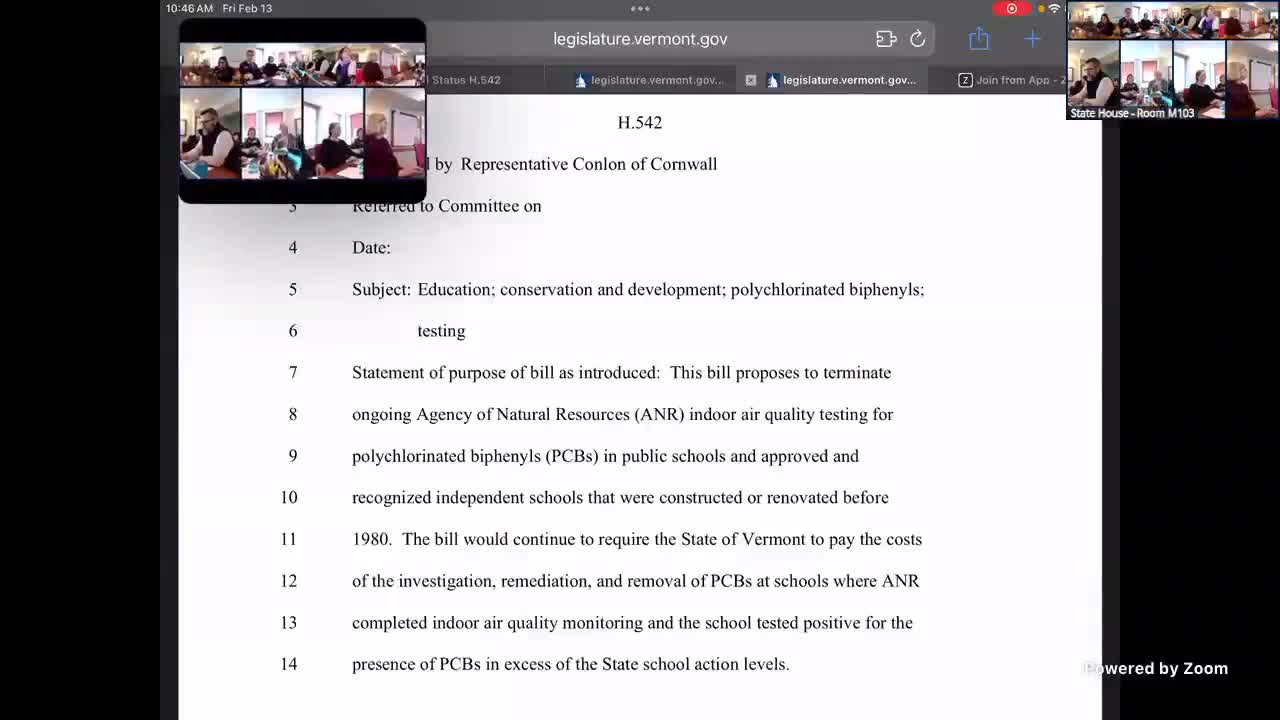
The Vermont House Education Committee on Feb. 13 reviewed H.542, a bill that would remove the states mandate requiring indoor-air PCB testing in public and independent schools constructed or renovated before 1980 while preserving state-funded cleanup obligations for schools that ANR already tested and found above state action levels.
Michael Grady of Legislative Council told the committee the 2021 law (Act 74 of 2021) initially required testing by 2024 and the deadline was later extended to 2027. "In 2021, you required all public schools, all independent schools to conduct PCB testing for air," Grady said, adding the legislature has since appropriated funds to the Agency of Natural Resources and the Agency of Education for that work. He said H.542 would "terminate any scheduled or ongoing testing for PCBs in public schools and approved and recognized schools" constructed or renovated before 1980, but would continue testing and remediation funding where ANR already detected PCBs above state action levels.
The bill would redirect remaining testing appropriations to pay for investigation, remediation and removal at schools already tested and found to exceed the states action levels. "The state, consistent with previously enacted law, shall pay for the cost of investigation, remediation, and removal of PCBs at the school," Grady said, while flagging that "the question is, do they have the money?" Committee discussion repeatedly returned to the financing question: Grady and members said roughly $4.5 million remains in related appropriations, but acknowledged that sum may not cover all liabilities.
Grady described ANRs alternative proposal, which would repeal the 2027 testing mandate but require PCB testing as part of future school capital-planning/master-plan processes and create a new special fund for remediation tied to capital projects. He noted ANRs language does not resolve how to address schools already tested and currently needing remediation.
Committee members asked about circumstances that trigger state responsibility. One member raised an example in which a school discovers PCBs while repairing a collapsed roof, asking whether such remediation would be state-funded. Grady replied that remediation arising from infrastructure failures that were not the product of the 2021 mandated indoor-air testing would not be paid from the PCB testing appropriations and that affected schools would seek capital-construction funding or other sources: "That wasn't a byproduct of the indoor air quality testing that you required in 2021," he said.
Committee members also discussed ongoing litigation. Grady said the states suit against the PCB manufacturer Monsanto is in discovery after the state prevailed on Monsantos motion to dismiss, with a phased trial currently scheduled for early 2027 involving claims tied to six schools and alleged discharges into Lake Champlain and the Oosuk River. He further told members that a pending private action involving about 90 plaintiffs is set for trial in September and that the Vermont Supreme Court in December affirmed that a private right of action for medical monitoring is available for persons who can prove PCB exposure.
The bill sponsor, who spoke without giving a name in the transcript, framed H.542 as a response to an "unfunded mandate." "This bill that I sponsor is, is really simply about an unfunded mandate," the sponsor said, adding that the measure is not intended to litigate the science of PCBs but to relieve districts of a testing requirement the sponsor said the state has not funded. The sponsor said the committee should revisit the requirement if the administration or legislature provides additional funding.
Committee members agreed to place H.542 on next weeks agenda for a markup and potential vote; the chair said Representative Taylor will present the bill on the House floor. ANR and AOE were asked to return with a detailed estimate of the funding needed to complete investigation, remediation and removal at schools that have exceeded action levels. The committee adjourned and planned to reconvene at 11:30.
The next procedural step is scheduled markup next week, with ANR expected to produce a remediation plan by Jan. 15, 2027, and annual progress reports thereafter, as described in the bill language.
Michael Grady of Legislative Council told the committee the 2021 law (Act 74 of 2021) initially required testing by 2024 and the deadline was later extended to 2027. "In 2021, you required all public schools, all independent schools to conduct PCB testing for air," Grady said, adding the legislature has since appropriated funds to the Agency of Natural Resources and the Agency of Education for that work. He said H.542 would "terminate any scheduled or ongoing testing for PCBs in public schools and approved and recognized schools" constructed or renovated before 1980, but would continue testing and remediation funding where ANR already detected PCBs above state action levels.
The bill would redirect remaining testing appropriations to pay for investigation, remediation and removal at schools already tested and found to exceed the states action levels. "The state, consistent with previously enacted law, shall pay for the cost of investigation, remediation, and removal of PCBs at the school," Grady said, while flagging that "the question is, do they have the money?" Committee discussion repeatedly returned to the financing question: Grady and members said roughly $4.5 million remains in related appropriations, but acknowledged that sum may not cover all liabilities.
Grady described ANRs alternative proposal, which would repeal the 2027 testing mandate but require PCB testing as part of future school capital-planning/master-plan processes and create a new special fund for remediation tied to capital projects. He noted ANRs language does not resolve how to address schools already tested and currently needing remediation.
Committee members asked about circumstances that trigger state responsibility. One member raised an example in which a school discovers PCBs while repairing a collapsed roof, asking whether such remediation would be state-funded. Grady replied that remediation arising from infrastructure failures that were not the product of the 2021 mandated indoor-air testing would not be paid from the PCB testing appropriations and that affected schools would seek capital-construction funding or other sources: "That wasn't a byproduct of the indoor air quality testing that you required in 2021," he said.
Committee members also discussed ongoing litigation. Grady said the states suit against the PCB manufacturer Monsanto is in discovery after the state prevailed on Monsantos motion to dismiss, with a phased trial currently scheduled for early 2027 involving claims tied to six schools and alleged discharges into Lake Champlain and the Oosuk River. He further told members that a pending private action involving about 90 plaintiffs is set for trial in September and that the Vermont Supreme Court in December affirmed that a private right of action for medical monitoring is available for persons who can prove PCB exposure.
The bill sponsor, who spoke without giving a name in the transcript, framed H.542 as a response to an "unfunded mandate." "This bill that I sponsor is, is really simply about an unfunded mandate," the sponsor said, adding that the measure is not intended to litigate the science of PCBs but to relieve districts of a testing requirement the sponsor said the state has not funded. The sponsor said the committee should revisit the requirement if the administration or legislature provides additional funding.
Committee members agreed to place H.542 on next weeks agenda for a markup and potential vote; the chair said Representative Taylor will present the bill on the House floor. ANR and AOE were asked to return with a detailed estimate of the funding needed to complete investigation, remediation and removal at schools that have exceeded action levels. The committee adjourned and planned to reconvene at 11:30.
The next procedural step is scheduled markup next week, with ANR expected to produce a remediation plan by Jan. 15, 2027, and annual progress reports thereafter, as described in the bill language.
Don't Miss a Word: See the Full Meeting!
Go beyond summaries. Unlock every video, transcript, and key insight with a Founder Membership.
✓
Get instant access to full meeting videos
✓
Search and clip any phrase from complete transcripts
✓
Receive AI-powered summaries & custom alerts
✓
Enjoy lifetime, unrestricted access to government data
30-day money-back guarantee
