District forecast: North Clackamas enrollment likely to decline modestly over 10 years, Flow Analytics says
February 13, 2026 | North Clackamas SD 12, School Districts, Oregon
This article was created by AI summarizing key points discussed. AI makes mistakes, so for full details and context, please refer to the video of the full meeting. Please report any errors so we can fix them. Report an error »
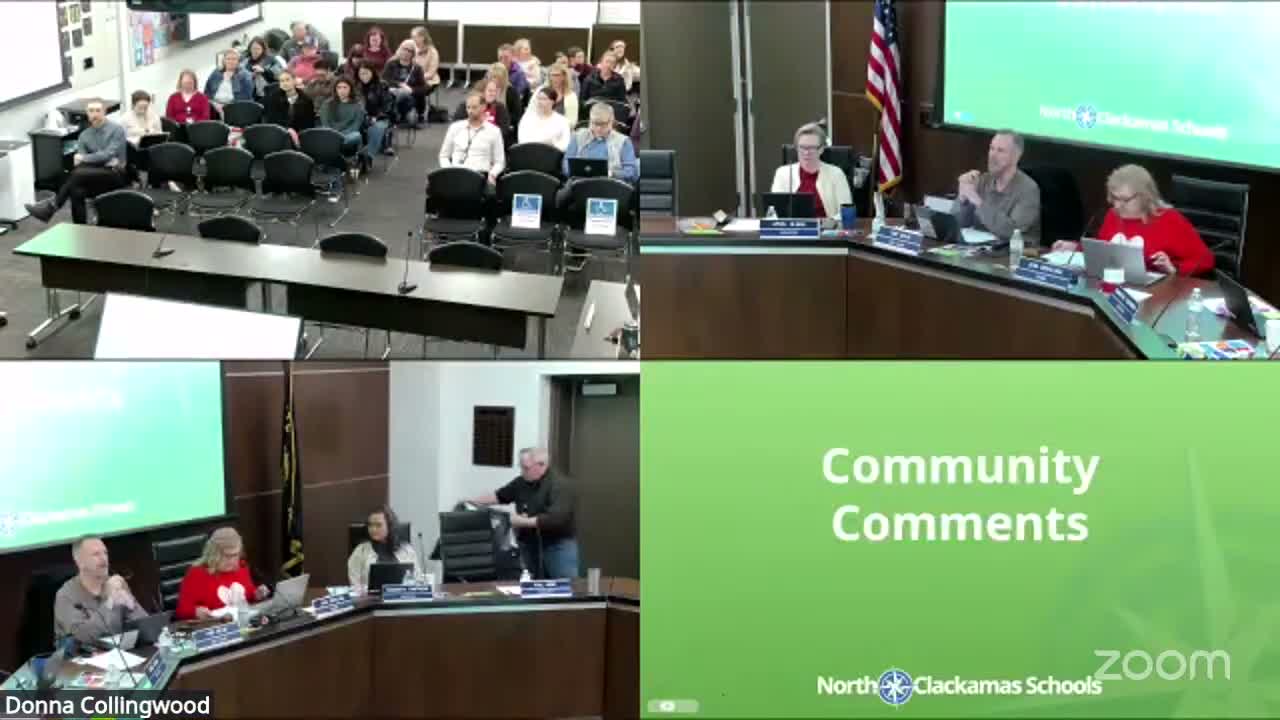
At the Feb. 12 meeting, Alex Brash of Flow Analytics presented NCSD’s 10‑year enrollment forecast, describing methods and implications for facilities and planning.
Brash said the team uses historical October headcount, demographic trends (including births and women of childbearing age), and residential development data from Metro’s parcel records to estimate student yield by housing type. He highlighted that North Clackamas’s proportion of residents aged 0–18 has fallen from 24.4% in 2000 to 20.8% in 2020 and noted recent birth cohorts (2020–2021) were smaller, which depresses upcoming kindergarten classes.
Key findings Brash described: district enrollment peaked in 2019, dipped in 2020, partially recovered, and then declined slightly from 2024 to 2025 with a net loss of just under 300 students in the recent period. Under a middle scenario, Brash presented a projection from 16,539 students in 2025 to approximately 15,664 over ten years. He said growth is geographically uneven, with most housing growth concentrated in the Happy Valley/Nelson High attendance area. Transfer data showed about 736 out‑of‑district students (roughly 4.5% of enrollment) and about 2,100 intra‑district transfers (about 13.5%).
On accuracy, Brash said one‑year forecasts are typically under 1% error; for the last cycle they overestimated 2025 enrollment by 97 students (0.6% error). He recommended producing low/high scenarios, monitoring k‑to‑birth ratios and grade progression ratios by school, and updating forecasts annually.
Board members asked clarifying questions about which population measures were shown in charts, the sources of intercensal estimates (American Community Survey and PSU estimates), and how forecast uncertainty grows toward year 10 (Brash said uncertainty widens and the high/low scenarios are roughly ±10% by 2035). Brash closed by offering to provide additional accuracy metrics and underlying maps for planning.
Brash said the team uses historical October headcount, demographic trends (including births and women of childbearing age), and residential development data from Metro’s parcel records to estimate student yield by housing type. He highlighted that North Clackamas’s proportion of residents aged 0–18 has fallen from 24.4% in 2000 to 20.8% in 2020 and noted recent birth cohorts (2020–2021) were smaller, which depresses upcoming kindergarten classes.
Key findings Brash described: district enrollment peaked in 2019, dipped in 2020, partially recovered, and then declined slightly from 2024 to 2025 with a net loss of just under 300 students in the recent period. Under a middle scenario, Brash presented a projection from 16,539 students in 2025 to approximately 15,664 over ten years. He said growth is geographically uneven, with most housing growth concentrated in the Happy Valley/Nelson High attendance area. Transfer data showed about 736 out‑of‑district students (roughly 4.5% of enrollment) and about 2,100 intra‑district transfers (about 13.5%).
On accuracy, Brash said one‑year forecasts are typically under 1% error; for the last cycle they overestimated 2025 enrollment by 97 students (0.6% error). He recommended producing low/high scenarios, monitoring k‑to‑birth ratios and grade progression ratios by school, and updating forecasts annually.
Board members asked clarifying questions about which population measures were shown in charts, the sources of intercensal estimates (American Community Survey and PSU estimates), and how forecast uncertainty grows toward year 10 (Brash said uncertainty widens and the high/low scenarios are roughly ±10% by 2035). Brash closed by offering to provide additional accuracy metrics and underlying maps for planning.
View the Full Meeting & All Its Details
This article offers just a summary. Unlock complete video, transcripts, and insights as a Founder Member.
✓
Watch full, unedited meeting videos
✓
Search every word spoken in unlimited transcripts
✓
AI summaries & real-time alerts (all government levels)
✓
Permanent access to expanding government content
30-day money-back guarantee
