Sugar Land outlines vision, RFQ and Char House preservation plan for Imperial Historic District
February 13, 2026 | Sugar Land, Fort Bend County, Texas
This article was created by AI summarizing key points discussed. AI makes mistakes, so for full details and context, please refer to the video of the full meeting. Please report any errors so we can fix them. Report an error »
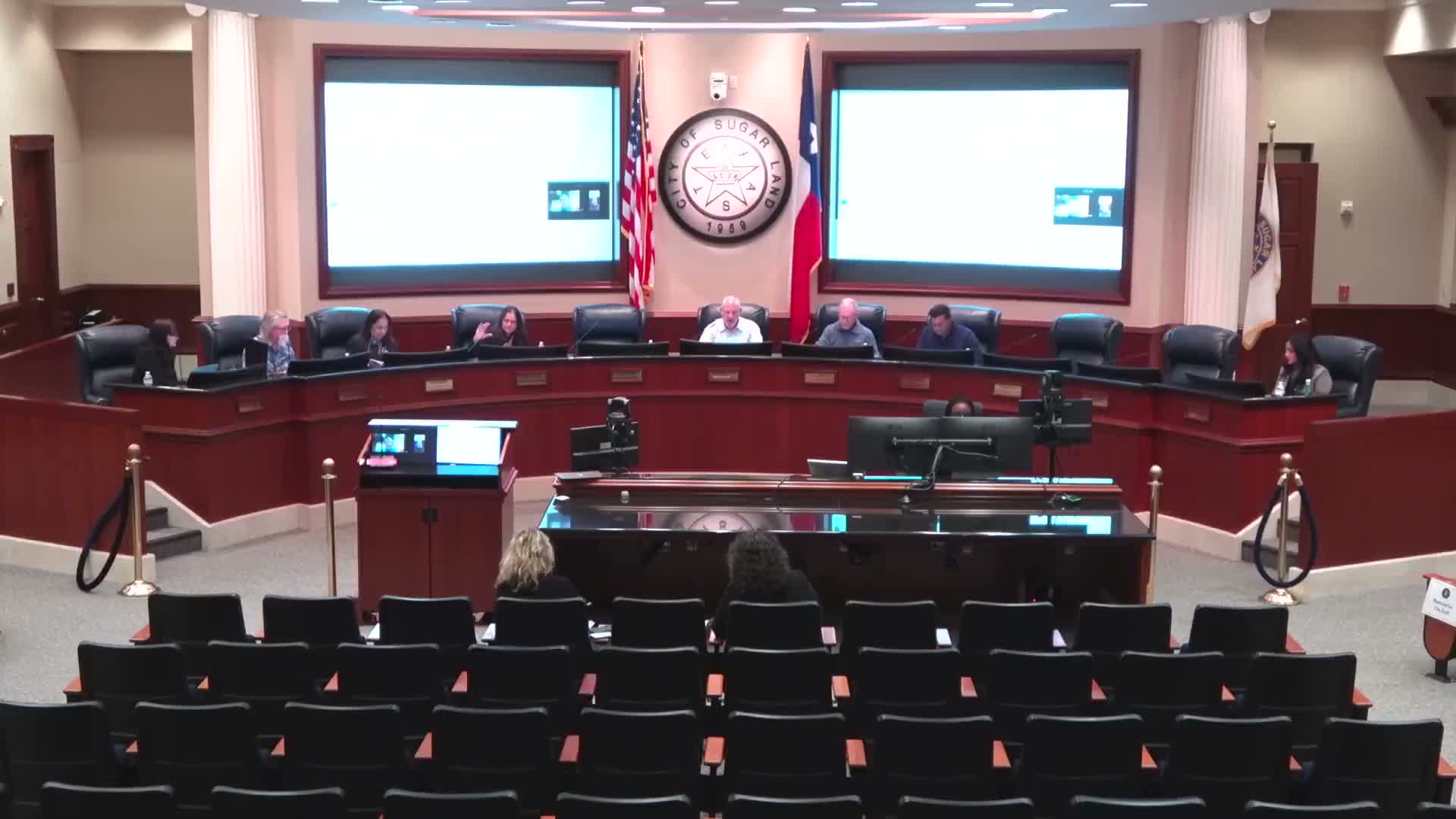
Devin Rodriguez, the city’s director of redevelopment, told the Sugar Land Planning & Zoning Commission on Feb. 12 that the city assembled roughly 40 acres around the roughly 18‑acre Imperial Historic District and is proceeding with a long‑term, market‑informed redevelopment strategy.
Rodriguez said the city engaged the Town Planning and Urban Design Collaborative (TPUDC) for a weeklong charrette and broad outreach. “We put the city in the driver's seat and go ahead and purchase and assemble these parcels,” he said, describing the purchase as a step to remove barriers that have made private‑market redevelopment infeasible for decades. He reported the outreach drew more than 360 participants and 60 survey responses, and that TPUDC delivered a strategic vision report intended as a playbook rather than a prescriptive site plan.
The report and vision were reviewed by City Council at a Jan. 20 workshop and a resolution adopting the vision and guiding pillars was approved at the council’s February meeting, Rodriguez said. He described the primary guiding goals as: telling the whole historic story across the site; creating a living district active day and night; designing flexible uses that can evolve with market conditions; emphasizing public gathering and mobility connections to avoid isolating the district across Highway 90.
On the Char House, Rodriguez said the building is the district’s most prominent historic asset and that council approved a design contract and initiated procurement for a construction manager at risk to begin preservation work. He said the design and preservation procurement work is underway, with phase‑one construction expected to begin this fall and preservation work estimated to take about 18 to 24 months.
Rodriguez outlined a two‑part request for qualifications (RFQ) for a master developer: an initial qualifications stage to identify experienced teams, followed by a second phase in which the top candidates provide detailed, site‑specific proposals. “We are expecting to release an RFQ at the end of this month,” he said, and staff expects to select a master development partner in the fall.
Commissioners pressed staff on several operational details. One asked whether the site’s land‑use plan or codes must change; Rodriguez said no major land‑use changes are anticipated at this stage and that entitlements are not currently active (a previously proposed planned development has expired). Commissioners asked who will make final decisions about design and uses; Rodriguez said decisions will be layered: staff will administer code‑level matters, the economic development committee and City Council will make final choices on major items, and the master development agreement will spell out roles, responsibilities and financial structures.
A community member urged more immediate public use of portions of the site rather than prolonged fencing; Rodriguez replied that parts of the site are already in public use (notably the Fort Bend Children’s Discovery Center) and that the three‑bay warehouse is being considered for near‑term activation though it has roof damage that will require repairs.
The commission also received routine liaison and staff reports and approved the Dec. 9, 2025 minutes by hand vote; the meeting adjourned by unanimous hand vote.
What’s next: staff will issue the RFQ for master development qualifications at the end of the month, proceed with the construction‑manager procurement for Char House preservation, and return future development agreements and specific zoning or entitlement items to commission and council for review as needed.
Rodriguez said the city engaged the Town Planning and Urban Design Collaborative (TPUDC) for a weeklong charrette and broad outreach. “We put the city in the driver's seat and go ahead and purchase and assemble these parcels,” he said, describing the purchase as a step to remove barriers that have made private‑market redevelopment infeasible for decades. He reported the outreach drew more than 360 participants and 60 survey responses, and that TPUDC delivered a strategic vision report intended as a playbook rather than a prescriptive site plan.
The report and vision were reviewed by City Council at a Jan. 20 workshop and a resolution adopting the vision and guiding pillars was approved at the council’s February meeting, Rodriguez said. He described the primary guiding goals as: telling the whole historic story across the site; creating a living district active day and night; designing flexible uses that can evolve with market conditions; emphasizing public gathering and mobility connections to avoid isolating the district across Highway 90.
On the Char House, Rodriguez said the building is the district’s most prominent historic asset and that council approved a design contract and initiated procurement for a construction manager at risk to begin preservation work. He said the design and preservation procurement work is underway, with phase‑one construction expected to begin this fall and preservation work estimated to take about 18 to 24 months.
Rodriguez outlined a two‑part request for qualifications (RFQ) for a master developer: an initial qualifications stage to identify experienced teams, followed by a second phase in which the top candidates provide detailed, site‑specific proposals. “We are expecting to release an RFQ at the end of this month,” he said, and staff expects to select a master development partner in the fall.
Commissioners pressed staff on several operational details. One asked whether the site’s land‑use plan or codes must change; Rodriguez said no major land‑use changes are anticipated at this stage and that entitlements are not currently active (a previously proposed planned development has expired). Commissioners asked who will make final decisions about design and uses; Rodriguez said decisions will be layered: staff will administer code‑level matters, the economic development committee and City Council will make final choices on major items, and the master development agreement will spell out roles, responsibilities and financial structures.
A community member urged more immediate public use of portions of the site rather than prolonged fencing; Rodriguez replied that parts of the site are already in public use (notably the Fort Bend Children’s Discovery Center) and that the three‑bay warehouse is being considered for near‑term activation though it has roof damage that will require repairs.
The commission also received routine liaison and staff reports and approved the Dec. 9, 2025 minutes by hand vote; the meeting adjourned by unanimous hand vote.
What’s next: staff will issue the RFQ for master development qualifications at the end of the month, proceed with the construction‑manager procurement for Char House preservation, and return future development agreements and specific zoning or entitlement items to commission and council for review as needed.
View the Full Meeting & All Its Details
This article offers just a summary. Unlock complete video, transcripts, and insights as a Founder Member.
✓
Watch full, unedited meeting videos
✓
Search every word spoken in unlimited transcripts
✓
AI summaries & real-time alerts (all government levels)
✓
Permanent access to expanding government content
30-day money-back guarantee
