United Way outlines nonprofit hub in Bangor, emphasizes training, shared space and regional partnerships
February 14, 2026 | Bangor City, Penobscot County, Maine
This article was created by AI summarizing key points discussed. AI makes mistakes, so for full details and context, please refer to the video of the full meeting. Please report any errors so we can fix them. Report an error »
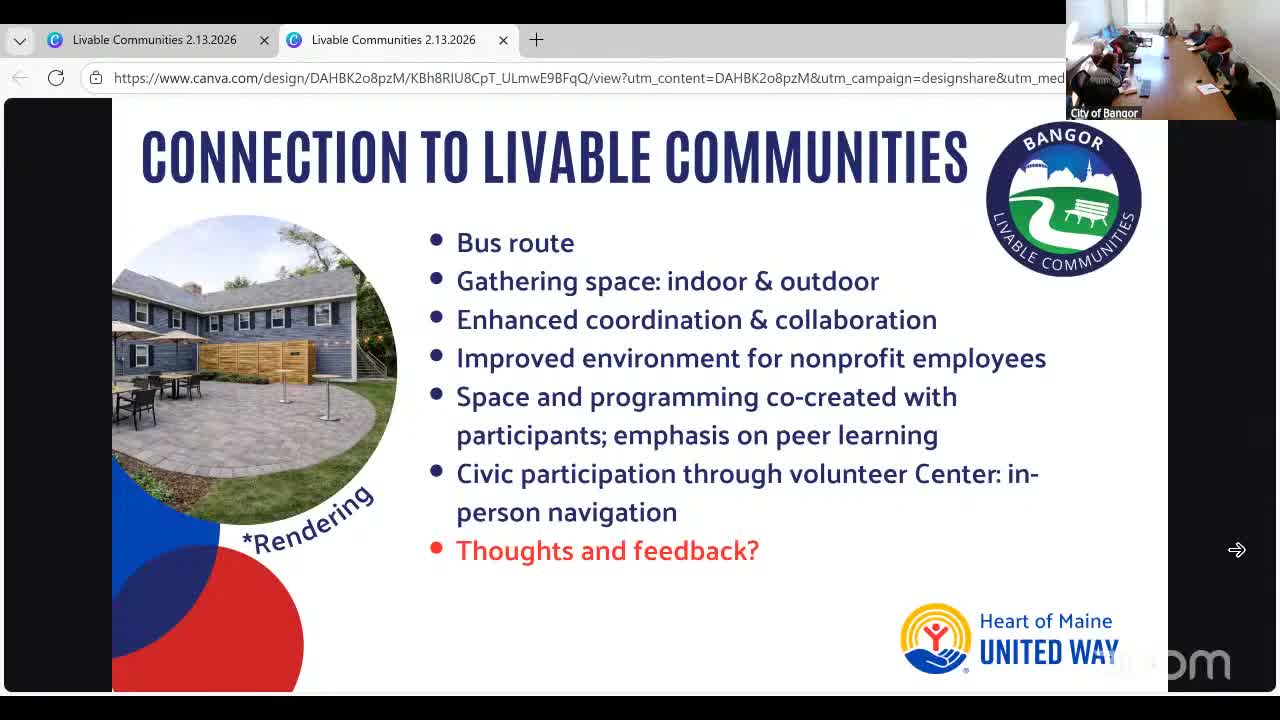
United Way staff on the nonprofit hub told Bangor’s Livable Communities group that the organization has opened a renovated shared space to support nonprofits across a six-county region and to bolster training, volunteer matching and program stability.
"We serve six counties in Maine. We're based in Bangor," said Elaine Thomas, identified in the meeting as United Way’s director of impact, who outlined the hub’s mission and services. She said the hub is the result of ARPA-funded acquisition and renovation of space at the Evergreen Woods Complex and that United Way moved into the building last October.
The hub offers a mix of subsidized rental offices, a large training/event room that can be configured for roughly 34 (training) to 64 (lecture) participants, meeting rooms, a wellness room, co-working space and a volunteer navigation center. Thomas said the volunteer center will target corporate employees with volunteer-time-off, retirees and people who must document volunteer hours for benefit programs.
United Way also described programmatic priorities that guided the hub: basic needs (food, shelter and heat), coordinated responses to pregnancy and substance-use disorders, early childhood and youth services, and a newer focus on nonprofit capacity—training, board development and staff supports. "We never fund more than 35% of a program's budget because of sustainability," Thomas said, describing the organization’s approach to grant awards and noting grant decisions are volunteer-led.
On funding, Thomas said United Way’s largest revenue source is its community campaign of private and business donors (a campaign goal she cited this year at $1,600,000). She said United Way typically distributes around $20,000 from its fuel-assistance fund, and that this year the organization received a larger one-time gift of about $180,000 to expand assistance across partner agencies. She also said state grants ("about $300,000") supported an expansion project; a federal award was mentioned but the transcript amount was unclear and is not reported here.
Committee members pressed United Way over scope: one member said the council expected the ARPA-funded hub to coordinate nonprofits addressing homelessness and drug addiction. Thomas replied that the hub’s original ARPA purpose was to create a convening, funding and shared-services hub that enables collaboration and reduces duplication, not to run direct case-management or single-issue service delivery. She added United Way funds and partners with agencies that operate shelters and transitional programs and cited several funded programs that together address shelter, diversion and transitional housing.
Thomas said United Way currently supports roughly 32 funded partners in the current grant cycle and that a complete partners list—showing which counties each partner serves—is available on United Way’s website and will be shared with committee staff. She also invited committee members to suggest training topics and local experts the hub could host.
Committee members asked about tenant vetting after local controversies about certain providers; Thomas said tenants will be screened and that United Way sets conditions for use of space (nonpartisan, nonreligious and not for providing medical services under its hosted events), and that rental tiers will include discounted rates for small nonprofits.
Next steps: United Way offered to provide partner lists and follow-up data, and committee members thanked presenters and signaled further engagement. No formal motions or votes were recorded during the presentation.
"We serve six counties in Maine. We're based in Bangor," said Elaine Thomas, identified in the meeting as United Way’s director of impact, who outlined the hub’s mission and services. She said the hub is the result of ARPA-funded acquisition and renovation of space at the Evergreen Woods Complex and that United Way moved into the building last October.
The hub offers a mix of subsidized rental offices, a large training/event room that can be configured for roughly 34 (training) to 64 (lecture) participants, meeting rooms, a wellness room, co-working space and a volunteer navigation center. Thomas said the volunteer center will target corporate employees with volunteer-time-off, retirees and people who must document volunteer hours for benefit programs.
United Way also described programmatic priorities that guided the hub: basic needs (food, shelter and heat), coordinated responses to pregnancy and substance-use disorders, early childhood and youth services, and a newer focus on nonprofit capacity—training, board development and staff supports. "We never fund more than 35% of a program's budget because of sustainability," Thomas said, describing the organization’s approach to grant awards and noting grant decisions are volunteer-led.
On funding, Thomas said United Way’s largest revenue source is its community campaign of private and business donors (a campaign goal she cited this year at $1,600,000). She said United Way typically distributes around $20,000 from its fuel-assistance fund, and that this year the organization received a larger one-time gift of about $180,000 to expand assistance across partner agencies. She also said state grants ("about $300,000") supported an expansion project; a federal award was mentioned but the transcript amount was unclear and is not reported here.
Committee members pressed United Way over scope: one member said the council expected the ARPA-funded hub to coordinate nonprofits addressing homelessness and drug addiction. Thomas replied that the hub’s original ARPA purpose was to create a convening, funding and shared-services hub that enables collaboration and reduces duplication, not to run direct case-management or single-issue service delivery. She added United Way funds and partners with agencies that operate shelters and transitional programs and cited several funded programs that together address shelter, diversion and transitional housing.
Thomas said United Way currently supports roughly 32 funded partners in the current grant cycle and that a complete partners list—showing which counties each partner serves—is available on United Way’s website and will be shared with committee staff. She also invited committee members to suggest training topics and local experts the hub could host.
Committee members asked about tenant vetting after local controversies about certain providers; Thomas said tenants will be screened and that United Way sets conditions for use of space (nonpartisan, nonreligious and not for providing medical services under its hosted events), and that rental tiers will include discounted rates for small nonprofits.
Next steps: United Way offered to provide partner lists and follow-up data, and committee members thanked presenters and signaled further engagement. No formal motions or votes were recorded during the presentation.
View the Full Meeting & All Its Details
This article offers just a summary. Unlock complete video, transcripts, and insights as a Founder Member.
✓
Watch full, unedited meeting videos
✓
Search every word spoken in unlimited transcripts
✓
AI summaries & real-time alerts (all government levels)
✓
Permanent access to expanding government content
30-day money-back guarantee
