Kern County planning commission recommends Buttonbush solar and storage project to supervisors
February 13, 2026 | Kern County, California
This article was created by AI summarizing key points discussed. AI makes mistakes, so for full details and context, please refer to the video of the full meeting. Please report any errors so we can fix them. Report an error »
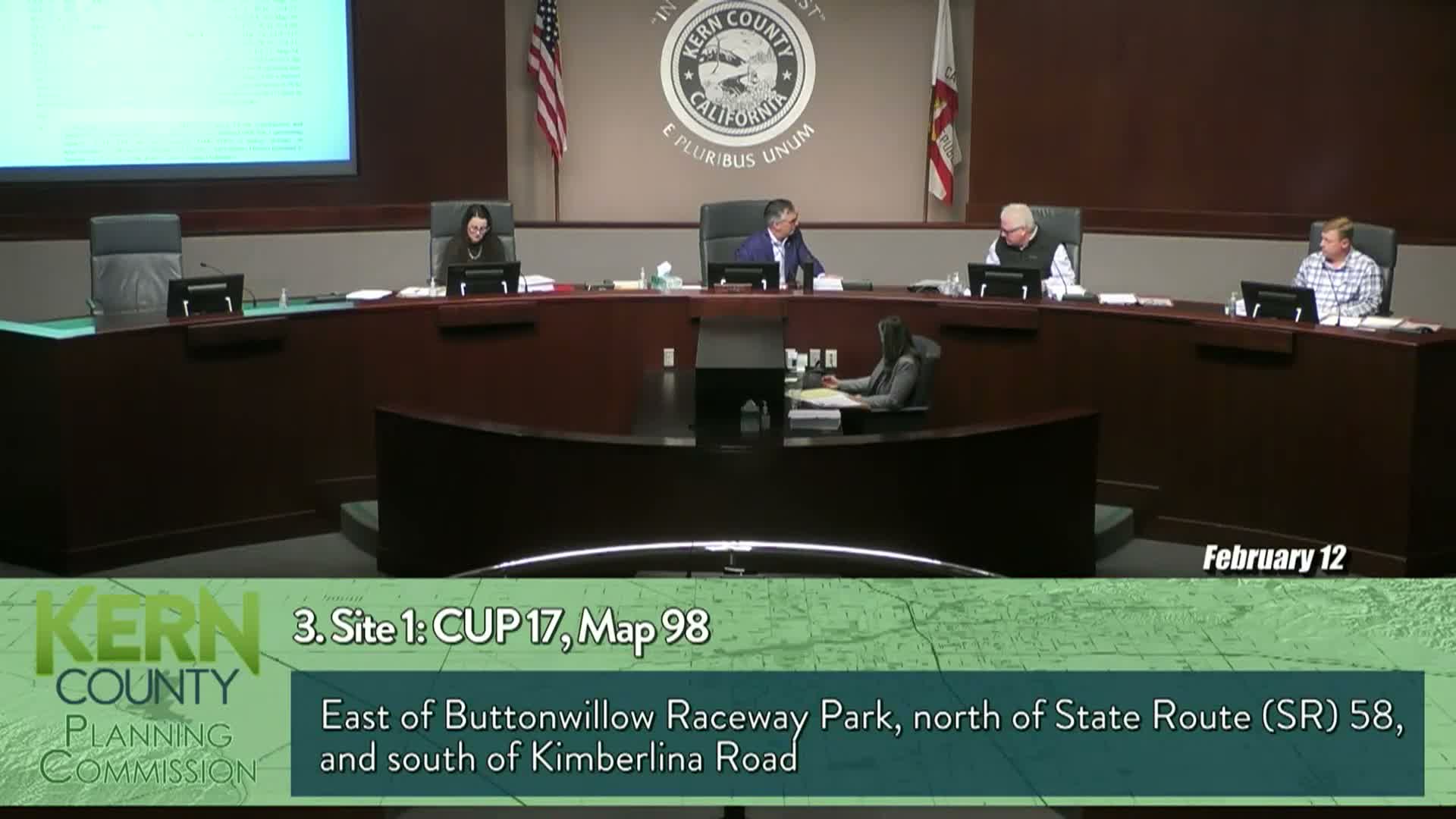
The Kern County Planning Commission voted 4-0, with one commissioner absent, on Feb. 12 to recommend that the Board of Supervisors certify the environmental impact report and approve land‑use entitlements for the Buttonbush Solar and Storage Project.
Planning staff told the commission the project would develop roughly 11,983 acres across 128 parcels north of the Buttonwillow area and would produce about 2 gigawatts of photovoltaic capacity paired with about 16 gigawatt‑hours of battery storage. Staff said the proposal includes multiple conditional use permits, six permits for microwave towers, cancellations of 37 Williamson Act land‑use contracts (about 10,689 acres), and changes to the Kern County General Plan circulation element and the Buttonwillow community development plan.
Staff also summarized the environmental review. A draft and a final environmental impact report were prepared under the California Environmental Quality Act; staff noted the final EIR comprises multiple volumes and outlines 79 mitigation measures. Staff reported that some impacts would remain significant and unavoidable in categories including aesthetics, agricultural resources, air quality during construction, biological resources (including effects on raptors and migratory birds), mineral resources and wildfire risk. Staff recommended the commission advise the Board to certify the EIR, adopt findings and a statement of overriding considerations, and approve the requested entitlements subject to mitigation and conditions.
Kevin Brokish, vice president of development for Avantis, the project's developer, said the company has worked on the project for seven years and emphasized local benefits. "We signed a transmission easement with Buttonwillow County Water District," Brokish said, describing a real‑estate agreement that will partially fund a wastewater treatment plant, and he said the project will use union labor under a project labor agreement. Brokish also said the project must be operational by 2029 to capture a federal investment tax credit and will pay property taxes after a state exclusion expires, which together he said produces a "unique window of opportunity" for Kern County.
Union leaders and local workforce representatives spoke in support during public comment, citing job creation and apprenticeship opportunities. "We are here in support of the Buttonbush Solar and Storage Project," said Herb Ramirez of Laborers' International Union of North America Local 220. Brian Holt of IBEW Local 428 said the unions had worked with Avantis for years and "stand in strong support" of the project. Apprenticeship and training leaders and several local farmers and water‑district officials also urged approval, saying the project would provide lease revenue for landowners, reduce operational water demand compared with historical irrigation, and support groundwater sustainability planning.
Planning staff and public speakers provided project estimates: staff described average on‑site construction employment of about 800 workers per day with peaks up to 1,334 and roughly 20 full‑time operational jobs; staff estimated construction water demand at about 3,500 acre‑feet over a 60‑month construction period and ongoing operational water needs of about 7 acre‑feet per year. Supporters and water‑district speakers characterized operational water use as "negligible" relative to agriculture and said the project would allow limited water supplies to be reallocated to higher‑value farmland.
No members of the public spoke in opposition at the hearing. After the staff presentation, commissioners expressed support, and a commissioner moved to approve the project "as presented," a second was recorded, and an on‑screen vote produced four ayes and one absence. The commission's action is advisory; staff said the project will be scheduled for final consideration by the Board of Supervisors on March 24.
The record submitted to the commission includes the draft and final EIR, recommended findings of fact, a mitigation monitoring and reporting program, and a draft memorandum of understanding between the project proponent and local agencies. The staff report also references limited exemptions under California Government Code section 53091 for certain energy projects and notes utility‑related exemptions under the California Public Utilities Commission's authority.
Next steps: the Planning Commission's approval will be forwarded as a recommendation; the Board of Supervisors is expected to consider certification of the EIR and the entitlements at its March 24 meeting for final action.
Planning staff told the commission the project would develop roughly 11,983 acres across 128 parcels north of the Buttonwillow area and would produce about 2 gigawatts of photovoltaic capacity paired with about 16 gigawatt‑hours of battery storage. Staff said the proposal includes multiple conditional use permits, six permits for microwave towers, cancellations of 37 Williamson Act land‑use contracts (about 10,689 acres), and changes to the Kern County General Plan circulation element and the Buttonwillow community development plan.
Staff also summarized the environmental review. A draft and a final environmental impact report were prepared under the California Environmental Quality Act; staff noted the final EIR comprises multiple volumes and outlines 79 mitigation measures. Staff reported that some impacts would remain significant and unavoidable in categories including aesthetics, agricultural resources, air quality during construction, biological resources (including effects on raptors and migratory birds), mineral resources and wildfire risk. Staff recommended the commission advise the Board to certify the EIR, adopt findings and a statement of overriding considerations, and approve the requested entitlements subject to mitigation and conditions.
Kevin Brokish, vice president of development for Avantis, the project's developer, said the company has worked on the project for seven years and emphasized local benefits. "We signed a transmission easement with Buttonwillow County Water District," Brokish said, describing a real‑estate agreement that will partially fund a wastewater treatment plant, and he said the project will use union labor under a project labor agreement. Brokish also said the project must be operational by 2029 to capture a federal investment tax credit and will pay property taxes after a state exclusion expires, which together he said produces a "unique window of opportunity" for Kern County.
Union leaders and local workforce representatives spoke in support during public comment, citing job creation and apprenticeship opportunities. "We are here in support of the Buttonbush Solar and Storage Project," said Herb Ramirez of Laborers' International Union of North America Local 220. Brian Holt of IBEW Local 428 said the unions had worked with Avantis for years and "stand in strong support" of the project. Apprenticeship and training leaders and several local farmers and water‑district officials also urged approval, saying the project would provide lease revenue for landowners, reduce operational water demand compared with historical irrigation, and support groundwater sustainability planning.
Planning staff and public speakers provided project estimates: staff described average on‑site construction employment of about 800 workers per day with peaks up to 1,334 and roughly 20 full‑time operational jobs; staff estimated construction water demand at about 3,500 acre‑feet over a 60‑month construction period and ongoing operational water needs of about 7 acre‑feet per year. Supporters and water‑district speakers characterized operational water use as "negligible" relative to agriculture and said the project would allow limited water supplies to be reallocated to higher‑value farmland.
No members of the public spoke in opposition at the hearing. After the staff presentation, commissioners expressed support, and a commissioner moved to approve the project "as presented," a second was recorded, and an on‑screen vote produced four ayes and one absence. The commission's action is advisory; staff said the project will be scheduled for final consideration by the Board of Supervisors on March 24.
The record submitted to the commission includes the draft and final EIR, recommended findings of fact, a mitigation monitoring and reporting program, and a draft memorandum of understanding between the project proponent and local agencies. The staff report also references limited exemptions under California Government Code section 53091 for certain energy projects and notes utility‑related exemptions under the California Public Utilities Commission's authority.
Next steps: the Planning Commission's approval will be forwarded as a recommendation; the Board of Supervisors is expected to consider certification of the EIR and the entitlements at its March 24 meeting for final action.
View the Full Meeting & All Its Details
This article offers just a summary. Unlock complete video, transcripts, and insights as a Founder Member.
✓
Watch full, unedited meeting videos
✓
Search every word spoken in unlimited transcripts
✓
AI summaries & real-time alerts (all government levels)
✓
Permanent access to expanding government content
30-day money-back guarantee
