Yuma Union board questions tracking, safety after student walkout; parents and public press for new policy
February 12, 2026 | Yuma Union High School District (4507), School Districts, Arizona
This article was created by AI summarizing key points discussed. AI makes mistakes, so for full details and context, please refer to the video of the full meeting. Please report any errors so we can fix them. Report an error »
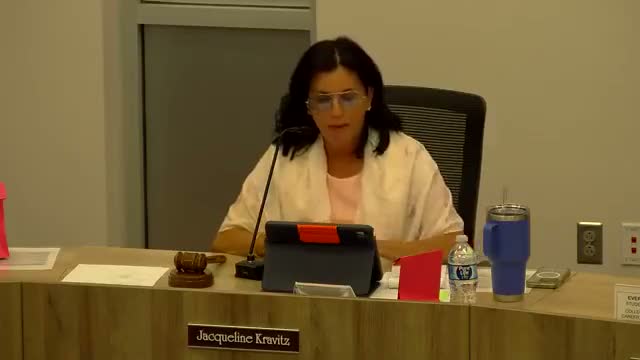
YUMA, Ariz. — Board members at the Yuma Union High School District on Feb. 12 pressed administrators for detail about how the district tracked and responded after a recent student walkout, while members of the public urged the board to adopt stronger staff-accountability rules and a formal policy for mass campus protests.
During an extended informational discussion on attendance, district staff and guests — including Chris Reese, identified as a dropout-prevention specialist at Somerton/Summerton High School, and Itzel Rodriguez, an assistant principal at Cibola — described how attendance is recorded and intervened upon. Teachers are expected to take attendance within the first 10 minutes of class; students who arrive after the final bell check in with an attendance clerk using an iPad that syncs with the Synergy student-information system and receive a late pass. ParentSquare messages alert families when students are absent or late for first or second period.
Board members focused heavily on the district’s response to a recent walkout that occurred during late-day periods. Reese said campus teams ran period-specific reports for the fourth and fifth periods and provided that data to administrators; staff also used teacher spreadsheets and parent notifications to identify students who left campus. When large groups left simultaneously, presenters said the immediate priority was student safety and that campus staff rely on teacher attendance, security redirection, and parent notifications to reconstruct who left.
District staff described a progressive-intervention framework for attendance: an initial conversation and warning; subsequent meetings that consider grades and underlying causes; and escalating consequences such as one-hour then two-hour detentions if patterns continue. Reese said more intensive responses — referrals to dropout-prevention staff, phone calls home, home visits — follow if absences or consecutive days increase to the levels the district tracks for early intervention.
Several board members asked whether consequences are applied on a per-period basis; presenters confirmed the discipline matrix considers absences period-by-period and that campus teams review students holistically before assigning sanctions.
Public commenters challenged how staff behaved before and during the walkout. Russell McLeod said students “joined in because of, for lack of a better term, a mob mentality” and suggested academic consequences such as tests to discourage future protests. Scott McLeod accused some teachers of encouraging or assisting student protesters (helping make signs or allowing class time) and called for a district policy to keep students safe during off-campus demonstrations; he also relayed an on-street assault reported near the protest.
District leaders told the board that parent engagement, safety coordination with local law enforcement off campus, and campus security are central to their response. They also said that when a student is observed attempting to leave campus during an instructional period, staff use ID checks and radio calls to administration and typically inform families. If a student refuses redirection, staff said they cannot physically restrain the student and will notify parents instead.
The board did not adopt a new policy at the meeting but several members said the walkout and the public response warrant a future agenda item to examine emergency procedures, staff practices during protests and communication with families.
What’s next: board members indicated they may schedule a future agenda item to explore a formal approach to mass walkouts and related staff/accountability questions.
During an extended informational discussion on attendance, district staff and guests — including Chris Reese, identified as a dropout-prevention specialist at Somerton/Summerton High School, and Itzel Rodriguez, an assistant principal at Cibola — described how attendance is recorded and intervened upon. Teachers are expected to take attendance within the first 10 minutes of class; students who arrive after the final bell check in with an attendance clerk using an iPad that syncs with the Synergy student-information system and receive a late pass. ParentSquare messages alert families when students are absent or late for first or second period.
Board members focused heavily on the district’s response to a recent walkout that occurred during late-day periods. Reese said campus teams ran period-specific reports for the fourth and fifth periods and provided that data to administrators; staff also used teacher spreadsheets and parent notifications to identify students who left campus. When large groups left simultaneously, presenters said the immediate priority was student safety and that campus staff rely on teacher attendance, security redirection, and parent notifications to reconstruct who left.
District staff described a progressive-intervention framework for attendance: an initial conversation and warning; subsequent meetings that consider grades and underlying causes; and escalating consequences such as one-hour then two-hour detentions if patterns continue. Reese said more intensive responses — referrals to dropout-prevention staff, phone calls home, home visits — follow if absences or consecutive days increase to the levels the district tracks for early intervention.
Several board members asked whether consequences are applied on a per-period basis; presenters confirmed the discipline matrix considers absences period-by-period and that campus teams review students holistically before assigning sanctions.
Public commenters challenged how staff behaved before and during the walkout. Russell McLeod said students “joined in because of, for lack of a better term, a mob mentality” and suggested academic consequences such as tests to discourage future protests. Scott McLeod accused some teachers of encouraging or assisting student protesters (helping make signs or allowing class time) and called for a district policy to keep students safe during off-campus demonstrations; he also relayed an on-street assault reported near the protest.
District leaders told the board that parent engagement, safety coordination with local law enforcement off campus, and campus security are central to their response. They also said that when a student is observed attempting to leave campus during an instructional period, staff use ID checks and radio calls to administration and typically inform families. If a student refuses redirection, staff said they cannot physically restrain the student and will notify parents instead.
The board did not adopt a new policy at the meeting but several members said the walkout and the public response warrant a future agenda item to examine emergency procedures, staff practices during protests and communication with families.
What’s next: board members indicated they may schedule a future agenda item to explore a formal approach to mass walkouts and related staff/accountability questions.
View the Full Meeting & All Its Details
This article offers just a summary. Unlock complete video, transcripts, and insights as a Founder Member.
✓
Watch full, unedited meeting videos
✓
Search every word spoken in unlimited transcripts
✓
AI summaries & real-time alerts (all government levels)
✓
Permanent access to expanding government content
30-day money-back guarantee
