Governor’s Advisory Council for Exceptional Citizens urges earlier inclusion in policymaking; highlights DelDee Hub usage
February 12, 2026 | 2026 Legislature DE, Legislative, Delaware
This article was created by AI summarizing key points discussed. AI makes mistakes, so for full details and context, please refer to the video of the full meeting. Please report any errors so we can fix them. Report an error »
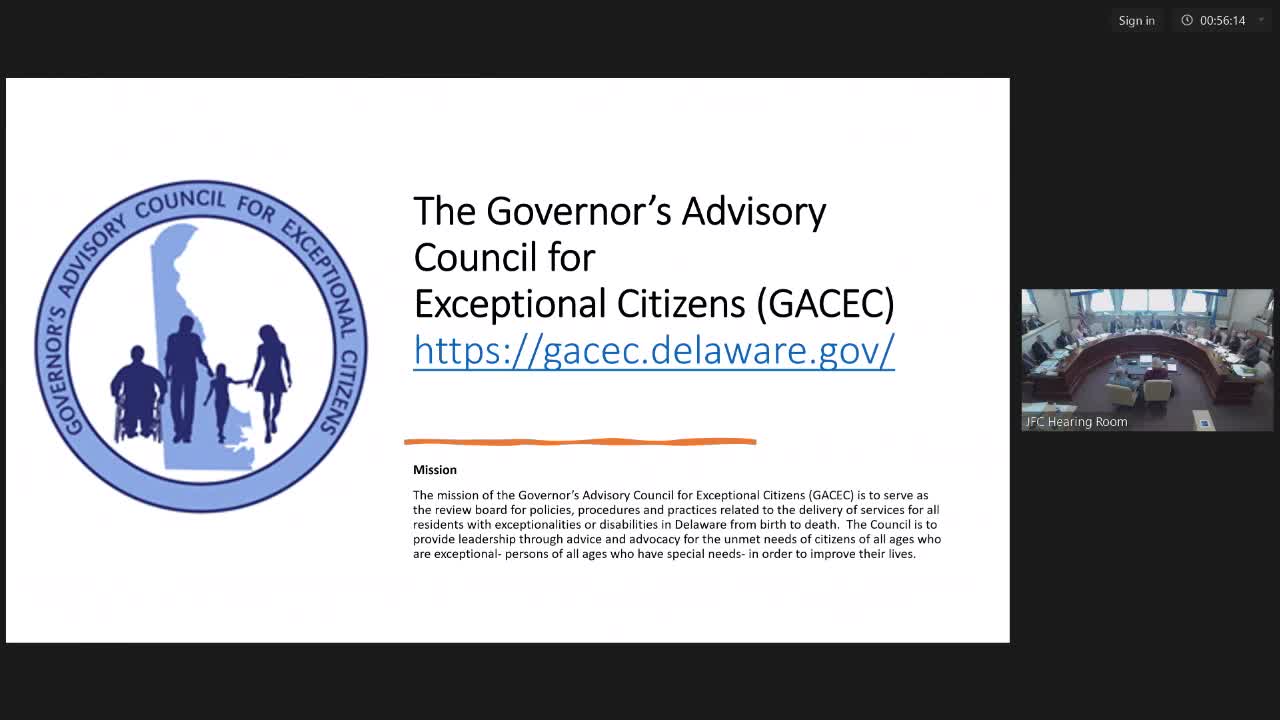
Director Weir and GACC Chair Bill Doolittle presented the Governor’s Advisory Council for Exceptional Citizens’ annual orientation to the Joint Finance Committee, framing the council as a small, state‑funded advisory agency with broad statutory duties.
Weir said the council is uniquely organized in Delaware as a standalone state agency charged with advising the Department of Education, the State Board of Education and other agencies on disability and special‑education issues, including oversight of prison education. She said the council is 100% state‑funded, operates with a staff of about 3.75 full‑time equivalent positions, and had no vacancies at the time of the presentation.
The council highlighted the DelDee Hub—a statewide transition‑age website intended to help students ages 14–22 prepare for adult life—and reported 22,339 visits and 16,542 unique users in the last year. The presentation said the site had more than 130 outdated federal links removed and that the council formed an advisory group to better align the hub with Department of Education transition work.
Both Weir and Doolittle pressed for earlier, structured engagement with agencies and legislators. "When individuals with disabilities are not meaningfully included in early planning stages, the result is costly retrofitting, revising regulations, retraining staff, addressing complaints, or defending litigation rather than designing inclusive systems from the outset," Weir said. The council recommended a consultation and response protocol so agencies document whether and how they considered GACC recommendations.
Legislators acknowledged the council’s constraints—FOIA and public‑meeting rules—and suggested practical steps such as using daily bill dockets, scheduling short weekly triage meetings during session, and deputizing staff to track legislative filings so the council can weigh in earlier. Several committee members offered to help bridge communication gaps with committees and executive agencies.
Public‑comment and committee discussion emphasized the importance of the council’s role across education, Medicaid, juvenile justice transitions, and prison education, and flagged both resource limits and procedural barriers that limit the council’s reach. The council recommended any 1% operating cuts be taken from travel and supplies to preserve staffing and core functions.
Next steps: committee members asked staff and the council to pursue options—more frequent leadership triage calls, sharing the daily legislative filings, and a possible request for modest budget support to expand the DelDee Hub’s remit beyond transition age.
Weir said the council is uniquely organized in Delaware as a standalone state agency charged with advising the Department of Education, the State Board of Education and other agencies on disability and special‑education issues, including oversight of prison education. She said the council is 100% state‑funded, operates with a staff of about 3.75 full‑time equivalent positions, and had no vacancies at the time of the presentation.
The council highlighted the DelDee Hub—a statewide transition‑age website intended to help students ages 14–22 prepare for adult life—and reported 22,339 visits and 16,542 unique users in the last year. The presentation said the site had more than 130 outdated federal links removed and that the council formed an advisory group to better align the hub with Department of Education transition work.
Both Weir and Doolittle pressed for earlier, structured engagement with agencies and legislators. "When individuals with disabilities are not meaningfully included in early planning stages, the result is costly retrofitting, revising regulations, retraining staff, addressing complaints, or defending litigation rather than designing inclusive systems from the outset," Weir said. The council recommended a consultation and response protocol so agencies document whether and how they considered GACC recommendations.
Legislators acknowledged the council’s constraints—FOIA and public‑meeting rules—and suggested practical steps such as using daily bill dockets, scheduling short weekly triage meetings during session, and deputizing staff to track legislative filings so the council can weigh in earlier. Several committee members offered to help bridge communication gaps with committees and executive agencies.
Public‑comment and committee discussion emphasized the importance of the council’s role across education, Medicaid, juvenile justice transitions, and prison education, and flagged both resource limits and procedural barriers that limit the council’s reach. The council recommended any 1% operating cuts be taken from travel and supplies to preserve staffing and core functions.
Next steps: committee members asked staff and the council to pursue options—more frequent leadership triage calls, sharing the daily legislative filings, and a possible request for modest budget support to expand the DelDee Hub’s remit beyond transition age.
View the Full Meeting & All Its Details
This article offers just a summary. Unlock complete video, transcripts, and insights as a Founder Member.
✓
Watch full, unedited meeting videos
✓
Search every word spoken in unlimited transcripts
✓
AI summaries & real-time alerts (all government levels)
✓
Permanent access to expanding government content
30-day money-back guarantee
