Committee weighs shortening post-eviction timelines for tenant removal and disposal of belongings
February 12, 2026 | General & Housing, HOUSE OF REPRESENTATIVES, Committees, Legislative , Vermont
This article was created by AI summarizing key points discussed. AI makes mistakes, so for full details and context, please refer to the video of the full meeting. Please report any errors so we can fix them. Report an error »
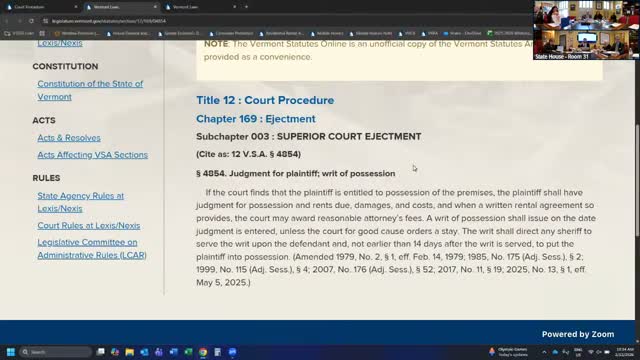
The Committee on General and Housing met Feb. 12 to consider competing drafts that would change how long landlords and sheriffs must wait after a court judgment before a tenant can be physically removed and before a landlord may dispose of the tenant’s remaining personal property. Chair opened the meeting saying the committee would review multiple bills, including drafts referred to in the discussion as 772 and 688.
Cameron Wood, officer of the council, told the committee he had pulled up the relevant statutes and read aloud the current framework: the writ of possession is directed to the sheriff and there is no statutory time frame for when the sheriff must serve, but once the writ is served the statute currently provides a minimum 14 days before a plaintiff may be put into possession. Wood also cited the section the group reviewed for property disposal, explaining that a landlord may dispose of personal property “15 days after the writ of possession is served or upon the landlord being legally restored to possession, whichever is later.”
Those provisions can produce, in practice, two successive waits: 14 days before the sheriff may put a plaintiff into physical possession and then another 15 days before the landlord may discard left items — a potential 29-day window that several members described as burdensome for landlords. “When the judgment’s issued, the right goes away,” the Chair summarized; “the question is, is the leasee physically removed and when can we move belongings?”
Members disagreed about whether the statute’s phrase “legally restored to possession” refers to the court’s decision date or the sheriff’s physical removal. Several called the drafting “poorly written” and noted that application varies across counties depending on sheriff availability. Members described two practical problems: (1) sheriff offices may triage work and not serve writs immediately, delaying the start of the statutory clock; and (2) if landlords must hold property for 15 days and then store it, landlords face time and cost burdens.
On policy options, the committee discussed multiple approaches in the competing bills: the draft labeled 688 would allow disposal almost immediately after service (the Chair summarized that 688 “says 24 hours” in the transcript), while the Chair described 772 as allowing a shorter but non-immediate timeline (the Chair noted 772 would permit removal after 7 days in one reading). Several members favored retaining a 14-day period to give tenants reasonable time to collect property but eliminating the subsequent 15-day storage requirement (a “14 + 0” formulation). Other members proposed shorter windows (for example, 7 days plus a short period to remove belongings) but expressed concern about fairness and practical feasibility when service falls on a Friday or over a weekend.
Cameron Wood recommended counsel clarify the conflicting statutory language; the Chair instructed counsel to redraft the text to remove ambiguity and to prepare a version that implements the committee’s sense (the Chair asked for language reflecting ‘‘14 plus 0’’ in the near-term). Members also asked staff to invite sheriff representatives to explain service practices and staffing constraints before the committee finalizes timing changes.
Next steps: counsel will prepare a clarified draft consistent with the committee’s instruction to reduce the post-possession storage burden and to make the statute’s timing precise; the committee will seek input from the sheriffs’ offices before returning the bill to the larger body.
Cameron Wood, officer of the council, told the committee he had pulled up the relevant statutes and read aloud the current framework: the writ of possession is directed to the sheriff and there is no statutory time frame for when the sheriff must serve, but once the writ is served the statute currently provides a minimum 14 days before a plaintiff may be put into possession. Wood also cited the section the group reviewed for property disposal, explaining that a landlord may dispose of personal property “15 days after the writ of possession is served or upon the landlord being legally restored to possession, whichever is later.”
Those provisions can produce, in practice, two successive waits: 14 days before the sheriff may put a plaintiff into physical possession and then another 15 days before the landlord may discard left items — a potential 29-day window that several members described as burdensome for landlords. “When the judgment’s issued, the right goes away,” the Chair summarized; “the question is, is the leasee physically removed and when can we move belongings?”
Members disagreed about whether the statute’s phrase “legally restored to possession” refers to the court’s decision date or the sheriff’s physical removal. Several called the drafting “poorly written” and noted that application varies across counties depending on sheriff availability. Members described two practical problems: (1) sheriff offices may triage work and not serve writs immediately, delaying the start of the statutory clock; and (2) if landlords must hold property for 15 days and then store it, landlords face time and cost burdens.
On policy options, the committee discussed multiple approaches in the competing bills: the draft labeled 688 would allow disposal almost immediately after service (the Chair summarized that 688 “says 24 hours” in the transcript), while the Chair described 772 as allowing a shorter but non-immediate timeline (the Chair noted 772 would permit removal after 7 days in one reading). Several members favored retaining a 14-day period to give tenants reasonable time to collect property but eliminating the subsequent 15-day storage requirement (a “14 + 0” formulation). Other members proposed shorter windows (for example, 7 days plus a short period to remove belongings) but expressed concern about fairness and practical feasibility when service falls on a Friday or over a weekend.
Cameron Wood recommended counsel clarify the conflicting statutory language; the Chair instructed counsel to redraft the text to remove ambiguity and to prepare a version that implements the committee’s sense (the Chair asked for language reflecting ‘‘14 plus 0’’ in the near-term). Members also asked staff to invite sheriff representatives to explain service practices and staffing constraints before the committee finalizes timing changes.
Next steps: counsel will prepare a clarified draft consistent with the committee’s instruction to reduce the post-possession storage burden and to make the statute’s timing precise; the committee will seek input from the sheriffs’ offices before returning the bill to the larger body.
Don't Miss a Word: See the Full Meeting!
Go beyond summaries. Unlock every video, transcript, and key insight with a Founder Membership.
✓
Get instant access to full meeting videos
✓
Search and clip any phrase from complete transcripts
✓
Receive AI-powered summaries & custom alerts
✓
Enjoy lifetime, unrestricted access to government data
30-day money-back guarantee
