Housing advocates tell committee state must add ongoing funding to avoid plunge in production
February 13, 2026 | General & Housing, HOUSE OF REPRESENTATIVES, Committees, Legislative , Vermont
This article was created by AI summarizing key points discussed. AI makes mistakes, so for full details and context, please refer to the video of the full meeting. Please report any errors so we can fix them. Report an error »
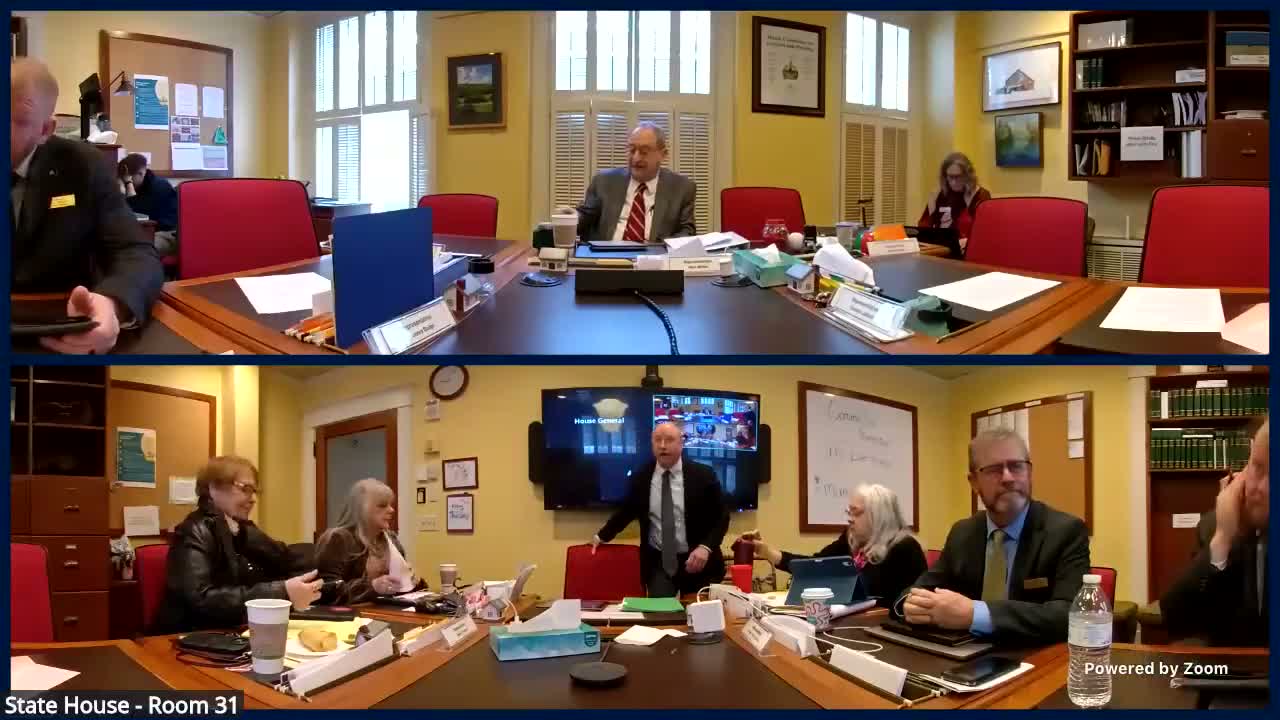
Champlain Housing Trust testified before a legislative housing panel that the state risks a sharp decline in housing production without sustained, additional state funding.
Chris Donnelly, director of community relations for Champlain Housing Trust, told the panel that one‑time pandemic and surplus investments had boosted housing development but that projected funding after fiscal 2027 would lead to a substantial drop in production unless the state adds ongoing resources. "We will just be hamstrung for that time," Donnelly said, arguing that new resources would reduce motel and hotel spending and help move people into permanent housing.
Donnelly walked members through two charts the trust provided: a production/preservation timeline showing the impact of prior ARPA and surplus investments, and a modeling scenario in which an annual $45 million state investment (or a mix such as $30 million to VHCV and $10 million to VHFA programs) would substantially raise yearly production compared with baseline funding. He said the committee’s modeling request had been to estimate what it would take to meet the state target of 30,000 homes over five years and that roughly two‑thirds of those homes would likely need subsidy to be affordable.
On subsidy costs, Donnelly told the panel that financing the roughly 4,000 subsidized homes per year needed to meet the target could cost on the order of $400 million — a modeling estimate presented as an indication of scale rather than a finalized budget figure. He urged committee members to press appropriators for base funding so federal tax credits and other leverage sources can be fully used.
Members asked about related issues. Several sought clarification on just‑cause/no‑cause eviction protections; Donnelly said Champlain Housing Trust supports tenant protections but noted implementation constraints, particularly in the court system and the speed of rehousing. The panel also questioned the trust about a HUD‑funded farmworker housing forgivable‑loan program that Champlain Housing Trust administers, which Donnelly said brings substandard on‑farm housing up to code and requires units remain used for worker housing.
Committee members raised the practical question of whether there is development pipeline capacity to absorb large new annual investments; Donnelly said projects and developers exist but lack funding. He also discussed leverage from federal tax credits (the 4% and 9% programs) and a state affordable housing tax credit carve‑out for manufactured housing down‑payment assistance that currently sets aside $250,000 annually in the transcripted discussion.
The panel did not take a vote. The moderator said the committee plans to send a letter next week to House Appropriations outlining its view of the housing budget and the priorities raised in testimony and recessed to await the next witness, Chad Simmons.
The committee will receive further testimony later in the day from Chad Simmons and representatives of the AFL‑CIO Housing Investment Trust, according to the moderator.
Chris Donnelly, director of community relations for Champlain Housing Trust, told the panel that one‑time pandemic and surplus investments had boosted housing development but that projected funding after fiscal 2027 would lead to a substantial drop in production unless the state adds ongoing resources. "We will just be hamstrung for that time," Donnelly said, arguing that new resources would reduce motel and hotel spending and help move people into permanent housing.
Donnelly walked members through two charts the trust provided: a production/preservation timeline showing the impact of prior ARPA and surplus investments, and a modeling scenario in which an annual $45 million state investment (or a mix such as $30 million to VHCV and $10 million to VHFA programs) would substantially raise yearly production compared with baseline funding. He said the committee’s modeling request had been to estimate what it would take to meet the state target of 30,000 homes over five years and that roughly two‑thirds of those homes would likely need subsidy to be affordable.
On subsidy costs, Donnelly told the panel that financing the roughly 4,000 subsidized homes per year needed to meet the target could cost on the order of $400 million — a modeling estimate presented as an indication of scale rather than a finalized budget figure. He urged committee members to press appropriators for base funding so federal tax credits and other leverage sources can be fully used.
Members asked about related issues. Several sought clarification on just‑cause/no‑cause eviction protections; Donnelly said Champlain Housing Trust supports tenant protections but noted implementation constraints, particularly in the court system and the speed of rehousing. The panel also questioned the trust about a HUD‑funded farmworker housing forgivable‑loan program that Champlain Housing Trust administers, which Donnelly said brings substandard on‑farm housing up to code and requires units remain used for worker housing.
Committee members raised the practical question of whether there is development pipeline capacity to absorb large new annual investments; Donnelly said projects and developers exist but lack funding. He also discussed leverage from federal tax credits (the 4% and 9% programs) and a state affordable housing tax credit carve‑out for manufactured housing down‑payment assistance that currently sets aside $250,000 annually in the transcripted discussion.
The panel did not take a vote. The moderator said the committee plans to send a letter next week to House Appropriations outlining its view of the housing budget and the priorities raised in testimony and recessed to await the next witness, Chad Simmons.
The committee will receive further testimony later in the day from Chad Simmons and representatives of the AFL‑CIO Housing Investment Trust, according to the moderator.
Don't Miss a Word: See the Full Meeting!
Go beyond summaries. Unlock every video, transcript, and key insight with a Founder Membership.
✓
Get instant access to full meeting videos
✓
Search and clip any phrase from complete transcripts
✓
Receive AI-powered summaries & custom alerts
✓
Enjoy lifetime, unrestricted access to government data
30-day money-back guarantee
