North Kingstown advisory committee presses for restorative focus, clearer process in draft discipline policy
February 12, 2026 | North Kingstown, School Districts, Rhode Island
This article was created by AI summarizing key points discussed. AI makes mistakes, so for full details and context, please refer to the video of the full meeting. Please report any errors so we can fix them. Report an error »
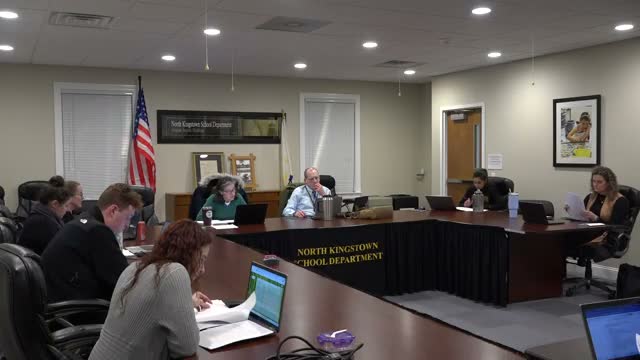
North Kingstown’s GEI advisory committee spent the bulk of its Feb. 11 meeting reviewing a redlined draft of the district’s student discipline policy, urging the administration and policy subcommittee to add clearer process steps, emphasize restorative practices, and make suspension a last resort.
The committee read aloud language from the draft revision, which Rob (the drafter) updated to say the policy’s purpose is "to promote a safe, supportive, and learning environment for all students by defining expectations for conduct, establishing a continuum of behavioral supports, and ensuring fair and consistent discipline procedures across all North Kingstown schools." Aaron Earl, school committee chair, read that language to the group and led discussion about where purpose and scope should appear in the document.
Why it matters: committee members said the public and school staff need straightforward guidance showing how low-level classroom issues escalate — or don’t — to formal discipline. Several members argued the draft devotes disproportionate space to statutory suspension procedures while offering little on lower-tier interventions and restorative responses that can change behavior without removing students from class.
What members asked for: speakers repeatedly recommended that the district maintain a tiered matrix that clarifies consequences and interventions by severity; add a simple process flow (incident → incident report → informal conversation → interventions → formal discipline → appeal) so families and staff know what to expect; and define key terms such as "fairness," "equity," "respect," and "dignity." A committee member suggested replacing or supplementing "fairness" with "equity" to reflect attention to differing needs.
Restorative vs. punitive: several participants pushed to center restorative practices in the policy’s philosophy. "What we're looking for is that the response to misconduct is going to be applied consistently and consider, like, individual circumstances and student needs," said Ally Nissenzi, the committee’s equity and engagement lead, summarizing what many speakers described as a desired balance between consistent consequences and individualized, restorative responses. Other members agreed that restorative programming should be coupled with consistent consequences so outcomes do not vary dramatically between families.
Suspensions and statute: members noted the draft includes detailed suspension language that appears to track statutory requirements (the committee referenced statute 16-2-17 during the discussion). Several members said the statute-driven suspension language is necessary but should be clearer and not crowd out the prevention and intervention content that families look for.
Teacher and parent involvement: the committee emphasized that teachers should stay "at the table" for problem-solving before a case is escalated to formal discipline, and that communications to families should be framed as discussions, not only notifications. Members raised concerns that referrals sometimes leave classroom teachers out of later conversations, reducing context for fair decision-making.
Next steps: the committee asked members to send annotated edits and highlighted notes to the chair for consolidation. The draft will move to the policy advisory committee after this committee’s input; the advisory group will determine final wording before administration and the school committee act.
The meeting ended with procedural business (approval of minutes and adjournment); no final vote on the policy occurred during the session.
The committee read aloud language from the draft revision, which Rob (the drafter) updated to say the policy’s purpose is "to promote a safe, supportive, and learning environment for all students by defining expectations for conduct, establishing a continuum of behavioral supports, and ensuring fair and consistent discipline procedures across all North Kingstown schools." Aaron Earl, school committee chair, read that language to the group and led discussion about where purpose and scope should appear in the document.
Why it matters: committee members said the public and school staff need straightforward guidance showing how low-level classroom issues escalate — or don’t — to formal discipline. Several members argued the draft devotes disproportionate space to statutory suspension procedures while offering little on lower-tier interventions and restorative responses that can change behavior without removing students from class.
What members asked for: speakers repeatedly recommended that the district maintain a tiered matrix that clarifies consequences and interventions by severity; add a simple process flow (incident → incident report → informal conversation → interventions → formal discipline → appeal) so families and staff know what to expect; and define key terms such as "fairness," "equity," "respect," and "dignity." A committee member suggested replacing or supplementing "fairness" with "equity" to reflect attention to differing needs.
Restorative vs. punitive: several participants pushed to center restorative practices in the policy’s philosophy. "What we're looking for is that the response to misconduct is going to be applied consistently and consider, like, individual circumstances and student needs," said Ally Nissenzi, the committee’s equity and engagement lead, summarizing what many speakers described as a desired balance between consistent consequences and individualized, restorative responses. Other members agreed that restorative programming should be coupled with consistent consequences so outcomes do not vary dramatically between families.
Suspensions and statute: members noted the draft includes detailed suspension language that appears to track statutory requirements (the committee referenced statute 16-2-17 during the discussion). Several members said the statute-driven suspension language is necessary but should be clearer and not crowd out the prevention and intervention content that families look for.
Teacher and parent involvement: the committee emphasized that teachers should stay "at the table" for problem-solving before a case is escalated to formal discipline, and that communications to families should be framed as discussions, not only notifications. Members raised concerns that referrals sometimes leave classroom teachers out of later conversations, reducing context for fair decision-making.
Next steps: the committee asked members to send annotated edits and highlighted notes to the chair for consolidation. The draft will move to the policy advisory committee after this committee’s input; the advisory group will determine final wording before administration and the school committee act.
The meeting ended with procedural business (approval of minutes and adjournment); no final vote on the policy occurred during the session.
View the Full Meeting & All Its Details
This article offers just a summary. Unlock complete video, transcripts, and insights as a Founder Member.
✓
Watch full, unedited meeting videos
✓
Search every word spoken in unlimited transcripts
✓
AI summaries & real-time alerts (all government levels)
✓
Permanent access to expanding government content
30-day money-back guarantee
