House transportation panel advances package tightening rules, evidence and vendor requirements for speed and traffic cameras
February 13, 2026 | 2026 Legislature VA, Virginia
This article was created by AI summarizing key points discussed. AI makes mistakes, so for full details and context, please refer to the video of the full meeting. Please report any errors so we can fix them. Report an error »
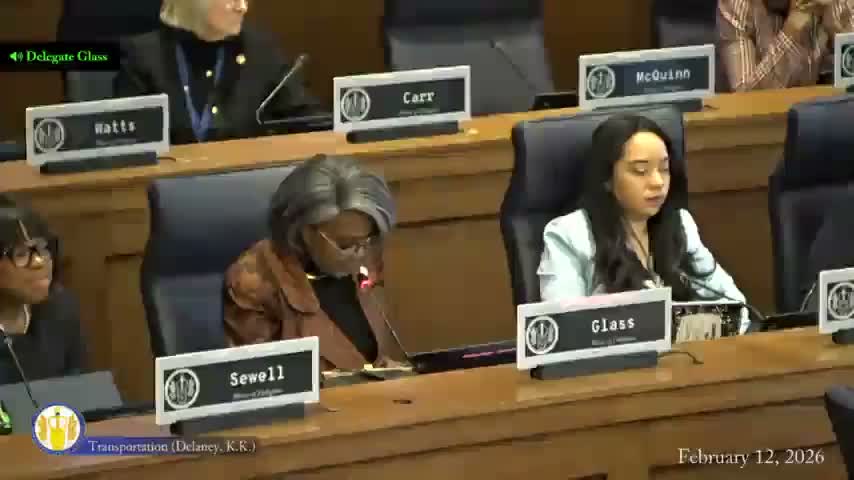
The House Committee on Transportation on Friday advanced a substitute package that adds operational limits, evidentiary rules and vendor requirements for automated speed, stop‑sign and pedestrian monitoring systems, sending the measure on for further consideration.
The substitute for House Bill 9 94 (which incorporates provisions from House Bill 12 20) requires public entities implementing or expanding pedestrian‑crossing and stop‑sign violation monitoring systems to run a public awareness program before deployment, directs the Commissioner of Highways to develop criteria for designating high‑risk pedestrian corridors, and imposes data‑retention, calibration and vendor‑compliance rules. "It directs the Commissioner of Highways to develop a criteria for designating highway segments as high risk pedestrian corridor," Delegate Glass said when outlining the substitute.
Committee members also debated evidentiary rules tied to photo‑derived citations. The substitute states that photographs or automated device output are not prima facie evidence in highway work zones unless the image depicts workers or the device operator provides a sworn certificate of certification verifying workers were present and visible. Counsel and members described additional provisions imposing civil penalties on vendors and requiring localities or vendors to waive sovereign immunity in certain court proceedings related to compliance failures.
Not all members supported the reported substitute. Delegate Carr said he was "just gonna register a no vote" on the last vote, citing ongoing concerns about the bill's treatment of sovereign immunity and the need for continued discussion with local governments. The Chair responded that she was committed to further work with localities and acknowledged the outstanding concern about enforcement and accountability.
The chair also emphasized a distinction between measures that expand the placement of speed cameras and the committee's guardrails language. "It does not affect the expansion of speed cameras, or where they can go," the Committee Chair said, describing her own bill as focused on guardrails rather than expansion.
The committee adopted a technical comma amendment and then moved the substitute as amended. The clerk closed the roll and announced the bill reports; the spoken record includes several roll tallies and committee voice votes recorded in the transcript.
The substitute for House Bill 9 94 (which incorporates provisions from House Bill 12 20) requires public entities implementing or expanding pedestrian‑crossing and stop‑sign violation monitoring systems to run a public awareness program before deployment, directs the Commissioner of Highways to develop criteria for designating high‑risk pedestrian corridors, and imposes data‑retention, calibration and vendor‑compliance rules. "It directs the Commissioner of Highways to develop a criteria for designating highway segments as high risk pedestrian corridor," Delegate Glass said when outlining the substitute.
Committee members also debated evidentiary rules tied to photo‑derived citations. The substitute states that photographs or automated device output are not prima facie evidence in highway work zones unless the image depicts workers or the device operator provides a sworn certificate of certification verifying workers were present and visible. Counsel and members described additional provisions imposing civil penalties on vendors and requiring localities or vendors to waive sovereign immunity in certain court proceedings related to compliance failures.
Not all members supported the reported substitute. Delegate Carr said he was "just gonna register a no vote" on the last vote, citing ongoing concerns about the bill's treatment of sovereign immunity and the need for continued discussion with local governments. The Chair responded that she was committed to further work with localities and acknowledged the outstanding concern about enforcement and accountability.
The chair also emphasized a distinction between measures that expand the placement of speed cameras and the committee's guardrails language. "It does not affect the expansion of speed cameras, or where they can go," the Committee Chair said, describing her own bill as focused on guardrails rather than expansion.
The committee adopted a technical comma amendment and then moved the substitute as amended. The clerk closed the roll and announced the bill reports; the spoken record includes several roll tallies and committee voice votes recorded in the transcript.
View the Full Meeting & All Its Details
This article offers just a summary. Unlock complete video, transcripts, and insights as a Founder Member.
✓
Watch full, unedited meeting videos
✓
Search every word spoken in unlimited transcripts
✓
AI summaries & real-time alerts (all government levels)
✓
Permanent access to expanding government content
30-day money-back guarantee
