House substitute advances rules for recovery residences; sponsors to weigh medical‑marijuana exemption
February 12, 2026 | 2026 Legislature VA, Virginia
This article was created by AI summarizing key points discussed. AI makes mistakes, so for full details and context, please refer to the video of the full meeting. Please report any errors so we can fix them. Report an error »
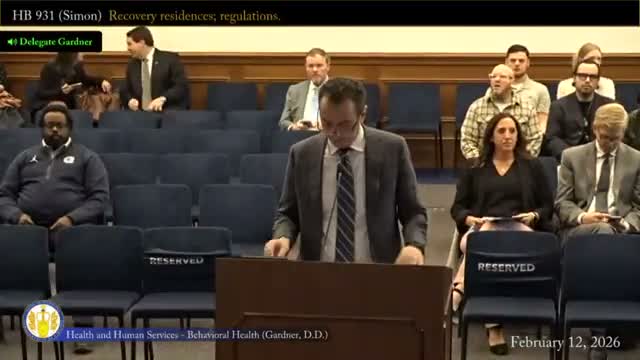
Delegate Douglas Simon presented a substitute for House Bill 931, saying the measure addresses three core areas for residential recovery homes: preventing referral‑based kickbacks between residences and clinical providers, tightening credentialing and separating certification authority from ownership, and establishing minimum certification standards and data collection tied to a continuing DBHDS work group.
The bill’s sponsor said the anti‑kickback provision would stop residences from being used as “captured marketplaces” funneling residents to affiliated clinical businesses. "Essentially the bill does 3 basic things," Simon said, outlining separation of ownership, certification reforms and specific credentialing criteria.
Public commenters largely supported the bill’s consumer protections while urging a narrowly drawn medical‑marijuana exemption. Jeremy Tillum, founder of Greenhouse RVA, told the subcommittee the bill "forces Virginians to choose between doctor‑prescribed medication and stable affordable housing" for people who use medical cannabis as part of recovery. Several Tri Cities Hospital social‑work trainees and multiple members of Greenhouse RVA also asked the committee to amend the substitute to permit medical cannabis when medically appropriate.
Simon responded that the bill requires development of consumption protocols and that those protocols could allow medical marijuana in appropriate circumstances: "I read that sort of protocols would be to prove perhaps and hopefully allow for medical marijuana when appropriate," he said, adding that the work group and crossover changes would continue to refine the language.
A motion to report the substitute and refer HB 931 to Appropriations passed on voice and roll call; the clerk recorded the bill as reported and referred 6 to 0. The sponsor and stakeholders committed to continued negotiations on the medical‑marijuana question as the measure moves forward.
The bill’s sponsor said the anti‑kickback provision would stop residences from being used as “captured marketplaces” funneling residents to affiliated clinical businesses. "Essentially the bill does 3 basic things," Simon said, outlining separation of ownership, certification reforms and specific credentialing criteria.
Public commenters largely supported the bill’s consumer protections while urging a narrowly drawn medical‑marijuana exemption. Jeremy Tillum, founder of Greenhouse RVA, told the subcommittee the bill "forces Virginians to choose between doctor‑prescribed medication and stable affordable housing" for people who use medical cannabis as part of recovery. Several Tri Cities Hospital social‑work trainees and multiple members of Greenhouse RVA also asked the committee to amend the substitute to permit medical cannabis when medically appropriate.
Simon responded that the bill requires development of consumption protocols and that those protocols could allow medical marijuana in appropriate circumstances: "I read that sort of protocols would be to prove perhaps and hopefully allow for medical marijuana when appropriate," he said, adding that the work group and crossover changes would continue to refine the language.
A motion to report the substitute and refer HB 931 to Appropriations passed on voice and roll call; the clerk recorded the bill as reported and referred 6 to 0. The sponsor and stakeholders committed to continued negotiations on the medical‑marijuana question as the measure moves forward.
Don't Miss a Word: See the Full Meeting!
Go beyond summaries. Unlock every video, transcript, and key insight with a Founder Membership.
✓
Get instant access to full meeting videos
✓
Search and clip any phrase from complete transcripts
✓
Receive AI-powered summaries & custom alerts
✓
Enjoy lifetime, unrestricted access to government data
30-day money-back guarantee
