State education chief tells House panel draft Act 73 map aims to balance quality, equity and cost
February 13, 2026 | Education, HOUSE OF REPRESENTATIVES, Committees, Legislative , Vermont
This article was created by AI summarizing key points discussed. AI makes mistakes, so for full details and context, please refer to the video of the full meeting. Please report any errors so we can fix them. Report an error »
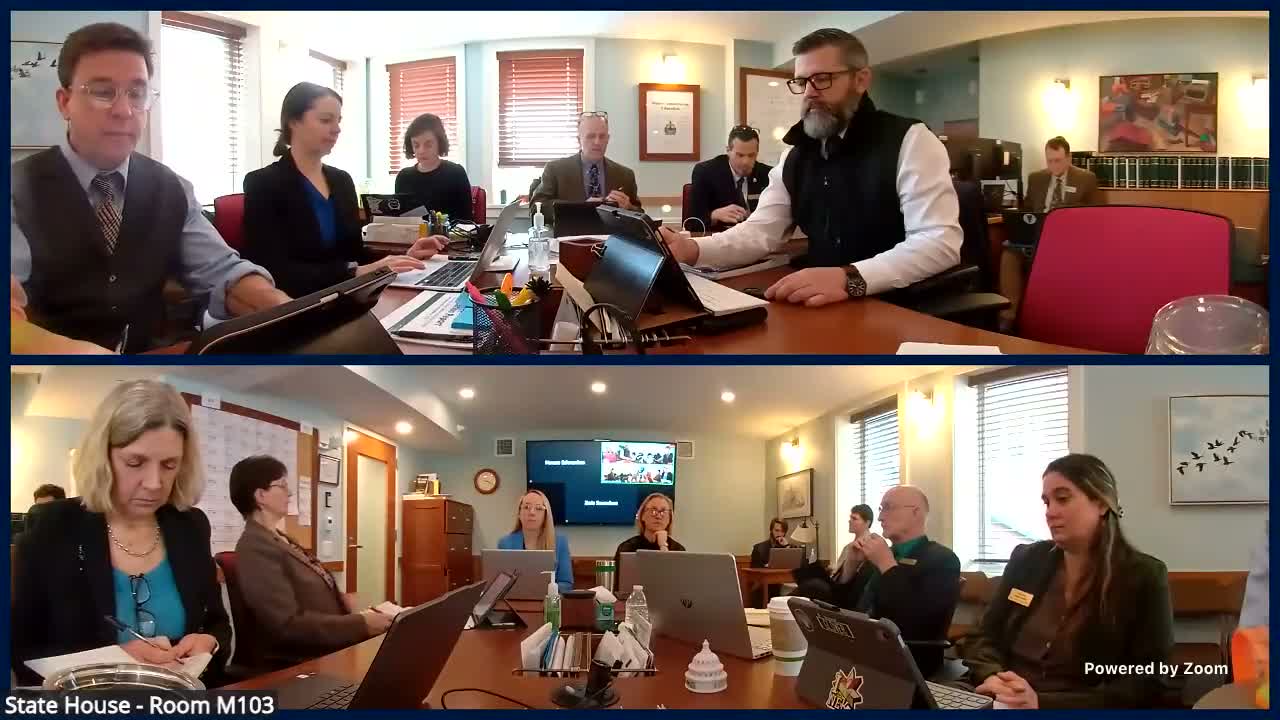
Zoe Saunders, Vermont’s secretary of education, told the House Education Committee on Feb. 12 that the committee’s draft redistricting map is intended as a starting point for discussion and is designed to help the state meet the quality goals set out in Act 73.
"I want to start by commending the committee for your courageous leadership in advancing a map," Saunders said, adding the Agency of Education would provide guiding principles rather than make line‑by‑line suggestions. She said the Agency’s role is to ensure the state delivers a "substantially equal education" across communities under federal and state accountability rules.
Saunders framed the discussion around three policy levers—funding, governance and education quality—and argued district size matters because the new foundation funding formula assumes larger, more efficient districts. Citing prior studies, she said the Agency adapted research for Vermont and noted a 2024 PICUS Automated Associates analysis that identified efficiency gains near a 3,900‑student district prototype. "That 3,900 does represent a point of efficiency," Saunders said, while emphasizing the Agency adjusted national models to fit Vermont.
Agency presenters told lawmakers that larger districts (they discussed ranges from about 2,000 up toward 4,000–8,000 students) allow centralized, specialized roles—pre‑K coordinators, curriculum directors, literacy coaches—that are costly to duplicate in many small districts. Those roles, the Agency said, are important for expanding early childhood education, mental‑health supports and career pathways and for raising teacher pay.
Saunders acknowledged trade‑offs for smaller districts: maintaining services at 2,000 students is possible but would typically require part‑time shared staff and other operating changes that limit specialization and could constrain salary increases. She said smaller districts of about 1,000 students face still greater limits on delivering the Agency’s defined quality standards.
Equity was a throughline of the testimony: Saunders argued socioeconomically and racially integrated districts tend to improve outcomes and reduce achievement gaps, and she said the House draft map narrows gaps in property wealth and student poverty compared with the current supervisory union/district configuration. The Agency noted the Vermont School Boards Association (VSBA) map narrows those gaps further and invited continued review.
Committee members raised political and practical concerns. One lawmaker said the Agency made "a very compelling case" but asked why many communities resist consolidation; another urged the panel to identify compromises that preserve local voice. Agency staff responded that fear and confusion about change drive resistance and proposed policy tools—voting wards, advisory school boards with local budget roles or targeted capital budgeting—to preserve local engagement while achieving scale.
Lawmakers also pressed the Agency on job impacts. Saunders said modeling how many teachers and support staff could lose positions is complex and depends on natural attrition, vacancies, provisional licenses and retirements. She noted Vermont has a notably high adult‑to‑student ratio in many schools and said the Agency will produce sample budgets and staffing matrices, shared with the Joint Fiscal Office (JFO), to show phased, evidence‑based scenarios rather than sudden cuts.
On timing and next steps, Saunders said the Agency has shared source files with JFO, will meet with JFO staff this week, and plans to return with more detailed modeling and updated slides. She also said she will present on school construction aid to House Ways and Means and emphasized implementation will be multi‑year, with an adjustment period the Agency expects to span several years to avoid crisis‑driven mergers.
The hearing closed with the Agency offering continued collaboration and a promise to provide the committee with updated slide decks, sample budgets and further technical support.
The Agency's presentation and follow‑up materials remain subject to committee review; no formal votes or motions on district boundaries were recorded in the hearing.
"I want to start by commending the committee for your courageous leadership in advancing a map," Saunders said, adding the Agency of Education would provide guiding principles rather than make line‑by‑line suggestions. She said the Agency’s role is to ensure the state delivers a "substantially equal education" across communities under federal and state accountability rules.
Saunders framed the discussion around three policy levers—funding, governance and education quality—and argued district size matters because the new foundation funding formula assumes larger, more efficient districts. Citing prior studies, she said the Agency adapted research for Vermont and noted a 2024 PICUS Automated Associates analysis that identified efficiency gains near a 3,900‑student district prototype. "That 3,900 does represent a point of efficiency," Saunders said, while emphasizing the Agency adjusted national models to fit Vermont.
Agency presenters told lawmakers that larger districts (they discussed ranges from about 2,000 up toward 4,000–8,000 students) allow centralized, specialized roles—pre‑K coordinators, curriculum directors, literacy coaches—that are costly to duplicate in many small districts. Those roles, the Agency said, are important for expanding early childhood education, mental‑health supports and career pathways and for raising teacher pay.
Saunders acknowledged trade‑offs for smaller districts: maintaining services at 2,000 students is possible but would typically require part‑time shared staff and other operating changes that limit specialization and could constrain salary increases. She said smaller districts of about 1,000 students face still greater limits on delivering the Agency’s defined quality standards.
Equity was a throughline of the testimony: Saunders argued socioeconomically and racially integrated districts tend to improve outcomes and reduce achievement gaps, and she said the House draft map narrows gaps in property wealth and student poverty compared with the current supervisory union/district configuration. The Agency noted the Vermont School Boards Association (VSBA) map narrows those gaps further and invited continued review.
Committee members raised political and practical concerns. One lawmaker said the Agency made "a very compelling case" but asked why many communities resist consolidation; another urged the panel to identify compromises that preserve local voice. Agency staff responded that fear and confusion about change drive resistance and proposed policy tools—voting wards, advisory school boards with local budget roles or targeted capital budgeting—to preserve local engagement while achieving scale.
Lawmakers also pressed the Agency on job impacts. Saunders said modeling how many teachers and support staff could lose positions is complex and depends on natural attrition, vacancies, provisional licenses and retirements. She noted Vermont has a notably high adult‑to‑student ratio in many schools and said the Agency will produce sample budgets and staffing matrices, shared with the Joint Fiscal Office (JFO), to show phased, evidence‑based scenarios rather than sudden cuts.
On timing and next steps, Saunders said the Agency has shared source files with JFO, will meet with JFO staff this week, and plans to return with more detailed modeling and updated slides. She also said she will present on school construction aid to House Ways and Means and emphasized implementation will be multi‑year, with an adjustment period the Agency expects to span several years to avoid crisis‑driven mergers.
The hearing closed with the Agency offering continued collaboration and a promise to provide the committee with updated slide decks, sample budgets and further technical support.
The Agency's presentation and follow‑up materials remain subject to committee review; no formal votes or motions on district boundaries were recorded in the hearing.
View the Full Meeting & All Its Details
This article offers just a summary. Unlock complete video, transcripts, and insights as a Founder Member.
✓
Watch full, unedited meeting videos
✓
Search every word spoken in unlimited transcripts
✓
AI summaries & real-time alerts (all government levels)
✓
Permanent access to expanding government content
30-day money-back guarantee
