Chief Administrative Judge tells Legislature the courts are recovering but seeks funds for e-filing, problem-solving courts and civil legal services
February 12, 2026 | 2026 Legislature NY, New York
This article was created by AI summarizing key points discussed. AI makes mistakes, so for full details and context, please refer to the video of the full meeting. Please report any errors so we can fix them. Report an error »
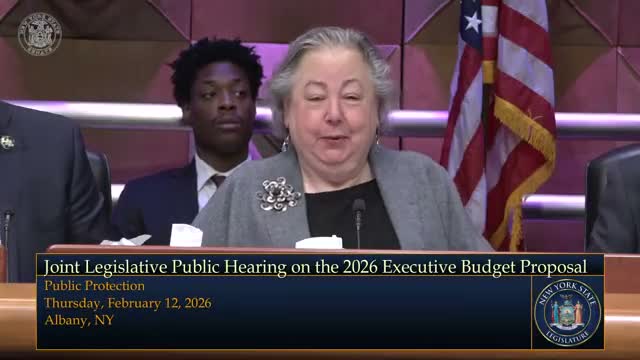
Chief Administrative Judge Joseph Zayas told New York's joint fiscal committees that the Unified Court System is recovering from years of staffing shortfalls and growing its problem‑solving courts and e‑filing program but needs additional funding to sustain gains.
Zayas said the court system's proposed operating increase of $150 million (part of a $3.2 billion request that includes a $49 million priority add) would maintain existing operations and allow continued progress on initiatives the courts view as priorities, including civil legal services, case processing reforms and a statewide rollout of e‑filing.
"Since July 2023, we have increased our nonjudicial workforce by 1,700 employees," Zayas said in opening remarks, adding that the system expects to return to staffing levels last seen in 2009 by the end of the fiscal year. Zayas highlighted reductions in family‑court backlogs—"Family Court e‑filing doubled its geographic footprint in 2025 and has now been implemented in 24 counties"—and said e‑filing pilots are expanding to more criminal and civil courtrooms.
Legislators used a long question period to press Zayas for details on how the courts are handling emergencies and immigration enforcement at courthouses. On Protect Our Courts Act implementation and federal activity at courthouses, Zayas said the system is tracking every federal law‑enforcement presence and: "We had only 58 situations where ICE came into our courthouses" in 2025 and "there were only 4 actual arrests happening in the courthouse," adding that many visits were limited to record requests or observation.
Lawmakers asked for county and district detail and asked whether OCA would publish district‑level logs; Zayas said the system is prepared to share data and is chronically tracking the incidents by judicial district.
The hearing also included questions about family court access (hours, supervised visitation and training for town and village judges), judicial vacancies and how the system determines where new judgeships should be located. Zayas said the assignment is based on caseload metrics and other factors and described efforts to create space in courthouses and pilot problem‑solving courts in more counties.
Why it matters: The court system argues that additional state funds are needed to preserve improvements such as reduced backlogs and e‑filing so New Yorkers get timely access to justice. The testimony also drew renewed scrutiny from lawmakers about how local courtroom operations interact with federal immigration enforcement; Zayas's figures prompted requests for more transparent, district‑level reporting. Next steps include follow‑up data requests from committee staff and a continuing review of the budget request during the fiscal negotiations.
Sources: Testimony by Joseph Zayas to the joint Senate Finance and Assembly Ways & Means hearing (Feb. 12, 2026).
Zayas said the court system's proposed operating increase of $150 million (part of a $3.2 billion request that includes a $49 million priority add) would maintain existing operations and allow continued progress on initiatives the courts view as priorities, including civil legal services, case processing reforms and a statewide rollout of e‑filing.
"Since July 2023, we have increased our nonjudicial workforce by 1,700 employees," Zayas said in opening remarks, adding that the system expects to return to staffing levels last seen in 2009 by the end of the fiscal year. Zayas highlighted reductions in family‑court backlogs—"Family Court e‑filing doubled its geographic footprint in 2025 and has now been implemented in 24 counties"—and said e‑filing pilots are expanding to more criminal and civil courtrooms.
Legislators used a long question period to press Zayas for details on how the courts are handling emergencies and immigration enforcement at courthouses. On Protect Our Courts Act implementation and federal activity at courthouses, Zayas said the system is tracking every federal law‑enforcement presence and: "We had only 58 situations where ICE came into our courthouses" in 2025 and "there were only 4 actual arrests happening in the courthouse," adding that many visits were limited to record requests or observation.
Lawmakers asked for county and district detail and asked whether OCA would publish district‑level logs; Zayas said the system is prepared to share data and is chronically tracking the incidents by judicial district.
The hearing also included questions about family court access (hours, supervised visitation and training for town and village judges), judicial vacancies and how the system determines where new judgeships should be located. Zayas said the assignment is based on caseload metrics and other factors and described efforts to create space in courthouses and pilot problem‑solving courts in more counties.
Why it matters: The court system argues that additional state funds are needed to preserve improvements such as reduced backlogs and e‑filing so New Yorkers get timely access to justice. The testimony also drew renewed scrutiny from lawmakers about how local courtroom operations interact with federal immigration enforcement; Zayas's figures prompted requests for more transparent, district‑level reporting. Next steps include follow‑up data requests from committee staff and a continuing review of the budget request during the fiscal negotiations.
Sources: Testimony by Joseph Zayas to the joint Senate Finance and Assembly Ways & Means hearing (Feb. 12, 2026).
View the Full Meeting & All Its Details
This article offers just a summary. Unlock complete video, transcripts, and insights as a Founder Member.
✓
Watch full, unedited meeting videos
✓
Search every word spoken in unlimited transcripts
✓
AI summaries & real-time alerts (all government levels)
✓
Permanent access to expanding government content
30-day money-back guarantee
