Transportation agency proposes excluding previously disturbed highway land from Act 250 calculations to avoid duplicative review
February 13, 2026 | Senate Transportation, SENATE, Committees, Legislative , Vermont
This article was created by AI summarizing key points discussed. AI makes mistakes, so for full details and context, please refer to the video of the full meeting. Please report any errors so we can fix them. Report an error »
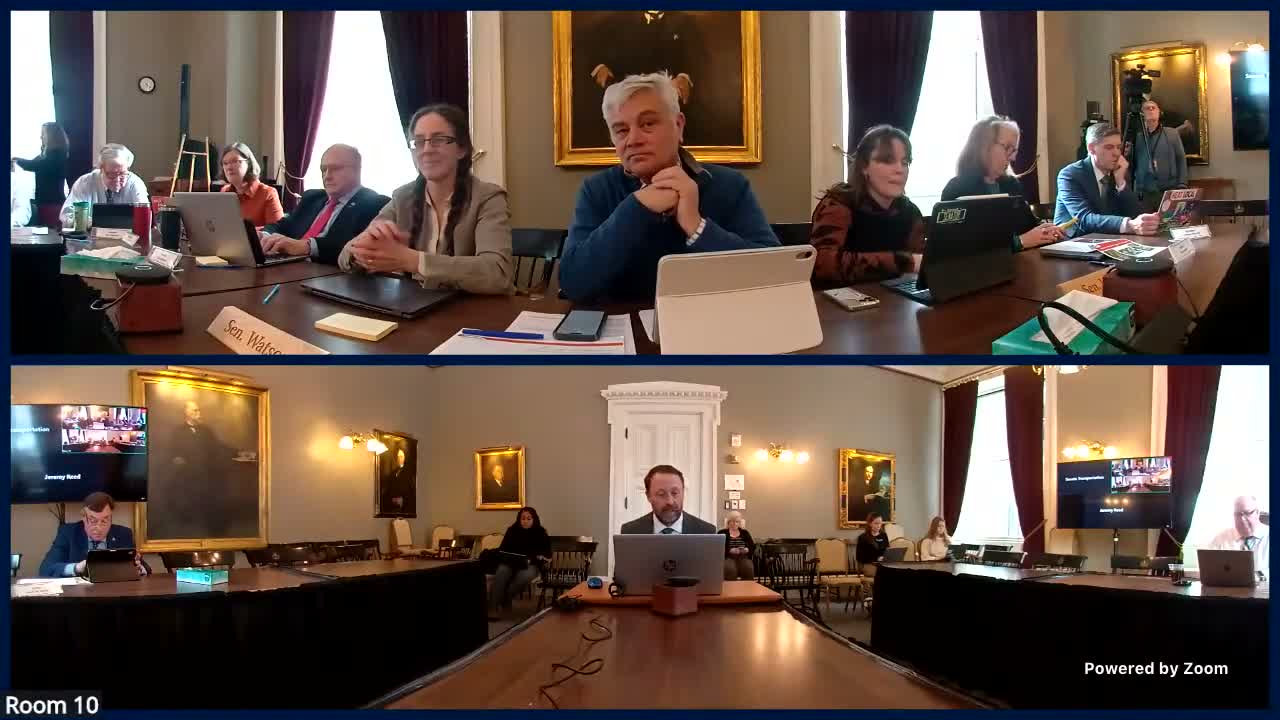
Jeremy Reed, chief engineer for the Agency of Transportation, told a joint meeting of the Senate Natural Resources and Senate Transportation committees that the agency plans to propose language to exclude land “previously disturbed as a result of the construction of a transportation facility” from the acreage calculation used to determine Act 250 jurisdiction for federally funded transportation projects. "Land that was previously disturbed as a result of the construction of a transportation facility will be excluded from computing the amount of land involved provided that the project is subject to this exclusion," Reed said during the presentation.
The change, Reed said, is intended to reduce duplicative review where projects already have federal environmental review through the National Environmental Policy Act (NEPA) and related state permits. Reed described recent projects with inconsistent outcomes — including a bridge project he called a "bridal design" bid project, a divergent-diamond interchange that required Act 250 review, and the Middlebury Tunnel, which did not — to show differing interpretations of what constitutes a "substantial change" that triggers Act 250 jurisdiction.
Reed illustrated the consequences with the Linden project, where a jurisdictional opinion issued late in the design process determined the project likely fell under Act 250. He said a private landowner refused use of a contiguous staging area, and the contractor estimated that losing that staging area would increase costs by about $2,000,000. Reed also warned that once lands are deemed "involved" under Act 250 they remain subject to the statute "in perpetuity," which can have long-term implications for property use and future work.
On timing, Reed said the Act 250 process "could take 6, 8 months," and that delays can drive up project costs; he used a general assumption of 3% year-over-year cost escalation to illustrate how lost construction seasons can increase expenses. He emphasized that the primary harm is uncertainty about timing rather than direct permit fees, and that the agency often relies on NEPA and state permits to satisfy many Act 250 criteria but must typically have those permits and final design in hand before an Act 250 application is considered complete.
Senators pressed Reed on environmental and local impacts. One member asked whether the proposal would affect areas designated as tier 1a or 1b and raised concerns about projects near rivers and wetlands. Reed said much of the state highway system falls in tier 2 or 3 but acknowledged that mapping and analysis are needed to determine how many facilities lie in more sensitive tiers. Michelle, an Agency of Transportation staff member, noted rail projects generally involve federal preemption and that airports are already jurisdictional; she added that federal wetlands permits and Section 106 archaeological reviews still apply to rail work.
Reed read core drafting ideas the agency has circulated in generic language: the proposal would net out previously disturbed land from acreage calculations for transportation facilities funded by federal aid, add a statutory definition of "transportation facility," and exempt routine maintenance (resurfacing, rehabilitation, like-for-like bridge and culvert replacement) from triggering Act 250 so long as no new permanent access or major realignment is proposed. He said the agency has no specific bill filed yet and is considering vehicles for the language, including a standalone bill or insertion into another transportation or natural-resources vehicle.
Committee members asked for clearer maps and data on which state transportation assets fall into sensitive tiers, specific cost-accounting for delays, and refined statutory language. Reed offered to return with more detail and to coordinate with the Agency of Natural Resources and other stakeholders. The committee did not take a formal vote; members asked that final bill language or alternatives be returned to the committee for review.
The change, Reed said, is intended to reduce duplicative review where projects already have federal environmental review through the National Environmental Policy Act (NEPA) and related state permits. Reed described recent projects with inconsistent outcomes — including a bridge project he called a "bridal design" bid project, a divergent-diamond interchange that required Act 250 review, and the Middlebury Tunnel, which did not — to show differing interpretations of what constitutes a "substantial change" that triggers Act 250 jurisdiction.
Reed illustrated the consequences with the Linden project, where a jurisdictional opinion issued late in the design process determined the project likely fell under Act 250. He said a private landowner refused use of a contiguous staging area, and the contractor estimated that losing that staging area would increase costs by about $2,000,000. Reed also warned that once lands are deemed "involved" under Act 250 they remain subject to the statute "in perpetuity," which can have long-term implications for property use and future work.
On timing, Reed said the Act 250 process "could take 6, 8 months," and that delays can drive up project costs; he used a general assumption of 3% year-over-year cost escalation to illustrate how lost construction seasons can increase expenses. He emphasized that the primary harm is uncertainty about timing rather than direct permit fees, and that the agency often relies on NEPA and state permits to satisfy many Act 250 criteria but must typically have those permits and final design in hand before an Act 250 application is considered complete.
Senators pressed Reed on environmental and local impacts. One member asked whether the proposal would affect areas designated as tier 1a or 1b and raised concerns about projects near rivers and wetlands. Reed said much of the state highway system falls in tier 2 or 3 but acknowledged that mapping and analysis are needed to determine how many facilities lie in more sensitive tiers. Michelle, an Agency of Transportation staff member, noted rail projects generally involve federal preemption and that airports are already jurisdictional; she added that federal wetlands permits and Section 106 archaeological reviews still apply to rail work.
Reed read core drafting ideas the agency has circulated in generic language: the proposal would net out previously disturbed land from acreage calculations for transportation facilities funded by federal aid, add a statutory definition of "transportation facility," and exempt routine maintenance (resurfacing, rehabilitation, like-for-like bridge and culvert replacement) from triggering Act 250 so long as no new permanent access or major realignment is proposed. He said the agency has no specific bill filed yet and is considering vehicles for the language, including a standalone bill or insertion into another transportation or natural-resources vehicle.
Committee members asked for clearer maps and data on which state transportation assets fall into sensitive tiers, specific cost-accounting for delays, and refined statutory language. Reed offered to return with more detail and to coordinate with the Agency of Natural Resources and other stakeholders. The committee did not take a formal vote; members asked that final bill language or alternatives be returned to the committee for review.
Don't Miss a Word: See the Full Meeting!
Go beyond summaries. Unlock every video, transcript, and key insight with a Founder Membership.
✓
Get instant access to full meeting videos
✓
Search and clip any phrase from complete transcripts
✓
Receive AI-powered summaries & custom alerts
✓
Enjoy lifetime, unrestricted access to government data
30-day money-back guarantee
