Joe White outlines Wicomico County priorities: education funding, taxes, housing and infrastructure
This article was created by AI summarizing key points discussed. AI makes mistakes, so for full details and context, please refer to the video of the full meeting. Please report any errors so we can fix them. Report an error »
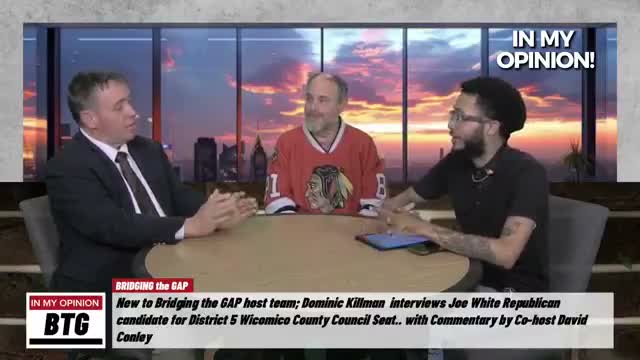
Joe White, a Wicomico County entrepreneur and podcast guest, outlined a set of local priorities in an interview with host David Conley and fellow guest Dominic Coleman, emphasizing caution on property‑tax increases, readiness for state school mandates, investment in workforce training and a disciplined approach to local incentives.
White said the county should wait to see what mandates the state of Maryland issues before committing additional Board of Education funds, and that the county has already faced a construction funding need at Fruitland Primary that he estimated at about $16,000,000. "We have to forward fund the construction there to the tune of about $16,000,000," he said, adding that the county raised its maintenance‑of‑effort level last year and provided roughly an extra $1,000,000.
On taxation, White opposed lifting local property‑tax caps. He argued that only about 35% of county revenue comes from property taxes and warned that removing caps could raise costs for small business owners. He also cited recent audit numbers and revenue figures, saying income‑tax revenues have risen substantially and noting a year‑over‑year increase he described as $15,600,000 and an unspent budget delta of about $33,000,000. The interview contains two different revenue figures White cited (one larger multi‑year figure and the $15.6 million year‑over‑year amount) that he did not reconcile during the discussion.
On affordable housing, White described the common 30‑percent‑of‑income definition and said the county should reduce regulatory barriers rather than rely primarily on large developer handouts. "If we're too busy fighting over who should get this check or that check, we're not actually worrying about our own citizens," he said, and singled out the Maryland Department of the Environment's rules as a constraint on expanding housing.
White said the county needs to plan for parks and open‑space spending rather than creating more parks immediately. Referring to Hebron Lions Field, he said upgrades are appropriate but urged a countywide master plan for project open‑space funds.
Turning to economic development, White emphasized workforce training as a route to attract manufacturers. He noted local training programs and pointed to a need for at least 92 ALS/BLS paramedics and EMTs, citing presentations that identified that shortfall, and suggested partnering with local institutions such as Wor‑Wic Community College and the county airport’s flight‑mechanics program to show prospective employers a trainable workforce.
White also addressed long‑running budget tradeoffs: he said about $500,000 (he described it as "half $1,000,000") earmarked for road paving was moved into the county pension fund, and he noted the pension plan’s funded ratio improved from roughly 72% to 78%. "The rule of thumb is 80%," he said, and advocated leaders set priorities together to balance pensions and infrastructure.
On governance and relationships, White said he supports County Executive Julie Giordano’s correctional‑officer training rollout in principle, favoring an in‑house WSO training model over the JEM model given current staffing shortages. He also said his past support for a ballot referendum on eliminating the county executive reflected a desire to let voters decide; because voters retained the executive position, he said he is now comfortable working within that structure.
White voiced opposition to adopting ranked‑choice voting countywide, saying local contests rarely feature enough candidates for the system to change outcomes. He criticized bringing out‑of‑town lobbyists into local discussions about voting reform as legally permissible but ill‑suited to a local audience.
The interview closed with mutual praise among hosts and guests for community efforts to help unhoused residents. The conversation was conversational and policy‑oriented rather than a formal campaign speech.
Next steps: White described policy priorities and questions for county leaders (state mandates, pension versus paving priorities, and workforce investments) but did not describe any formal motions, legislative proposals or votes in this interview.
White said the county should wait to see what mandates the state of Maryland issues before committing additional Board of Education funds, and that the county has already faced a construction funding need at Fruitland Primary that he estimated at about $16,000,000. "We have to forward fund the construction there to the tune of about $16,000,000," he said, adding that the county raised its maintenance‑of‑effort level last year and provided roughly an extra $1,000,000.
On taxation, White opposed lifting local property‑tax caps. He argued that only about 35% of county revenue comes from property taxes and warned that removing caps could raise costs for small business owners. He also cited recent audit numbers and revenue figures, saying income‑tax revenues have risen substantially and noting a year‑over‑year increase he described as $15,600,000 and an unspent budget delta of about $33,000,000. The interview contains two different revenue figures White cited (one larger multi‑year figure and the $15.6 million year‑over‑year amount) that he did not reconcile during the discussion.
On affordable housing, White described the common 30‑percent‑of‑income definition and said the county should reduce regulatory barriers rather than rely primarily on large developer handouts. "If we're too busy fighting over who should get this check or that check, we're not actually worrying about our own citizens," he said, and singled out the Maryland Department of the Environment's rules as a constraint on expanding housing.
White said the county needs to plan for parks and open‑space spending rather than creating more parks immediately. Referring to Hebron Lions Field, he said upgrades are appropriate but urged a countywide master plan for project open‑space funds.
Turning to economic development, White emphasized workforce training as a route to attract manufacturers. He noted local training programs and pointed to a need for at least 92 ALS/BLS paramedics and EMTs, citing presentations that identified that shortfall, and suggested partnering with local institutions such as Wor‑Wic Community College and the county airport’s flight‑mechanics program to show prospective employers a trainable workforce.
White also addressed long‑running budget tradeoffs: he said about $500,000 (he described it as "half $1,000,000") earmarked for road paving was moved into the county pension fund, and he noted the pension plan’s funded ratio improved from roughly 72% to 78%. "The rule of thumb is 80%," he said, and advocated leaders set priorities together to balance pensions and infrastructure.
On governance and relationships, White said he supports County Executive Julie Giordano’s correctional‑officer training rollout in principle, favoring an in‑house WSO training model over the JEM model given current staffing shortages. He also said his past support for a ballot referendum on eliminating the county executive reflected a desire to let voters decide; because voters retained the executive position, he said he is now comfortable working within that structure.
White voiced opposition to adopting ranked‑choice voting countywide, saying local contests rarely feature enough candidates for the system to change outcomes. He criticized bringing out‑of‑town lobbyists into local discussions about voting reform as legally permissible but ill‑suited to a local audience.
The interview closed with mutual praise among hosts and guests for community efforts to help unhoused residents. The conversation was conversational and policy‑oriented rather than a formal campaign speech.
Next steps: White described policy priorities and questions for county leaders (state mandates, pension versus paving priorities, and workforce investments) but did not describe any formal motions, legislative proposals or votes in this interview.
Don't Miss a Word: See the Full Meeting!
Go beyond summaries. Unlock every video, transcript, and key insight with a Founder Membership.
✓
Get instant access to full meeting videos
✓
Search and clip any phrase from complete transcripts
✓
Receive AI-powered summaries & custom alerts
✓
Enjoy lifetime, unrestricted access to government data
30-day money-back guarantee
