Aurora Police outline redistricting to cut response times and clarify immigration role
February 12, 2026 | Aurora City, Douglas County, Colorado
This article was created by AI summarizing key points discussed. AI makes mistakes, so for full details and context, please refer to the video of the full meeting. Please report any errors so we can fix them. Report an error »
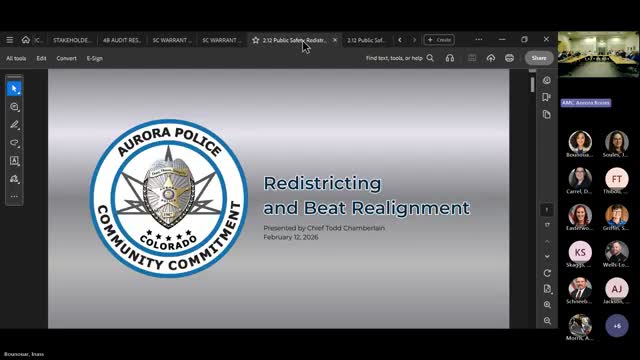
Aurora Police Department leaders outlined planned boundary changes, staffing shifts and policy clarifications intended to improve response times and reduce victimization across the city.
APD leadership said the department will change district lines this Saturday, moving from north–south to east–west boundaries, redistribute beats and add three officers to strengthen the PAR (Police and Resource) teams. "We are gonna flip the switch on it," the chief said, and staff will monitor performance metrics and audits to ensure continuity of operations.
Police presenters attributed year-over-year reductions in several major crime categories — citing figures presented to the council of a 16.7% drop in homicides, a 43.2% drop in motor-vehicle thefts and more than a 54% drop in nonfatal shootings — to policy changes including dispatch-priority updates, revised nomenclature for emergent calls, hot-spot policing and scheduling that improved unit reliability.
The chief also addressed questions about immigration enforcement: "We do not enforce federal immigration laws," the APD leader said, explaining that city practice is to enforce state and local criminal law and to provide arrest-related information to federal partners where required. The presentation referenced a statutory reporting requirement the speaker called the "Lake and Riley Act," and staff said arrest data are sent to DHS after arrest (pre-conviction) via NCIC, the internal law-enforcement database; they said redactions and protective orders are applied where statutory rules require them.
Council members pressed staff about data fields retained in police records — such as country of origin or identification types — and whether those records could be disclosed through subpoenas or public-records requests. Staff replied that such information is collected for victimology and operational analytics, is treated as internal data, and would be subject to redaction and protective-order review when appropriate.
Officials emphasized audits and monitoring after implementation and said the city will adjust boundaries or policy if the evaluations show problems.
APD leadership said the department will change district lines this Saturday, moving from north–south to east–west boundaries, redistribute beats and add three officers to strengthen the PAR (Police and Resource) teams. "We are gonna flip the switch on it," the chief said, and staff will monitor performance metrics and audits to ensure continuity of operations.
Police presenters attributed year-over-year reductions in several major crime categories — citing figures presented to the council of a 16.7% drop in homicides, a 43.2% drop in motor-vehicle thefts and more than a 54% drop in nonfatal shootings — to policy changes including dispatch-priority updates, revised nomenclature for emergent calls, hot-spot policing and scheduling that improved unit reliability.
The chief also addressed questions about immigration enforcement: "We do not enforce federal immigration laws," the APD leader said, explaining that city practice is to enforce state and local criminal law and to provide arrest-related information to federal partners where required. The presentation referenced a statutory reporting requirement the speaker called the "Lake and Riley Act," and staff said arrest data are sent to DHS after arrest (pre-conviction) via NCIC, the internal law-enforcement database; they said redactions and protective orders are applied where statutory rules require them.
Council members pressed staff about data fields retained in police records — such as country of origin or identification types — and whether those records could be disclosed through subpoenas or public-records requests. Staff replied that such information is collected for victimology and operational analytics, is treated as internal data, and would be subject to redaction and protective-order review when appropriate.
Officials emphasized audits and monitoring after implementation and said the city will adjust boundaries or policy if the evaluations show problems.
View the Full Meeting & All Its Details
This article offers just a summary. Unlock complete video, transcripts, and insights as a Founder Member.
✓
Watch full, unedited meeting videos
✓
Search every word spoken in unlimited transcripts
✓
AI summaries & real-time alerts (all government levels)
✓
Permanent access to expanding government content
30-day money-back guarantee
