California launches Medi‑Cal Behavioral Health Scholarship Program; applications due March 16
February 12, 2026 | Department of Health Care Access and Information, Agencies under Office of the Governor, Executive, California
This article was created by AI summarizing key points discussed. AI makes mistakes, so for full details and context, please refer to the video of the full meeting. Please report any errors so we can fix them. Report an error »
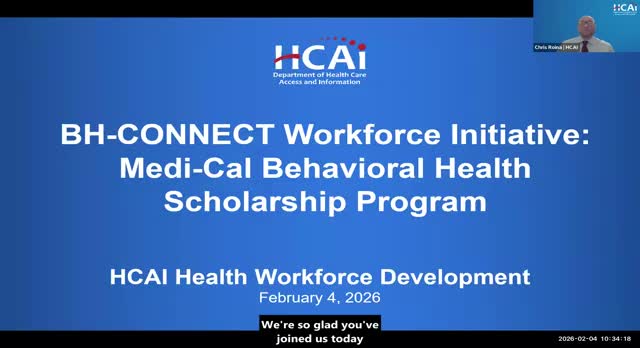
The Department of Health Care Access and Information (HCAI) on Feb. 2 launched the Medi‑Cal Behavioral Health Scholarship Program (MBHSP), a state scholarship intended to help students complete behavioral‑health credentials and commit to serving Medi‑Cal members in safety‑net settings.
"The Medi‑Cal Behavioral Health Scholarship Program is designed to support students pursuing careers in behavioral health," said Dr. Sharmell Shaw, branch chief for behavioral health and policy at HCAI, during the webinar launch. The program is part of HCAI’s BH Connect workforce initiative, which HCAI said will invest up to $1.9 billion between 2025 and 2029 across five workforce programs.
According to HCAI, the MBHSP cycle that opened Feb. 2 has approximately $6.9 million available for individual awards. Samantha Sadler, behavioral health policy analyst, said individual award maximums vary by profession: nurse practitioners and physician assistants may be eligible for awards up to $240,000 (with a four‑year service obligation); a second tier of licensed behavioral‑health professionals may receive up to $180,000 (four years); a third tier that includes alcohol and other drug counselors, certified peer support specialists, certified wellness coaches and community health workers has a maximum of $120,000, with service‑obligation length scaling by award amount.
Charles Frost, program officer, gave the application timeline and requirements: the application opened Feb. 2; the deadline to apply is March 16, 2026 at 3 p.m.; award notices are expected in June; and grant agreements are anticipated to start in August. Frost said applications require attestations, selection of anticipated profession and accredited pathway, a screenshot of publicly listed tuition for the applicant’s 2025–26 academic program, and upload of the 2026–27 FAFSA and Cal Grant verification.
HCAI emphasized that scholarship payments will be made directly to educational institutions and cannot be provided to individuals. The funds are restricted to education‑related costs — tuition, mandatory fees, textbooks and required supplies — and cannot be used for living expenses, childcare or transportation. Grantees must notify HCAI of any delays or changes to education or service obligations; HCAI may seek repayment of awarded funds if recipients fail to complete their education or fulfill service obligations except in limited circumstances spelled out in the grant guide.
Eligibility and service‑site rules: HCAI said applicants must be current, full‑time students in an eligible behavioral‑health program that leads directly to licensure or certification. The education program must be located in California (online programs are eligible if they have a physical presence in California). MBHSP recipients must complete their education by June 30, 2029, maintain active registration/licensure during their service obligation, and fulfill a full‑time service obligation in Medi‑Cal safety‑net settings. Examples of eligible settings include federally qualified health centers (FQHCs), community mental health centers (CMHCs) as defined by the California Department of Public Health, rural health clinics and hospitals or behavioral settings that meet specified Medicaid/uninsured payer‑mix thresholds.
On scoring and program priorities, Frost said applications will be evaluated for language skills (languages other than English), prior participation in publicly funded grant programs, prior experience working in a Medi‑Cal safety‑net setting, institution type (public or private), and degree type. HCAI advised applicants to consult the grant guide for full scoring criteria and detailed definitions of what counts as direct client care for service‑obligation purposes.
During the webinar Q&A, HCAI staff answered common applicant questions: MBHSP is for currently enrolled students (not already‑licensed practitioners), full‑time student status requires at least 12 credits per semester/quarter, and applicants must apply for FAFSA and Cal Grant as part of the federal agreement requirements. HCAI said it does not provide direct employment placement assistance but will rely on employer‑completed employment verification forms to confirm site eligibility and payer mix when recipients begin their service obligations.
The application and resources: HCAI posted the application on the BH Connect/MBHSP funding portal; the grant guide, informational flyer and webinar recording will be available on HCAI’s website. Frost noted that applicants who need help determining program eligibility should email the MBHSP inbox for individualized review.
"The latest you can complete your education program is June 30, 2029," Sadler said, and Charles Frost reminded applicants of the March 16, 2026 at 3 p.m. deadline. HCAI provided an inbox for program‑specific questions (mbhsp@hcai.ca.gov) and a BH Connect helpline at (916) 326‑3899.
What happens next: HCAI expects to notify applicants of awards in June and to begin grant agreements in August 2026. Applicants should review the grant guide for full program rules, waiver and breach policies, and scoring criteria before applying.
"The Medi‑Cal Behavioral Health Scholarship Program is designed to support students pursuing careers in behavioral health," said Dr. Sharmell Shaw, branch chief for behavioral health and policy at HCAI, during the webinar launch. The program is part of HCAI’s BH Connect workforce initiative, which HCAI said will invest up to $1.9 billion between 2025 and 2029 across five workforce programs.
According to HCAI, the MBHSP cycle that opened Feb. 2 has approximately $6.9 million available for individual awards. Samantha Sadler, behavioral health policy analyst, said individual award maximums vary by profession: nurse practitioners and physician assistants may be eligible for awards up to $240,000 (with a four‑year service obligation); a second tier of licensed behavioral‑health professionals may receive up to $180,000 (four years); a third tier that includes alcohol and other drug counselors, certified peer support specialists, certified wellness coaches and community health workers has a maximum of $120,000, with service‑obligation length scaling by award amount.
Charles Frost, program officer, gave the application timeline and requirements: the application opened Feb. 2; the deadline to apply is March 16, 2026 at 3 p.m.; award notices are expected in June; and grant agreements are anticipated to start in August. Frost said applications require attestations, selection of anticipated profession and accredited pathway, a screenshot of publicly listed tuition for the applicant’s 2025–26 academic program, and upload of the 2026–27 FAFSA and Cal Grant verification.
HCAI emphasized that scholarship payments will be made directly to educational institutions and cannot be provided to individuals. The funds are restricted to education‑related costs — tuition, mandatory fees, textbooks and required supplies — and cannot be used for living expenses, childcare or transportation. Grantees must notify HCAI of any delays or changes to education or service obligations; HCAI may seek repayment of awarded funds if recipients fail to complete their education or fulfill service obligations except in limited circumstances spelled out in the grant guide.
Eligibility and service‑site rules: HCAI said applicants must be current, full‑time students in an eligible behavioral‑health program that leads directly to licensure or certification. The education program must be located in California (online programs are eligible if they have a physical presence in California). MBHSP recipients must complete their education by June 30, 2029, maintain active registration/licensure during their service obligation, and fulfill a full‑time service obligation in Medi‑Cal safety‑net settings. Examples of eligible settings include federally qualified health centers (FQHCs), community mental health centers (CMHCs) as defined by the California Department of Public Health, rural health clinics and hospitals or behavioral settings that meet specified Medicaid/uninsured payer‑mix thresholds.
On scoring and program priorities, Frost said applications will be evaluated for language skills (languages other than English), prior participation in publicly funded grant programs, prior experience working in a Medi‑Cal safety‑net setting, institution type (public or private), and degree type. HCAI advised applicants to consult the grant guide for full scoring criteria and detailed definitions of what counts as direct client care for service‑obligation purposes.
During the webinar Q&A, HCAI staff answered common applicant questions: MBHSP is for currently enrolled students (not already‑licensed practitioners), full‑time student status requires at least 12 credits per semester/quarter, and applicants must apply for FAFSA and Cal Grant as part of the federal agreement requirements. HCAI said it does not provide direct employment placement assistance but will rely on employer‑completed employment verification forms to confirm site eligibility and payer mix when recipients begin their service obligations.
The application and resources: HCAI posted the application on the BH Connect/MBHSP funding portal; the grant guide, informational flyer and webinar recording will be available on HCAI’s website. Frost noted that applicants who need help determining program eligibility should email the MBHSP inbox for individualized review.
"The latest you can complete your education program is June 30, 2029," Sadler said, and Charles Frost reminded applicants of the March 16, 2026 at 3 p.m. deadline. HCAI provided an inbox for program‑specific questions (mbhsp@hcai.ca.gov) and a BH Connect helpline at (916) 326‑3899.
What happens next: HCAI expects to notify applicants of awards in June and to begin grant agreements in August 2026. Applicants should review the grant guide for full program rules, waiver and breach policies, and scoring criteria before applying.
View the Full Meeting & All Its Details
This article offers just a summary. Unlock complete video, transcripts, and insights as a Founder Member.
✓
Watch full, unedited meeting videos
✓
Search every word spoken in unlimited transcripts
✓
AI summaries & real-time alerts (all government levels)
✓
Permanent access to expanding government content
30-day money-back guarantee
