Residents urge Clackamas County to act on PGE Stafford transmission project; county counsel cautions limited options
February 12, 2026 | Clackamas County, Oregon
This article was created by AI summarizing key points discussed. AI makes mistakes, so for full details and context, please refer to the video of the full meeting. Please report any errors so we can fix them. Report an error »
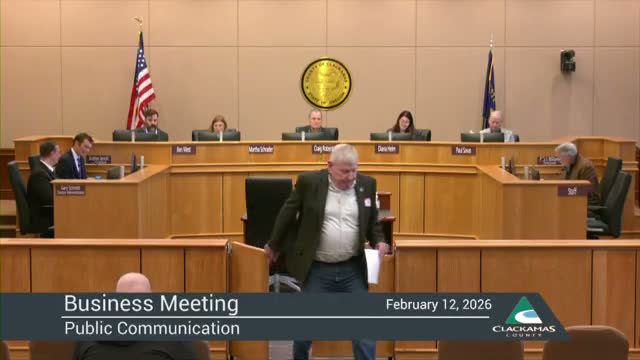
Residents and advocates urged the Clackamas County Board of Commissioners on Feb. 12 to take legal steps to block or delay Portland General Electric’s Stafford Road transmission project, saying the utility’s plans would replace smaller wooden poles with much larger steel towers along scenic rural roads.
"If you allow this to go through, I guarantee you, those lines that you see on Stafford Road, they will be over every home," Ed Wagner told the board during the public-comment period. Wagner and other speakers said the project would be precedent-setting and that the county should use "every legal tool" available, including asking the Land Use Board of Appeals (LUBA) for a voluntary remand so the county can reconsider its prior actions.
Kelly Bartholomew, who has worked with the community on the appeal for several years, said PGE repeatedly redacted data she sought and that a recent state law (referred to in testimony as House Bill 3681) had removed a PUC necessity requirement, increasing the stakes for local review. She presented a technical memo she said suggested planned data centers may be driving the need for the line.
County counsel Caleb told the board the legal options are constrained. He said the county does not decide whether approval criteria were met in the appeal — that is the hearings officer’s role under the zoning code — and that a voluntary remand would most likely send the matter back to the hearings officer without LUBA guidance, making it unlikely to change the result. "PGE is not going to agree to a voluntary remand," Caleb said, and LUBA could issue its final decision before deciding a motion for remand.
Caleb also told the board that parts of Bartholomew’s written brief cited cases that did not exist and were likely generated by artificial intelligence. He described those fake citations as a serious strain on judicial resources and said the Court of Appeals had sanctioned similar behavior in other matters.
Board members acknowledged constituent frustration and said they have been discussing what they can and cannot legally do. Commissioner Helm said he shared residents’ aesthetic concerns and asked staff to clarify what authority the board has. Chair Roberts thanked the speakers and said staff and counsel would continue to evaluate options and report back.
There was no formal action or vote on remand during the meeting. Community speakers asked the board to consider voluntary remand or other legal avenues; counsel advised the board those options were legally limited and that a remand would likely not restore decision-making authority to the board.
What happens next: County staff said they will report back to the board after further conversations with counsel. The LUBA appeal process and any subsequent procedural motions remain pending, and the board did not take a formal vote to pursue remand at the Feb. 12 session.
"If you allow this to go through, I guarantee you, those lines that you see on Stafford Road, they will be over every home," Ed Wagner told the board during the public-comment period. Wagner and other speakers said the project would be precedent-setting and that the county should use "every legal tool" available, including asking the Land Use Board of Appeals (LUBA) for a voluntary remand so the county can reconsider its prior actions.
Kelly Bartholomew, who has worked with the community on the appeal for several years, said PGE repeatedly redacted data she sought and that a recent state law (referred to in testimony as House Bill 3681) had removed a PUC necessity requirement, increasing the stakes for local review. She presented a technical memo she said suggested planned data centers may be driving the need for the line.
County counsel Caleb told the board the legal options are constrained. He said the county does not decide whether approval criteria were met in the appeal — that is the hearings officer’s role under the zoning code — and that a voluntary remand would most likely send the matter back to the hearings officer without LUBA guidance, making it unlikely to change the result. "PGE is not going to agree to a voluntary remand," Caleb said, and LUBA could issue its final decision before deciding a motion for remand.
Caleb also told the board that parts of Bartholomew’s written brief cited cases that did not exist and were likely generated by artificial intelligence. He described those fake citations as a serious strain on judicial resources and said the Court of Appeals had sanctioned similar behavior in other matters.
Board members acknowledged constituent frustration and said they have been discussing what they can and cannot legally do. Commissioner Helm said he shared residents’ aesthetic concerns and asked staff to clarify what authority the board has. Chair Roberts thanked the speakers and said staff and counsel would continue to evaluate options and report back.
There was no formal action or vote on remand during the meeting. Community speakers asked the board to consider voluntary remand or other legal avenues; counsel advised the board those options were legally limited and that a remand would likely not restore decision-making authority to the board.
What happens next: County staff said they will report back to the board after further conversations with counsel. The LUBA appeal process and any subsequent procedural motions remain pending, and the board did not take a formal vote to pursue remand at the Feb. 12 session.
View the Full Meeting & All Its Details
This article offers just a summary. Unlock complete video, transcripts, and insights as a Founder Member.
✓
Watch full, unedited meeting videos
✓
Search every word spoken in unlimited transcripts
✓
AI summaries & real-time alerts (all government levels)
✓
Permanent access to expanding government content
30-day money-back guarantee
