HCAI details Medi‑Cal behavioral health training scholarships; applications open March 16, 2026
February 12, 2026 | Department of Health Care Access and Information, Agencies under Office of the Governor, Executive, California
This article was created by AI summarizing key points discussed. AI makes mistakes, so for full details and context, please refer to the video of the full meeting. Please report any errors so we can fix them. Report an error »
The Department of Health Care Access and Information (HCAI) used a Feb. 2026 webinar to outline the Medi‑Cal Behavioral Health Community‑Based Provider Training Program (MBH CBPTP), a scholarship‑style grant for people training to work as alcohol and other drug (AOD) counselors, Medi‑Cal community health workers (CHWs) and Medi‑Cal peer support specialists.
HCAI said the agency will make up to $21,250,000 available statewide in this grant cycle and that individual awardees may receive up to $10,000 to cover eligible training and education costs, including tuition, required fees, textbooks, supplies and certification or exam fees. HCAI will pay funds directly to training or education providers under the BH Connect special terms and conditions (STCs), HCAI staff said.
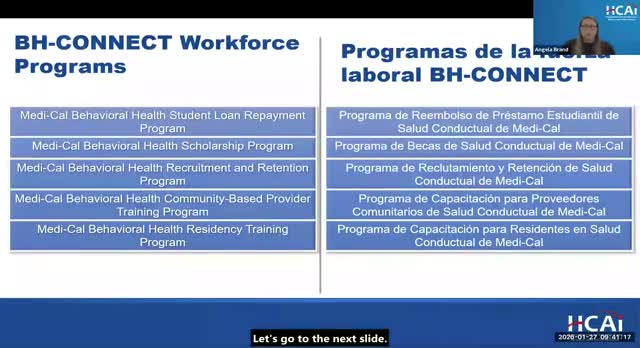
The program is part of California’s BH Connect initiative, which HCAI described as the state’s behavioral‑health transformation effort funded in part through the CMS‑approved 1115 demonstration waiver and related state plan amendments. HCAI and the Department of Healthcare Services (DHCS) said they expect to invest up to $1.9 billion across five workforce programs from 2025–2029; MBH CBPTP is one of those workforce programs.
Applicants must be training for an eligible profession (AOD counselor, Medi‑Cal CHW, or Medi‑Cal peer support specialist) and meet the credentialing criteria aligned with Medi‑Cal billing and state plan requirements. The application is individual: prospective trainees apply and indicate the training program they will attend; HCAI will coordinate with training programs to verify program eligibility. For peer and AOD training, HCAI will use existing approved lists (for example, CalMESA‑approved peer trainings and the three AOD certifying entities); for CHWs applicants may list a program for later validation.
HCAI staff described the service obligation: recipients who accept awards must complete a three‑year full‑time service obligation in Medi‑Cal safety‑net settings. HCAI defines full time as at least 32 hours per week of direct client care, or 30 hours per week in school‑based behavioral health settings. ‘‘Direct care’’ examples provided include prevention, early intervention, assessment, treatment, counseling, patient education and documentation; telehealth and first‑line supervision are also included.
HCAI listed qualifying safety‑net sites (examples cited by presenters): federally qualified health centers (FQHCs), community mental health centers licensed by the California Department of Public Health, rural health clinics (RHCs), hospitals and rural hospitals meeting Medicaid/uninsured payer‑mix thresholds, and other Medi‑Cal enrolled behavioral‑health providers that meet the stated payer‑mix criteria. HCAI staff said more detailed guidance and any site lists will be in the forthcoming grant guide.
Key dates announced on the webinar: the application portal and grant guide will be available on March 16, 2026; the application deadline is April 30, 2026, at 3 p.m.; award notifications are expected in July or August 2026; proposed grant start dates are August–September 2026. HCAI said training must begin by September 2026 and be completed by June 30, 2028, and that recipients’ service must begin on or before June 30, 2029 or within one year of completing training, whichever comes first.
Presenters answered applicant questions in a lengthy Q&A: they confirmed funds do not cover personal living expenses and will not be paid retroactively for prior academic years; employers will not be contacted during application review but will be asked during the service‑obligation monitoring phase to confirm site eligibility and hours via portal forms; HCAI staff will evaluate multi‑site employment and count time only at eligible sites. HCAI also said applicants who already hold another program award with a service obligation are ineligible to accept this award; if an award recipient breaches the service obligation the program requires repayment of funds and bars future participation in HCAI programs.
HCAI advised applicants to consult the grant guide for full scoring metrics, the list of eligible training programs, and complete application instructions. The agency said slides and the webinar recording will be posted on HCAI’s website within 7–10 business days and pointed attendees to a BH Connect helpline (916‑326‑3899) and the program inbox (mbhcbp@hca.gov) for follow‑up questions.
HCAI staff emphasized that some operational details — including official payment timing to training providers and specific program lists for CHWs — will be clarified in a launch webinar and in the grant guide when the application opens.
HCAI said the agency will make up to $21,250,000 available statewide in this grant cycle and that individual awardees may receive up to $10,000 to cover eligible training and education costs, including tuition, required fees, textbooks, supplies and certification or exam fees. HCAI will pay funds directly to training or education providers under the BH Connect special terms and conditions (STCs), HCAI staff said.
The program is part of California’s BH Connect initiative, which HCAI described as the state’s behavioral‑health transformation effort funded in part through the CMS‑approved 1115 demonstration waiver and related state plan amendments. HCAI and the Department of Healthcare Services (DHCS) said they expect to invest up to $1.9 billion across five workforce programs from 2025–2029; MBH CBPTP is one of those workforce programs.
Applicants must be training for an eligible profession (AOD counselor, Medi‑Cal CHW, or Medi‑Cal peer support specialist) and meet the credentialing criteria aligned with Medi‑Cal billing and state plan requirements. The application is individual: prospective trainees apply and indicate the training program they will attend; HCAI will coordinate with training programs to verify program eligibility. For peer and AOD training, HCAI will use existing approved lists (for example, CalMESA‑approved peer trainings and the three AOD certifying entities); for CHWs applicants may list a program for later validation.
HCAI staff described the service obligation: recipients who accept awards must complete a three‑year full‑time service obligation in Medi‑Cal safety‑net settings. HCAI defines full time as at least 32 hours per week of direct client care, or 30 hours per week in school‑based behavioral health settings. ‘‘Direct care’’ examples provided include prevention, early intervention, assessment, treatment, counseling, patient education and documentation; telehealth and first‑line supervision are also included.
HCAI listed qualifying safety‑net sites (examples cited by presenters): federally qualified health centers (FQHCs), community mental health centers licensed by the California Department of Public Health, rural health clinics (RHCs), hospitals and rural hospitals meeting Medicaid/uninsured payer‑mix thresholds, and other Medi‑Cal enrolled behavioral‑health providers that meet the stated payer‑mix criteria. HCAI staff said more detailed guidance and any site lists will be in the forthcoming grant guide.
Key dates announced on the webinar: the application portal and grant guide will be available on March 16, 2026; the application deadline is April 30, 2026, at 3 p.m.; award notifications are expected in July or August 2026; proposed grant start dates are August–September 2026. HCAI said training must begin by September 2026 and be completed by June 30, 2028, and that recipients’ service must begin on or before June 30, 2029 or within one year of completing training, whichever comes first.
Presenters answered applicant questions in a lengthy Q&A: they confirmed funds do not cover personal living expenses and will not be paid retroactively for prior academic years; employers will not be contacted during application review but will be asked during the service‑obligation monitoring phase to confirm site eligibility and hours via portal forms; HCAI staff will evaluate multi‑site employment and count time only at eligible sites. HCAI also said applicants who already hold another program award with a service obligation are ineligible to accept this award; if an award recipient breaches the service obligation the program requires repayment of funds and bars future participation in HCAI programs.
HCAI advised applicants to consult the grant guide for full scoring metrics, the list of eligible training programs, and complete application instructions. The agency said slides and the webinar recording will be posted on HCAI’s website within 7–10 business days and pointed attendees to a BH Connect helpline (916‑326‑3899) and the program inbox (mbhcbp@hca.gov) for follow‑up questions.
HCAI staff emphasized that some operational details — including official payment timing to training providers and specific program lists for CHWs — will be clarified in a launch webinar and in the grant guide when the application opens.
View the Full Meeting & All Its Details
This article offers just a summary. Unlock complete video, transcripts, and insights as a Founder Member.
✓
Watch full, unedited meeting videos
✓
Search every word spoken in unlimited transcripts
✓
AI summaries & real-time alerts (all government levels)
✓
Permanent access to expanding government content
30-day money-back guarantee
