Administration and council introduce amendments to Housing Options & Opportunity Act; committee holds work session
February 12, 2026 | Baltimore City, Baltimore County, Maryland
This article was created by AI summarizing key points discussed. AI makes mistakes, so for full details and context, please refer to the video of the full meeting. Please report any errors so we can fix them. Report an error »
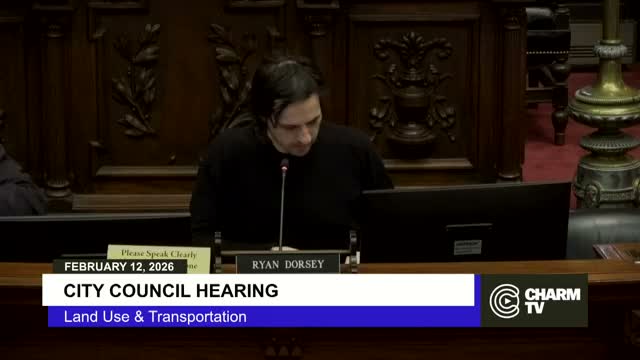
The Land Use & Transportation Committee on Feb. 12 convened a work session on council bill 250066 (the Housing Options and Opportunity Act) to introduce and discuss a package of amendments from the mayor’s office and a separate set from Councilman Parker. The session was informational; the committee did not vote on amendments.
Tyler Shonella of the Mayor’s Office presented the administration’s amendment package and framed the need for the changes around rising housing costs and a projected shortage of housing capacity in Baltimore. "If we want to retain residents, attract new households, and support long term growth, we must make meaningful progress in expanding housing opportunities," Shonella said, summarizing data on price increases and a shortage of buildable land that the administration said supports targeted zoning changes and additional tools.
Key elements described by the administration include:
- Reporting requirements: an annual report from the Board of Municipal Zoning Appeals (BMZA) on conditional-use approvals and denials for multifamily conversions, and a triennial planning commission report tracking units created through low-density multifamily conversions and related metrics.
- ADU (accessory dwelling unit) implementation: language to carry out the state law that requires jurisdictions to allow ADUs, including limits tying ADU height to the principal dwelling, a 75% floor-area cap relative to the principal unit, and allowances for ADUs to encroach into required rear-yard setbacks where necessary to effectuate the state law’s intent.
Administration and planning staff said the ADU language is crafted to meet state requirements while preserving the local code’s accessory-use structure and clarifying where ADUs fit in the zoning tables.
Council members questioned implementation details. Planning staff explained the permit path: an applicant would consult zoning, confirm ADU is allowed in the zone, then proceed through the regular permit review process; variances could be required if specific standards are not met. Committee members pressed the administration on enforcement capacity and permitting timelines; the administration said residential permitting median review had improved to three days and noted creation of a dedicated sanitation inspection team and active hiring (nine sanitation inspectors currently working via temporary positions as the process is finalized).
Councilman Parker presented additional amendments that he said would, among other things, link some multifamily conversion benefits to owner-occupancy and change certain conversion processes from ordinance-required approvals to BMZA review to streamline conversions in R7 and R8 districts. He argued that an owner-occupancy tie could guard against speculation by large, absentee corporate owners.
The law department noted a legal point: Jeff Hochsteller said a text amendment that materially increases permitted density across many residential districts can raise legal ambiguity similar to a comprehensive rezoning; law nonetheless approved for form and recommended the committee weigh that consideration and, if desired, request a deeper legal study.
Vice President Sharon Green Middleton and others raised concerns about outreach and trust-building in longtime Black homeownership neighborhoods, asking for more robust community engagement before widespread implementation. The session concluded with the amendments entered into the record; no committee votes were taken and the committee went into recess on the bill. Further consideration will be scheduled for subsequent meetings.
Tyler Shonella of the Mayor’s Office presented the administration’s amendment package and framed the need for the changes around rising housing costs and a projected shortage of housing capacity in Baltimore. "If we want to retain residents, attract new households, and support long term growth, we must make meaningful progress in expanding housing opportunities," Shonella said, summarizing data on price increases and a shortage of buildable land that the administration said supports targeted zoning changes and additional tools.
Key elements described by the administration include:
- Reporting requirements: an annual report from the Board of Municipal Zoning Appeals (BMZA) on conditional-use approvals and denials for multifamily conversions, and a triennial planning commission report tracking units created through low-density multifamily conversions and related metrics.
- ADU (accessory dwelling unit) implementation: language to carry out the state law that requires jurisdictions to allow ADUs, including limits tying ADU height to the principal dwelling, a 75% floor-area cap relative to the principal unit, and allowances for ADUs to encroach into required rear-yard setbacks where necessary to effectuate the state law’s intent.
Administration and planning staff said the ADU language is crafted to meet state requirements while preserving the local code’s accessory-use structure and clarifying where ADUs fit in the zoning tables.
Council members questioned implementation details. Planning staff explained the permit path: an applicant would consult zoning, confirm ADU is allowed in the zone, then proceed through the regular permit review process; variances could be required if specific standards are not met. Committee members pressed the administration on enforcement capacity and permitting timelines; the administration said residential permitting median review had improved to three days and noted creation of a dedicated sanitation inspection team and active hiring (nine sanitation inspectors currently working via temporary positions as the process is finalized).
Councilman Parker presented additional amendments that he said would, among other things, link some multifamily conversion benefits to owner-occupancy and change certain conversion processes from ordinance-required approvals to BMZA review to streamline conversions in R7 and R8 districts. He argued that an owner-occupancy tie could guard against speculation by large, absentee corporate owners.
The law department noted a legal point: Jeff Hochsteller said a text amendment that materially increases permitted density across many residential districts can raise legal ambiguity similar to a comprehensive rezoning; law nonetheless approved for form and recommended the committee weigh that consideration and, if desired, request a deeper legal study.
Vice President Sharon Green Middleton and others raised concerns about outreach and trust-building in longtime Black homeownership neighborhoods, asking for more robust community engagement before widespread implementation. The session concluded with the amendments entered into the record; no committee votes were taken and the committee went into recess on the bill. Further consideration will be scheduled for subsequent meetings.
View the Full Meeting & All Its Details
This article offers just a summary. Unlock complete video, transcripts, and insights as a Founder Member.
✓
Watch full, unedited meeting videos
✓
Search every word spoken in unlimited transcripts
✓
AI summaries & real-time alerts (all government levels)
✓
Permanent access to expanding government content
30-day money-back guarantee
