Council committee weighs major rewrites to Baltimore Children & Youth Fund ordinance; BCYF warns of harm to rapid response and grassroots grantees
February 12, 2026 | Baltimore City, Baltimore County, Maryland
This article was created by AI summarizing key points discussed. AI makes mistakes, so for full details and context, please refer to the video of the full meeting. Please report any errors so we can fix them. Report an error »
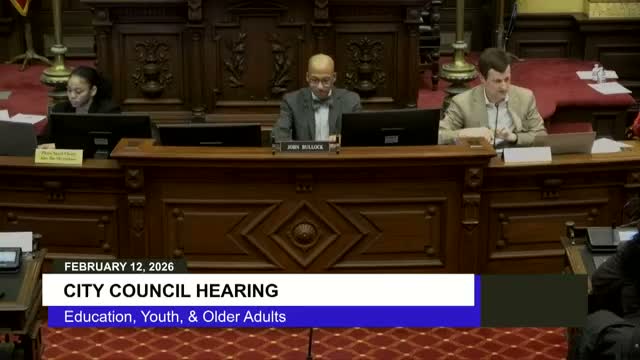
Councilman Mark Parker, sponsor of an updated ordinance for the Baltimore Children & Youth Fund (BCYF), told the Education, Youth and Older Adults Committee that the 2020 law no longer reflects the fund’s operational reality and laid out a set of 16 amendments intended to align city code with current practice and the charter’s requirement that allocation methods be set by ordinance. "Every $3 of grants we put out, that's at 60%, we wanna spend $1 on technical support," Parker said while explaining a proposed split of the fund’s budget.
BCYF President and CEO Alicia Lee told the committee the fund has invested "over $42,000,000 into the youth development ecosystem by grants alone" since 2020 and presented results from a grantee survey conducted after the most recent draft amendments. Lee said 89% of respondents were very or somewhat concerned the bill would reduce flexibility and increase administrative burden. She listed five operational impacts grantees flagged most frequently: constrained flexible youth programs, weakened rapid‑response funding, statutory requirements limiting BCYF's ability to adapt, greater reporting burden that reduces time serving youth, and diminished community voice in funding decisions.
The draft ordinance makes multiple substantive changes. It clarifies eligibility for fiscally sponsored organizations, requires a triennial needs assessment to inform allocation criteria, establishes quarterly fiscal reporting with exceptions and risk‑based authority for more frequent reporting, schedules a performance audit every three years at the comptroller's request, expands board size to permit additional youth and community seats, strengthens the standard that at least one‑third of board seats be youth and tightens the rules for any waiver of that minimum, and specifies elements the annual financial plan must include (budgeted dispersal amount, fund balance, prior fiscal year property tax receipts, audit results and a multiyear disbursement progress report).
On budgeting, Parker described an overall division that retains 80% of funds for grants to community organizations and proposes breaking that 80% into 60% for direct grant‑making and 20% for technical assistance and capacity building. The bill also would set a public engagement baseline (3%) and carve out 2% specifically to fund community grant review processes; Parker said he would pursue restoring that suballocation to 5% following feedback. The draft includes a cap that would prevent a single grant from exceeding 20% of total annual grant disbursements, a point Parker said may be negotiable toward 25%.
Legal counsel from the city law department, Jeff Hockstetter, told the committee the charter’s language makes clear the city must set "methods and criteria" for identifying eligible programs and allocating funds by ordinance, which is why some operational items appear in the draft code rather than exclusively in BCYF policies or the MOU with the city.
Council members raised several operational and equity concerns. Councilman James Torrance urged that the council not "tell people how to do their work" and proposed an alternative in which BCYF operational policies be submitted to the council as resolutions (a public process with hearings and comment) rather than rigidly codified, allowing more flexibility. Torrance also questioned proposed new staff and budget items tied to the performance audit and asked for exact staffing PINs, salary and fringe projections. Committee members asked the comptroller’s office to provide a clear breakdown of the fiscal note tied to audits and the portion attributable to BCYF specifically.
BCYF staff urged preserving expedited grant authority for rapid response programs and keeping capacity‑building eligibility broad enough to include fiscally sponsored and emerging grassroots groups. Lee said the fund’s community grant review panels usually number 25–35 reviewers, nearly half of whom are young people, and recommended additional facilitated working sessions to reconcile statutory language with current practice.
Multiple members asked the sponsor, BCYF and the mayor’s office to convene follow‑up meetings to produce a prioritized list of the 16 amendments, indicate where there is agreement, and resolve outstanding legal and operational questions before returning with amendments prepared for committee action. Chair John Bullock said the committee seeks a "finish line" but does not want to rush the process.
The committee did not take any votes. Members requested further documentation — including a detailed cost breakdown for proposed audit staff and the BCYF rules and regulations or sample grant agreements — and agreed to additional working sessions involving BCYF, the law department, the mayor's office and the bill sponsor. The meeting was adjourned after those next steps were confirmed.
BCYF President and CEO Alicia Lee told the committee the fund has invested "over $42,000,000 into the youth development ecosystem by grants alone" since 2020 and presented results from a grantee survey conducted after the most recent draft amendments. Lee said 89% of respondents were very or somewhat concerned the bill would reduce flexibility and increase administrative burden. She listed five operational impacts grantees flagged most frequently: constrained flexible youth programs, weakened rapid‑response funding, statutory requirements limiting BCYF's ability to adapt, greater reporting burden that reduces time serving youth, and diminished community voice in funding decisions.
The draft ordinance makes multiple substantive changes. It clarifies eligibility for fiscally sponsored organizations, requires a triennial needs assessment to inform allocation criteria, establishes quarterly fiscal reporting with exceptions and risk‑based authority for more frequent reporting, schedules a performance audit every three years at the comptroller's request, expands board size to permit additional youth and community seats, strengthens the standard that at least one‑third of board seats be youth and tightens the rules for any waiver of that minimum, and specifies elements the annual financial plan must include (budgeted dispersal amount, fund balance, prior fiscal year property tax receipts, audit results and a multiyear disbursement progress report).
On budgeting, Parker described an overall division that retains 80% of funds for grants to community organizations and proposes breaking that 80% into 60% for direct grant‑making and 20% for technical assistance and capacity building. The bill also would set a public engagement baseline (3%) and carve out 2% specifically to fund community grant review processes; Parker said he would pursue restoring that suballocation to 5% following feedback. The draft includes a cap that would prevent a single grant from exceeding 20% of total annual grant disbursements, a point Parker said may be negotiable toward 25%.
Legal counsel from the city law department, Jeff Hockstetter, told the committee the charter’s language makes clear the city must set "methods and criteria" for identifying eligible programs and allocating funds by ordinance, which is why some operational items appear in the draft code rather than exclusively in BCYF policies or the MOU with the city.
Council members raised several operational and equity concerns. Councilman James Torrance urged that the council not "tell people how to do their work" and proposed an alternative in which BCYF operational policies be submitted to the council as resolutions (a public process with hearings and comment) rather than rigidly codified, allowing more flexibility. Torrance also questioned proposed new staff and budget items tied to the performance audit and asked for exact staffing PINs, salary and fringe projections. Committee members asked the comptroller’s office to provide a clear breakdown of the fiscal note tied to audits and the portion attributable to BCYF specifically.
BCYF staff urged preserving expedited grant authority for rapid response programs and keeping capacity‑building eligibility broad enough to include fiscally sponsored and emerging grassroots groups. Lee said the fund’s community grant review panels usually number 25–35 reviewers, nearly half of whom are young people, and recommended additional facilitated working sessions to reconcile statutory language with current practice.
Multiple members asked the sponsor, BCYF and the mayor’s office to convene follow‑up meetings to produce a prioritized list of the 16 amendments, indicate where there is agreement, and resolve outstanding legal and operational questions before returning with amendments prepared for committee action. Chair John Bullock said the committee seeks a "finish line" but does not want to rush the process.
The committee did not take any votes. Members requested further documentation — including a detailed cost breakdown for proposed audit staff and the BCYF rules and regulations or sample grant agreements — and agreed to additional working sessions involving BCYF, the law department, the mayor's office and the bill sponsor. The meeting was adjourned after those next steps were confirmed.
Don't Miss a Word: See the Full Meeting!
Go beyond summaries. Unlock every video, transcript, and key insight with a Founder Membership.
✓
Get instant access to full meeting videos
✓
Search and clip any phrase from complete transcripts
✓
Receive AI-powered summaries & custom alerts
✓
Enjoy lifetime, unrestricted access to government data
30-day money-back guarantee
