Committee hears CIP update: State Street repairs, Lot work and upcoming structures assessment
February 12, 2026 | Santa Barbara City, Santa Barbara County, California
This article was created by AI summarizing key points discussed. AI makes mistakes, so for full details and context, please refer to the video of the full meeting. Please report any errors so we can fix them. Report an error »
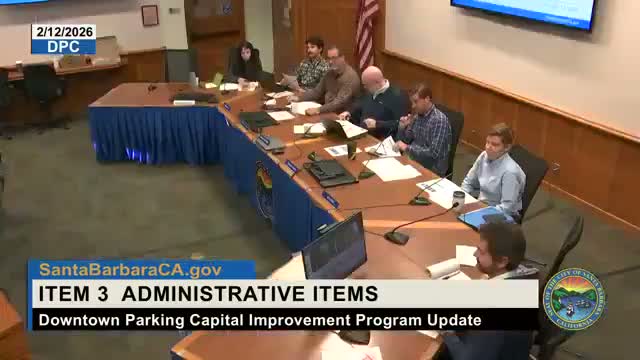
The Downtown Parking Committee received an update on Feb. 12 on downtown parking capital projects and short- and long-term planning ahead of the next five-year capital improvement program (CIP).
Chelsea Swanson, project planner with the downtown team, told the committee that most parking capital projects come from a five-year CIP developed every two years and that the city will begin the next CIP process this fall. Swanson said FY26 funding was scaled back to finish existing projects and that some work arises outside the CIP when directives or unforeseen infrastructure failures occur.
Recent and completed work includes brick repairs on State Street and Carrillo (funded from Measure C carryover funds), a pilot on the 1200 block to expand paving for outdoor dining and native plantings with the Santa Barbara Botanical Garden, Lot 5 repaving with ADA perimeter improvements, and repairs at Lots 7 and 9 addressing water intrusion and concrete spalling.
Swanson said the city has selected a consultant (identified in the transcript as "Wachry") to perform a parking structures and facilities assessment to evaluate maintenance needs, short- and long-term repairs, and potential locations for pay-on-foot or self-service pay stations. She said the assessment will provide cost estimates to inform the upcoming CIP.
Swanson also described in-progress work at the depot lot, including ADA compliance steps resulting from a Department of Justice review; she said the city has completed its responsibilities and Amtrak remains responsible for restroom upgrades and permitting, with anticipated work in spring.
Staff and committee members discussed trellis repairs (Lot 11), the scope and unit costs of State Street brick repair, depot-lot parcel consolidation to simplify property boundaries, and plans to return to the committee with a full list of proposed CIP projects when the assessment is complete. Swanson estimated the parking-structures assessment would take roughly two to three months once it starts.
Ed (staff) also described a recent ecommerce launch for monthly permits and residential permit payments funded through the parking access control capital fund. "We've been able to pay out of this fund to get a system that people can pretty much instantaneously, pay for a parking permit," he said, emphasizing reduced friction for permit holders.
The committee requested additional cost-per-unit detail for brick repairs and a more extensive capital list (including deferred projects such as Lot 11 trellis work) to support future budget conversations. Staff committed to bringing the assessment results and a full project list to the committee before the fall CIP process.
Chelsea Swanson, project planner with the downtown team, told the committee that most parking capital projects come from a five-year CIP developed every two years and that the city will begin the next CIP process this fall. Swanson said FY26 funding was scaled back to finish existing projects and that some work arises outside the CIP when directives or unforeseen infrastructure failures occur.
Recent and completed work includes brick repairs on State Street and Carrillo (funded from Measure C carryover funds), a pilot on the 1200 block to expand paving for outdoor dining and native plantings with the Santa Barbara Botanical Garden, Lot 5 repaving with ADA perimeter improvements, and repairs at Lots 7 and 9 addressing water intrusion and concrete spalling.
Swanson said the city has selected a consultant (identified in the transcript as "Wachry") to perform a parking structures and facilities assessment to evaluate maintenance needs, short- and long-term repairs, and potential locations for pay-on-foot or self-service pay stations. She said the assessment will provide cost estimates to inform the upcoming CIP.
Swanson also described in-progress work at the depot lot, including ADA compliance steps resulting from a Department of Justice review; she said the city has completed its responsibilities and Amtrak remains responsible for restroom upgrades and permitting, with anticipated work in spring.
Staff and committee members discussed trellis repairs (Lot 11), the scope and unit costs of State Street brick repair, depot-lot parcel consolidation to simplify property boundaries, and plans to return to the committee with a full list of proposed CIP projects when the assessment is complete. Swanson estimated the parking-structures assessment would take roughly two to three months once it starts.
Ed (staff) also described a recent ecommerce launch for monthly permits and residential permit payments funded through the parking access control capital fund. "We've been able to pay out of this fund to get a system that people can pretty much instantaneously, pay for a parking permit," he said, emphasizing reduced friction for permit holders.
The committee requested additional cost-per-unit detail for brick repairs and a more extensive capital list (including deferred projects such as Lot 11 trellis work) to support future budget conversations. Staff committed to bringing the assessment results and a full project list to the committee before the fall CIP process.
Don't Miss a Word: See the Full Meeting!
Go beyond summaries. Unlock every video, transcript, and key insight with a Founder Membership.
✓
Get instant access to full meeting videos
✓
Search and clip any phrase from complete transcripts
✓
Receive AI-powered summaries & custom alerts
✓
Enjoy lifetime, unrestricted access to government data
30-day money-back guarantee
